
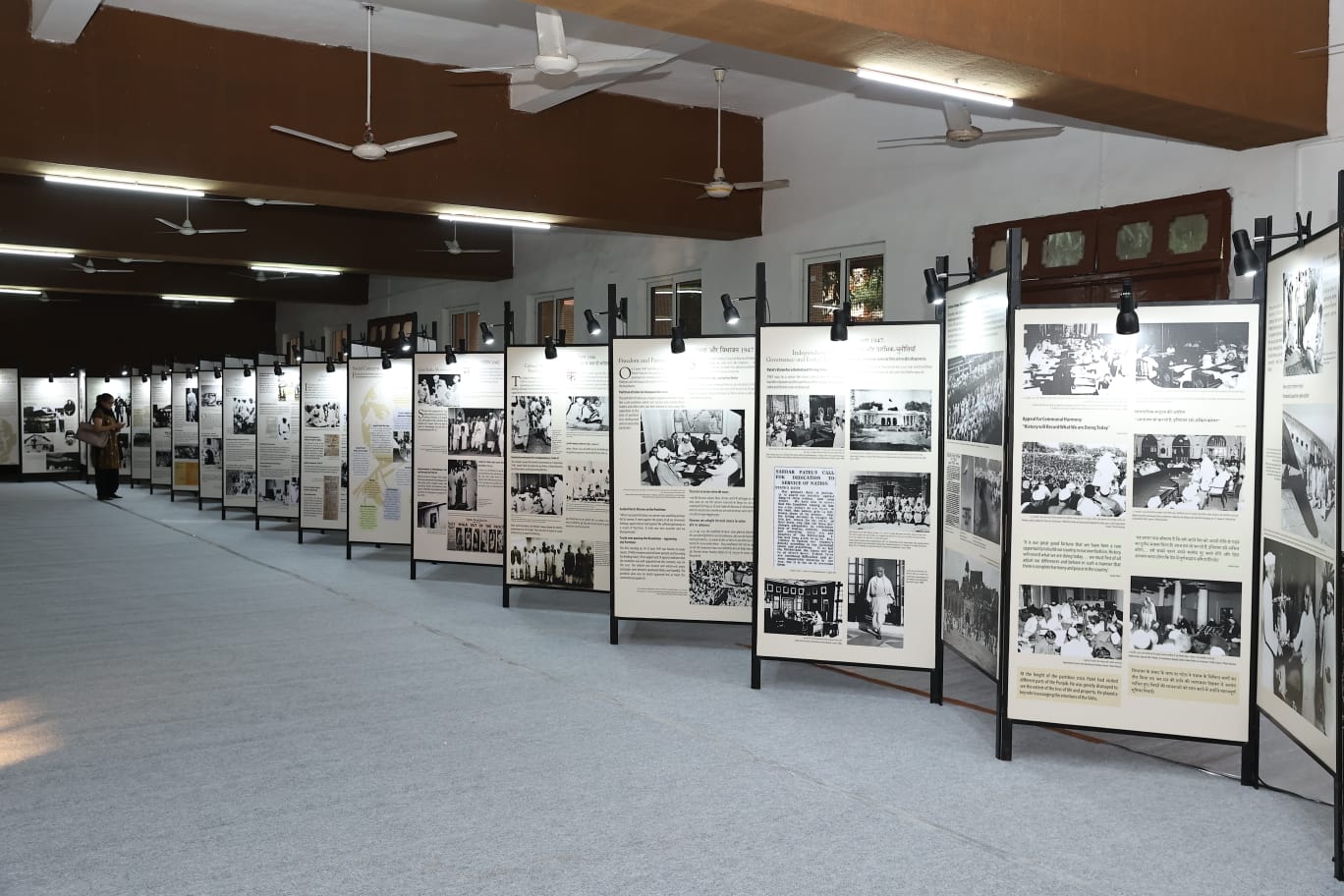
Gandhinagar/Ahmedabad, Nov 27 (SocialNews.XYZ) Engaging the younger generation with India's constitutional values, democratic institutions and nation-building legacy, Gujarat marked 'Constitution Day' on Thursday with a seminar involving law students at the State Legislative Assembly and the inauguration of an exhibition featuring 251 rare photographs and historical documents on Sardar Vallabhbhai Patel at Gujarat Vidyapith.
At the Legislative Assembly in Gandhinagar, Speaker Shankar Chaudhary emphasised the role of young people in strengthening democracy, saying they would become the future carriers of the legislature and directly participate in the process of making laws.
Addressing students under the Ganesh Vasudev Mavalankar Training Committee, Chaudhary referred to Articles 168, 170 and 172 of Part VI of the Constitution, explaining the constitutional provisions governing state legislatures, their composition and duration.
"Law-making took place within legislative Houses, while the executive, comprising the Cabinet and bureaucracy, is responsible for implementation. The judiciary, meanwhile, addressed injustice, questions of interpretation and ambiguities in laws and their drafting," he said.
He encouraged students to pursue careers as advocates and judges, saying their ability to present arguments in legal language would contribute to the administration of justice.
Highlighting the opportunities provided by the Constitution, Chaudhary said he had himself progressed from being a student and a member of an ordinary family to becoming Speaker of the Assembly.
He cited Prime Minister Narendra Modi's journey from an ordinary and economically disadvantaged family in Vadnagar to the country's highest executive office as an example of the opportunities offered by the constitutional framework.
Explaining the illustrations incorporated into the original Constitution, Chaudhary said: "They represented India's ancient civilisation, cultural heritage and philosophy of governance. The bull from Mohenjo-daro reflected India's ancient agricultural civilisation and demonstrated that the country is not a newly formed nation."
The illustrations of Vedic ashrams and yajnas conveyed the importance of nurturing rather than exploiting nature, along with the ideals of clean air, water and the environment.
He linked these illustrations to the principles of 'Sarve Bhavantu Sukhinah' and 'Vasudhaiva Kutumbakam', emphasising collective welfare.
Chaudhary stressed the need to follow systematic processes rather than seek shortcuts to resolve problems.
"Reforms could be undertaken in response to changing times and generations, but the fundamental principles should remain intact," he said, invoking the philosophy of 'Charai Veti, Charai Veti' (keep moving forward).
Drawing a comparison between family and national systems, he said taxes and public facilities were funded by citizens themselves.
"Therefore, disagreements and dissatisfaction should be addressed through dialogue and discipline rather than vandalism, with people respecting established rules," he added.
He also suggested that students organise structured debates on constitutional subjects under the guidance of their professors, decide the topics and time limits themselves and preserve recordings of the discussions for future learning.
Education Minister Dr Pradyuman Vaja, addressing the gathering, described the Constitution as the supreme legal document governing a country's administration.
He said the words 'We, the People of India' in its Preamble represented the strength of democracy and were not merely a phrase.
He recalled that the Constituent Assembly adopted the Constitution on November 26, 1949, while it came into effect on January 26, 1950.
"India's Constitution incorporated several important features from constitutions across the world, including fundamental rights and duties, the parliamentary system, the Directive Principles of State Policy and the ideals of liberty, equality and fraternity," he said.
Students and faculty members from Uma Arts and Nathiba Commerce College, Government Arts College, P K Chaudhary Women's College, Motilal Nehru Law College, Government Law College in Maninagar, Siddharth Law College, Vivekanand Law College and the Institute of Law at Nirma University participated in discussions on the Uniform Civil Code and religious freedom, digital rights and fundamental rights, and the achievements and challenges of the Constitution over more than 75 years.
Meanwhile, at Gujarat Vidyapith in Ahmedabad, Governor Acharya Devvrat inaugurated an exhibition titled 'Sardar Patel: Life and Times' to mark the 150th birth anniversary of Sardar Vallabhbhai Patel.
The exhibition features 251 rare photographs and original historical documents tracing Patel's life, from his childhood in Karamsad and his career as a barrister to his leadership in the Kheda and Bardoli Satyagrahas, his contribution to India's freedom struggle and his decisive role in the integration of princely states after Independence.
Several photographs and documents on display had not previously been made available to the general public.
The exhibition has been divided into 28 thematic and chronological sections to help visitors understand different phases of Patel's life and his contribution to the making of a united India.
The exhibition has been opened to the public, including students, researchers and history enthusiasts, at the Mahadev Desai Upasana Hall on the Gujarat Vidyapith campus.
It will remain open until December 2, from 10:30 a.m. to 6 p.m. every day.
Source: IANS

About Gopi
Gopi Adusumilli is a Programmer. He is the editor of SocialNews.XYZ and President of AGK Fire Inc.
He enjoys designing websites, developing mobile applications and publishing news articles on current events from various authenticated news sources.
When it comes to writing he likes to write about current world politics and Indian Movies. His future plans include developing SocialNews.XYZ into a News website that has no bias or judgment towards any.
He can be reached at gopi@socialnews.xyz