
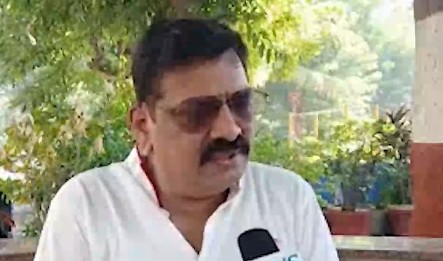
Mumbai, Nov 26 (SocialNews.XYZ) As the world pays tribute to the victims of the Mumbai 26/11 terror attack on Thursday, retired Inspector Sanjay Govilkar recalled the moments leading to Ajmal Kasab's capture, calling him the "world's first fidayeen attacker to be caught alive".
Speaking to IANS, Govilkar said that on the fateful day in 2008, he was serving as an Assistant Police Inspector at DB Marg Police Station in Mumbai.
"After completing my day shift, I had returned home. I learned about the attacks from the news, following which I immediately rushed to the police station on my motorcycle," he said.
"At the station, our Senior Inspector instructed me to proceed to Girgaum Chowpatty for a security checkpoint. Our team of 14 personnel was stationed there. Every police vehicle has wireless communication equipment, and through those we learned that attacks and bomb blasts had taken place at locations such as Nariman Point, the Taj Hotel, and the Oberoi Hotel. At that moment, we did not know who was carrying out these attacks," he added.
Since Girgaum Chowpatty is a crowded area, Govilkar recalled that first the entire beach was vacated even as the police team remained focused on the messages through the wireless, trying to understand what exactly was happening.
"Around 12:15 a.m., we received information that a silver coloured car carrying suspicious individuals was heading towards our location. As a result, we became more alert. Around 12:30 a.m., the car stopped about 50 feet before the barricades. Normally, vehicles stop at the barricades for inspection, but this car halted far away. We began moving towards it. Suddenly, the occupants switched on the wipers, windshield washer, and headlights. We were already suspicious and continued advancing towards them," the retired police officer said.
He said that the road was empty at that time and the driver, while attempting a U-turn, failed, and the vehicle came to a stop on the divider.
"Our team then split into two groups. One team included Bavdhankar, Bhaskar Kadam, Nikam, Kole, and others. The team on my side included Tukaram Ombale, me, Mangesh Naik, Pawar, Sohni, Sanjay Patil, and others," he said.
Govilkar recounted that the man in the driver's seat was Abu Ismail, who immediately opened fire as the police personnel approached the vehicle.
"He was firing from a sitting position while we were standing. Bhaskar drew his service weapon and fired the first shot, which struck Abu Ismail in the eye," he said.
The former cop recalled that after Abu Ismail was hit, Ajmal Kasab raised his hands.
Describing the sequence of events that led to Kasab's capture, the retired officer, who had himself been shot, said: "We thought he was surrendering, so we moved toward the vehicle to apprehend him. However, he had an AK-47 resting near his legs. He suddenly picked it up. Tukaram Ombale noticed this and grabbed hold of the rifle. A barrage of bullets hit Ombale 'Sahab'. I was also struck by a bullet, and for a few moments we scattered. Just as Kasab was about to load a second magazine, we charged at him with batons and sticks and succeeded in capturing him alive."
"At that moment, our entire staff was furious. Bhaskar and others were ready to shoot him. Then someone shouted, "Stop." After that, Kasab was taken alive. We tied his hands with handkerchiefs and immediately sent both him and Abu Ismail to Nair Hospital. Ombale 'Sahab' and I were taken to Harkisandas Hospital, which is now the Reliance Hospital," he said, adding that Abu Ismail was in extremely critical condition.
According to Sanjay Govilkar, it was because Kasab was captured alive that Pakistan was ultimately forced to acknowledge its connection to the terror attack.
"Because this was the world's first fidayeen attack in which a fidayeen attacker was captured alive. Capturing him alive allowed investigators to uncover many crucial links," he stated.
The former cop added that "capturing the world's first fidayeen attacker alive", is what gives him satisfaction.
"Before this, India had suffered several attacks in which Pakistan's involvement was suspected, directly or indirectly, but proving it was difficult. Capturing a living terrorist born and trained on Pakistani soil enabled India to establish who was behind the attack and how it was carried out. That remains one of the most significant achievements arising from that tragedy," he underlined.
Source: IANS

About Gopi
Gopi Adusumilli is a Programmer. He is the editor of SocialNews.XYZ and President of AGK Fire Inc.
He enjoys designing websites, developing mobile applications and publishing news articles on current events from various authenticated news sources.
When it comes to writing he likes to write about current world politics and Indian Movies. His future plans include developing SocialNews.XYZ into a News website that has no bias or judgment towards any.
He can be reached at gopi@socialnews.xyz