
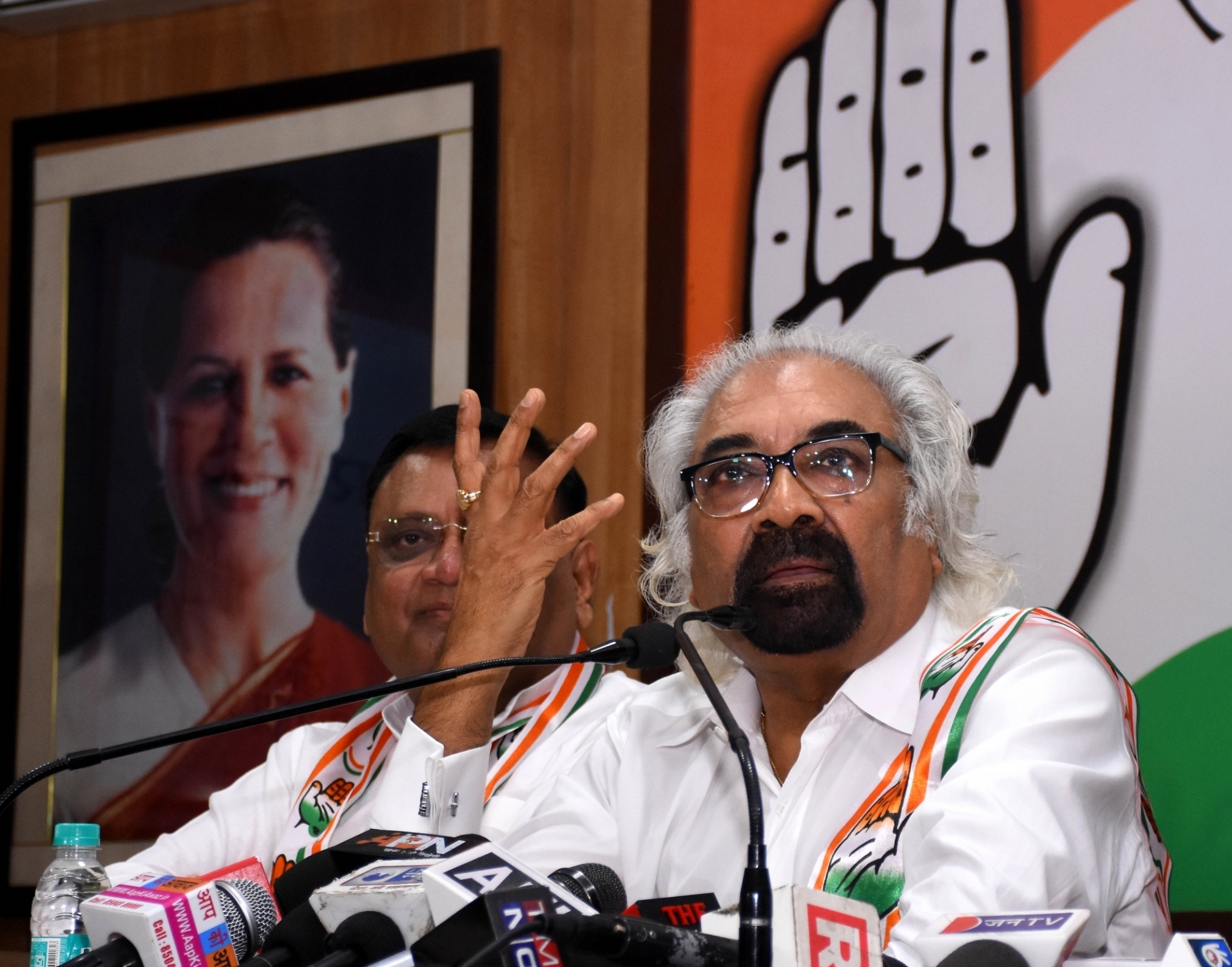
New Delhi, Nov 12 (SocialNews.XYZ) Indian Overseas Congress (IOC) Chief Sam Pitroda has said that he has "lost trust in the election system in India", while claiming that several members of "civil society" feel the same.
He made these remarks in an exclusive interview with IANS, when he was asked what he thought of the Congress-led INDIA bloc's campaign against the voter-roll revision process of the Election Commission of India (ECI).
Pitroda also spoke about Congress Parliamentary Chairperson Sonia Gandhi's memoir, 'Belonging: A Journey of Love', Prime Minister Narendra Modi, US Midterm election results, the Babri Masjid issue, Maoism and the anti-Sikh riots.
IANS: Rahul Gandhi has been continuously raising the issue of vote theft. What do you think of the ECI?
Sam Pitroda: One thing I can tell you is that I have lost trust in the election system in India. Somebody has to bridge that trust deficit. Why, what, when, how needs to be discussed, debated. But a lot of people, especially civil society, have really lost trust in the system. I have several friends in civil society. I talk to them on and off, and I am convinced that there is something that gives me a great deal of concern about the way my vote is cast and counted. It's a very serious issue in democracy.
IANS: Sonia Gandhi had described PM Modi as a "big orator". What is your opinion of PM Modi?
Sam Pitroda: He is a Gujarati friend. I respect him as a person. I met him. My wife and I met him. He's been very warm, very kind, very loving, caring at a personal level. Of course, he's a good orator, hard-working. We get along well.
We have no personal issues. I have nothing against Mr Modi as a Gujarati leader, friend, well-wisher. He's very warm to me. No issues about that. I appreciate that.
And equally on my side, you know, I've been to his house in Gujarat several times. But I may have issues with his views of the world. I may have issues with his ideology. But that's a separate issue; that's not against the individual. It's against the idea. And these are two separate things. You know, I can disagree with Mr Modi, and I can also have dinner with him and have a laugh. So I have no issues.
IANS: What were the reasons behind the Republicans' defeat in the US midterm elections?
Sam Pitroda: All I can say in the US, people were unhappy with the state of the economy, apparently unhappy with the war, and with the authoritarian attitude in decision-making. And young people, especially, don't want war; they want peace, employment, education, and security. They want to look at their future. And young people basically felt that Democrats might do a better job, and that's what came up in the results.
IANS: Does the Modi government need to take the US Midterm results as a warning? Do you think public anger against the government has been continuously increasing in India?
Sam Pitroda: It is up to them. They know what happened. So, who am I to tell them?... I don't know about public anger, but I can tell you about the demonstrations. Demonstrations show that what started as a small group of Gen Z and Cockroach Janata Party (CJP) people who were against the exam results has taken a different form: a national one. It has taken a form which is more about democracy, elections, lack of performance, economy, jobs, and in a very short period of time, it has captured the imagination of many more people than we thought.
IANS: Do you think CJP can compete with the BJP?
Sam Pitroda: I don't know; one is a party, one is not a party, so it all depends. I mean, this question has, you know, different meanings to different people.
IANS: Do you see any possibility of a change of government in India?
Sam Pitroda: It is for people to decide, not for me.
IANS: Do you think there should be a biopic on Sonia Gandhi?
Sam Pitroda: It's up to the publisher and the people who want to make a movie. I think it'll make a good movie, but that's up to the film industry people. They know better about these kinds of things; what will sell, what will not sell, what is the market for. But it's a great story to be told.
IANS: Do you hold the Gandhi family responsible for the anti-Sikh riots?
Sam Pitroda: What is the sense in talking about something that happened 40 years ago now? I have said many times that there has been so much conversation on it. Let the people in court, and others decide; it was decided 40 years ago. Everything is ok; why do we just dig things up from nowhere and throw mud? I don't understand our attitude. What does that have to do with today? How long can you go on with this? You've got to look to the future.
That was more than 40 years ago. And this has been going on and digging, and people just do this. Let's look at the future. Let's move on. Let's design a better, prosperous, peaceful nation for everybody. That should be the agenda. Not what happened in Ram's time or why Hanuman went here, why he lifted the mountain. I mean, this is of no consequence.
It makes very little sense today to talk a lot about the past. We are still hung up on the past. We've got to look forward. We have to see the future of our children, our grandchildren, their education, their employment, their jobs, in a sense, their skill set. That is the real challenge.
IANS: Sonia Gandhi has described Pranab Mukherjee as ambitious. What do you want to say about this?
Sam Pitroda: I have not seen the book. But I think it's a story of love, character, commitment to a nation, to a family, to a husband. It is also a story of courage to be able to come to an unknown environment and live your whole life, leaving behind everything that you had growing up: language, culture, food, you know, family, everything. It's a story of a lot of courage. How many people can do that? And then withstand all the criticism in India, from citizenship to this, to that, and, you know, just throwing mud at you. Sad that people do these things to a person who has given up so much of her personal comfort. But that's the way we are. What can you do?
I think it's a great story. I am proud of her journey. I commend her for sticking to her principles, surviving the onslaught and living a very respectful life. How many people can say something like that? Now, in the process, we all make mistakes in life. I made hundreds of mistakes. That's the way life is.
I look forward to reading it. It takes a long time and a lot of effort to write a book like that. I have written one which is only 350 pages; hers is almost 500 pages or more. And I know what it takes to write a book. It's a mathematical puzzle where you're trying to fit in every little puzzle in the right place, keep changing it, colouring it differently. And it's laborious. So rather than respecting all that work, immediately we jump to page 19, you said this, and I said that. I mean, it's silly. But that's our character. So good luck.
IANS: Sonia Gandhi said that she cried when the Babri Masjid was demolished. In your view, was the demolition of the Babri Masjid a matter of national shame?
Sam Pitroda: She has to write what she has to write. It is her book; who am I to comment on it? She wrote something. I respect that. If she had tears in her eyes at that point in time, I respect that. That doesn't mean she didn't have tears somewhere else. So I have no comments on it. I would say, you know, just read it as it is.
IANS: If the Congress comes back to power, could the Babri Masjid be rebuilt?
Sam Pitroda: That's for the Congress party and the government and people of India to decide; who am I to decide that? I have no opinion on these things. I have no opinion on Masjid, temple, God; I don't do that. I have an opinion on humanity, character, technology, economy, future, and vision. I don't look back. I'm not good at looking back. So don't ask me anything about what happened in the past.
IANS: In her book, Sonia Gandhi has mentioned the time when she refused to accept the Prime Minister's post. She has written that leaders were crying inside the hall in her presence. So what do you want to say about that?
Sam Pitroda: Whatever she has written is good; that's up to her, that's her view. She was there. I wasn't there. It was her decision, not mine. So how can I comment? I have no business commenting on that. Or, for that matter, anybody's decision like that, not just Sonia Gandhi's. It's a very personal matter. How you view that is very different from how anybody else would view it.
IANS: Do you want to give any message to the younger generation?
Sam Pitroda: My advice to young people like you would be to really get off this bandwagon of Indian 'tamasha'. Of asking questions that have no meaning, which are about the past. We can start from Ram and Krishna, you know, why did Lakshman go here, and why did the deer come, and you know. Is that what you want to get trapped in? Of course it's important. I'm not saying it's not important. But the key is for young people to define their future, solve problems and not be part of a chaos that has been created and get trapped in it. But that's the way we are.
IANS: BJP claims to have ended Maoism and is celebrating over the decline of the movement. What is your opinion on this?
Sam Pitroda: Naxalism that I knew 40 years ago is different from the Naxalism today. As a student growing up, I knew a little bit about Naxalism, and they were basically extremists who believed that they had not been given a fair share. The rich and powerful have come together and left them behind, which is still the case in many parts of the world. That hasn't changed. The degree has changed. In fact, now there are more rich and powerful than ever before in history.
It's an ideology. But when you resort to violence, that's not good. I don't buy into that. Ideology is fine. We can sit across the table and decide, have a conversation, agree and disagree and move on. But whenever you resort to violence, it makes no sense to me. Whether it is in Gaza or Ukraine or Naxals or anywhere else.
It's a matter of philosophy. Violence does not solve the problem; it basically adds to the problem. We have seen all the wars in my lifetime, since 1942, from World War to the Korean War to Vietnam to Afghanistan, Iraq, Libya, and in the Middle East and Ukraine; there are a lot of wars that have been going on. At the end of all these wars, nothing much happens; people get killed, and assets get destroyed. We have seen that billions and billions are spent on weapons, and innocent people suffer. Naxals took to violence, which changed the whole movement. Again, I am not an expert on Naxalites.
Source: IANS

About Gopi
Gopi Adusumilli is a Programmer. He is the editor of SocialNews.XYZ and President of AGK Fire Inc.
He enjoys designing websites, developing mobile applications and publishing news articles on current events from various authenticated news sources.
When it comes to writing he likes to write about current world politics and Indian Movies. His future plans include developing SocialNews.XYZ into a News website that has no bias or judgment towards any.
He can be reached at gopi@socialnews.xyz