
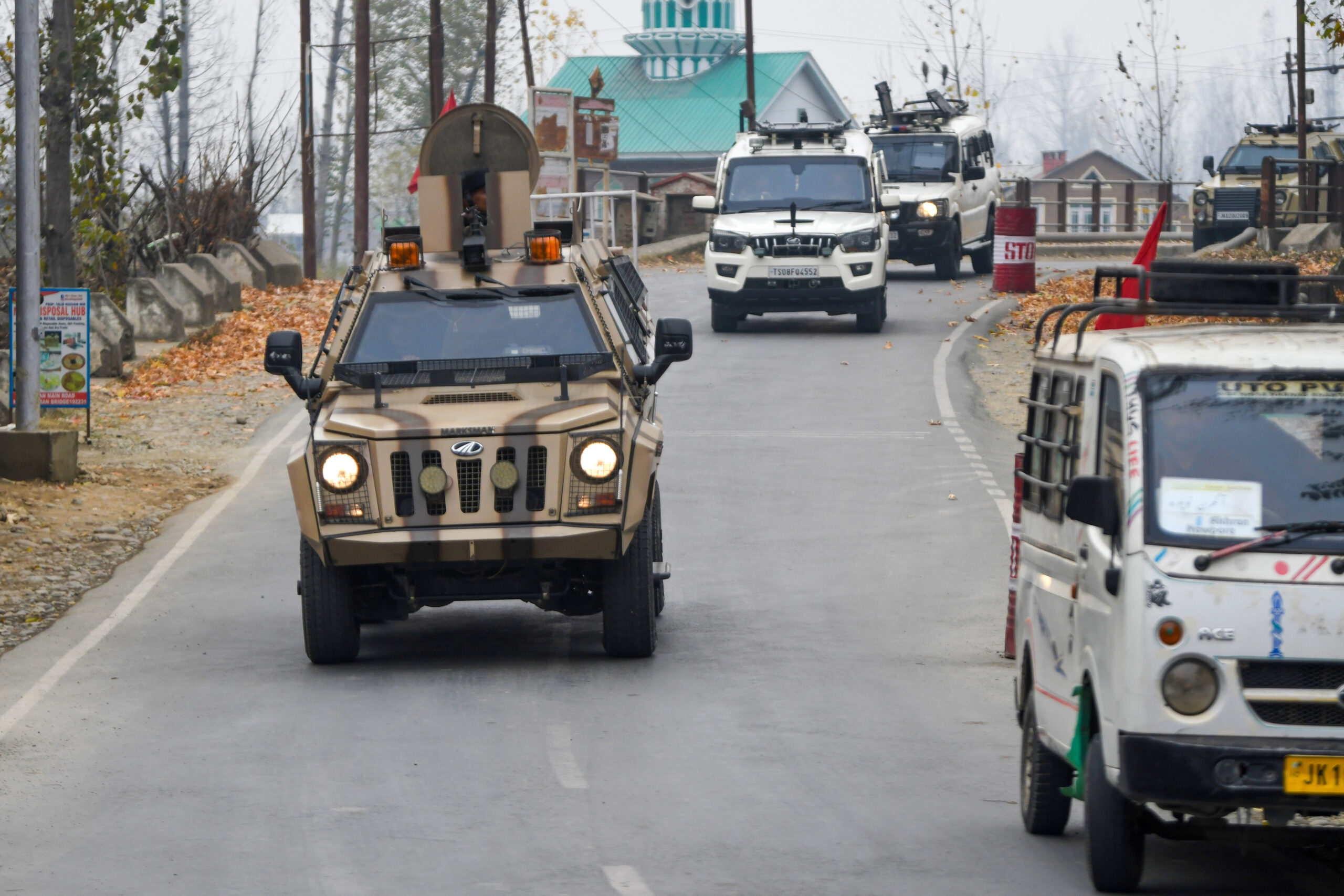
New Delhi, Nov 12 (SocialNews.XYZ) Jammu and Kashmir is witnessing a fresh spurt in violence, with two separate incidents raising concerns over the security situation in the Union Territory. On Wednesday, three Central Reserve Police Force (CRPF) personnel were injured when terrorists attacked a security checkpoint at Akhran near Mira Bazar in Kulgam district.
In a separate incident, the bullet-riddled bodies of two missing Special Police Officers (SPOs) were recovered in Kishtwar district. Security agencies suspect that the killings could have a terror angle.
The suspicion has been heightened by the disappearance of the SPOs' service weapons, which were missing from the spot. Investigators are examining whether the killings were part of a terror-related operation.
Jammu and Kashmir has witnessed a recurring pattern in recent months, with periods of heightened terrorist activity followed by relative calm. The latest incidents have once again brought the security situation in the region under scrutiny.
In July this year, a terrorist targeted a police party deployed for the Amarnath Yatra during which Aashiq Hussain Qureshi, a head constable was killed.
It was during this time that terrorists from the Lashkar-e-Taiba’s (LeT) proxy, The Resistence Front (TRF) had resumed the targeting of migrant workers while also sending out warnings to the Kashmiri Pandits.
There had been a lull in terrorist activities in Jammu and Kashmir following the earlier spate of incidents. However, the attacks in Kulgam and Kishtwar suggest a possible resurgence of terror-related violence in the Union Territory.
Dr. Abhinav Pandya, founder of Usanas Foundation, a geopolitical and security affairs think tank based in Udaipur, Rajasthan, says that such incidents show that the Inter Services Intelligence (ISI) still has assets in Jammu and Kashmir.
“The ISI has been operating through its proxies, TRF. The rise of such proxies has risen since the abrogation of Article 370,” he says.
He further adds that the attack is way of sending a message to the Indian government that the ISI still has the capabilities to operate in Jammu and Kashmir.
“There is a pattern to these recent spate of attacks. These persons are not carrying out large scale strikes. They just want to send the message about their capabilities in Jammu and Kashmir and want to keep the ship sailing,” Dr. Pandya says.
An official said that one cannot take these low key attacks lightly. The ISI is deliberately keeping the attacks smaller in nature.
This not only keeps them in contention, but also gives them ample time to build resources on the ground, the official said.
Dr. Pandya adds that the ISI, which has taken direct command from the Lashkar, Jaish-e-Mohammed and Hizbul Mujahideen when it comes to operations in Jammu and Kashmir, has been mobilising resources at the grass-root level.
“They are planning a huge attack in the near future and hence the mobilisation exercise is on in full swing,” he added.
Another official said that post the abrogation of Article 370 and Operation Sindoor, Pakistan has found itself to be on backfoot when it comes to Jammu and Kashmir.
They are not able to enforce infiltrations and there are nearly a thousand terrorists at the launchpads who are waiting and getting equally frustrated.
“Pakistan feels that the best way to approach the J&K issue is by building a strong local force. This eliminates the need to infiltrate and the ISI feels that in case of an attack, it cannot be traced back to Pakistan,” the official added.
The investigations that are being conducted in connection with the Kulgam attack clearly points to the role of local commanders of the TRF.
The security agencies are on the lookout for Mohammad Lateef Bhat, a 22 year old local commander of the outfit and a resident of Kulgam in South Kashmir.
The others that the agencies are looking for are Bilal Ahmad Mir, Mohammad Umar Mir and Abid Qayoom, all residents of Baramulla in North Kashmir.
Officials say that this clearly points towards the ISI’s strategy of using only locals in terror attacks. The Pakistan spy agency wants to localise terror to Jammu and Kashmir to avoid the trail that would directly lead up to Islamabad, the official said.
These persons have been instructed to carry off a couple of low key attacks. This would give the ISI time to build up on the ground level and put up a much stronger force that could launch massive strikes in the Valley, the official said.
Dr. Pandya says that the ISI would continue to strategise and stabilise its base adding the Indian agencies need to focus more on human Intelligence (HUMINT) to overcome this problem.
With the ISI going completely local and placing very little reliance on the Pakistan based terrorists for operations in J&K, the Indian agencies must not just rely on technical intelligence (TECHINT).
It is the right time to ensure that both TECHINT and HUMINT work in tandem to battle this problem, an official said.
Source: IANS

About Gopi
Gopi Adusumilli is a Programmer. He is the editor of SocialNews.XYZ and President of AGK Fire Inc.
He enjoys designing websites, developing mobile applications and publishing news articles on current events from various authenticated news sources.
When it comes to writing he likes to write about current world politics and Indian Movies. His future plans include developing SocialNews.XYZ into a News website that has no bias or judgment towards any.
He can be reached at gopi@socialnews.xyz