
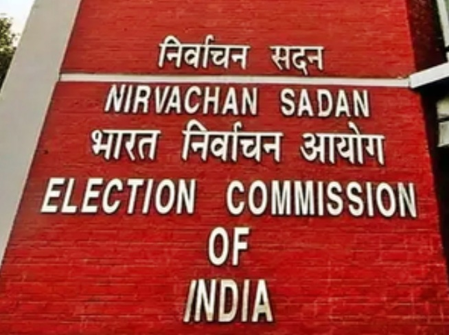
New Delhi, Sep 23 (SocialNews.XYZ) The Election Commission of India (ECI) has rejected the suggestion that differences among its three members amount to an institutional "rupture", saying internal objections and written notes are an established part of the functioning of a multi-member constitutional body and do not, by themselves, establish illegality or dysfunction.
The response followed The Indian Express report of September 23 that Election Commissioners Sukhbir Singh Sandhu and Vivek Joshi had raised 14 formal objections over 10 months on decisions of the Commission, including issues linked to the Special Intensive Revision (SIR) of electoral rolls.
While the objections are on record, the ECI has said that the report does not adequately explain the legal framework, safeguards and judicial scrutiny surrounding SIR.
The ECI has functioned as a multi-member body since 1993, with differences resolved through majority decisions as provided by law.
During a nationwide exercise involving crores of voters, 14 objections over 10 months cannot by themselves establish an institutional crisis, analysts say.
The Commission has witnessed sharper disagreements in the past also.
"In 2009, Chief election Commissioner (CEC) N. Gopalaswami recommended the removal of Election Commissioner Navin Chawla over alleged partisan conduct; the government rejected the recommendation and Chawla later became CEC," experts said. Between 1993 and 1995, CEC T.N. Seshan even challenged the creation of the multi-member Commission in court, leading to an open legal battle with Commissioners M.S. Gill and G.V.G. Krishnamurthy," they noted.
Gill later joined the Congress and became a Union Cabinet Minister after his tenure, they said.
In a press note issued on Wednesday, the ECI said internal notes and checks are routine mechanisms intended to ensure transparency and legal compliance.
It added that all official decisions carry legal sanction under the 2023 law governing the Commission's conduct of business and that every officer can offer suggestions for electoral reforms.
The Commission said around 40 new initiatives introduced in the past year were unanimously approved by the full Commission and that elections were successfully conducted in Bihar, Kerala, Tamil Nadu, Puducherry, Assam and West Bengal.
It also said ECINet and other digital platforms have strict data-security, IT audit and access-control mechanisms.
On Form 6, the ECI disputed the suggestion that the statutory voter-registration form was illegally altered.
It said its May 2026 SIR order had already provided for a separate Declaration Form to accompany Form 6, containing questions on whether a voter or relative appeared in the previous SIR roll.
Legal observers said that changing a statutory form and adding a linked declaration are distinct legal actions.
Concerns over "centralization" of electoral data also remain a matter of scrutiny rather than established wrongdoing, analysts said.
The Commissioners sought an audit of database access, but seeking an audit is not evidence of tampering.
Electoral Registration Officers (EROs) continue to decide inclusion and exclusion of names, while the ECI has reiterated that ECINet operates with security and audit controls.
The reported figure of 13 crore "deletions" has also been described as misleading by the ECI. The figure relates to names not carried forward into the draft roll, not final deletions.
SIR provides for claims, objections, hearings and a final roll.
Reasons such as Absent, Shifted, Death and Duplicate are listed so genuine voters can seek correction.
"The report raises a fair question on who filed these appeals, but it does not establish that the ECI itself filed them. Implying that it did, is a leap the evidence does not support," observers said.
More than 1.26 lakh appeals have been resolved and 1.14 lakh voters restored, the Commission said.
In Goa, 97 voters were found eligible after hearings, but software lacked a facility to reverse earlier deletions. The Chief Electoral Officer wrote eight times seeking a solution before the final-roll deadline.
Observers said this points to a technical shortcoming requiring correction, not proof of an intent to disenfranchise voters.
The legal backdrop is the Supreme Court's May 27, 2026, judgment which upheld the ECI's power to conduct SIR under Article 324 of the Constitution read with Section 21(3) of the Representation of the People Act, 1950.
The apex court examined the procedure and did not find the exercise disproportionate or contrary to law.
The Supreme Court's judgment also recognised the Commission's responsibility to maintain accurate electoral rolls.
Analysts also noted that SIR is not a first-time exercise. India has conducted 10 such revisions since Independence, eight under Congress-led governments.
SIR also incorporates multiple safeguards -- Booth Level Officers, supervisors, Assistant EROs, EROs, draft publication, claims and objections, hearings and final-roll publication -- besides monitoring by political parties through Booth Level Agents, experts said.
Analysts said the documented disagreements merit scrutiny, particularly on transparency and decision-making, but stressed that internal dissent and institutional wrongdoing are separate questions.
The ECI's position is that a multi-member body debating and recording objections, while ultimately taking decisions through the prescribed process, is evidence of institutional checks rather than necessarily a crisis, an analyst noted.
Source: IANS

About Gopi
Gopi Adusumilli is a Programmer. He is the editor of SocialNews.XYZ and President of AGK Fire Inc.
He enjoys designing websites, developing mobile applications and publishing news articles on current events from various authenticated news sources.
When it comes to writing he likes to write about current world politics and Indian Movies. His future plans include developing SocialNews.XYZ into a News website that has no bias or judgment towards any.
He can be reached at gopi@socialnews.xyz