

A scenario analysis, not a prediction. Election Day is Tuesday, November 3, 2026; results would largely be known on November 4, and a new Congress would take office in January 2027.
The starting point: favored, not certain
As of November 1, forecasters and prediction markets lean Democratic in the House and lean Democratic, more narrowly, in the Senate. Prediction markets put Democratic House control at about 92–93% and Senate control at about 68%, while Decision Desk HQ put the figures at 80% for the House and 60% for the Senate, projecting 52 Democratic Senate seats. Democrats need a net gain of four Senate seats to reach 51, since a 50–50 Senate would be broken by a Republican vice president.
That matters because the scenario in this article — Democrats holding both chambers — is plausible on current numbers, but it is not the same as Democrats holding the government.
First, the limit that shapes everything else
A Democratic House and Senate would still face a Republican president until January 2029. As one pre-election tax analysis puts it, new legislation would still need President Donald Trump's signature until the end of his term, unless Congress overrides his veto.
That single fact reframes "how bad will it be." A Democratic Congress could:
- block new Republican legislation,
- use appropriations, oversight, subpoenas and hearings,
- set the agenda for 2028, and
- pass bills that force presidential vetoes and create political pressure.
It could not, on its own, raise the corporate tax rate, impose a new AI tax, break up a company, or repeal the 2025 tax law. Most major bills would also need 60 Senate votes to clear a filibuster, unless Democrats changed Senate rules — a step with no agreed Democratic consensus in the material reviewed.
So the realistic story is not "Congress rewrites tech law in January." It is "Congress becomes a source of political, regulatory and financing risk for an industry that is already financially stretched."
Why Silicon Valley is exposed before Congress votes
The AI buildout is no longer funded mainly from cash flow. One analysis of the 2026 debt wave notes that the five large U.S. cloud names — Alphabet, Amazon, Meta, Microsoft and Oracle — sold roughly $274 billion of investment-grade bonds in 2026 through late September, versus an average of about $30 billion a year in 2020–24. Another puts total AI-adjacent issuance near $850 billion year-to-date.
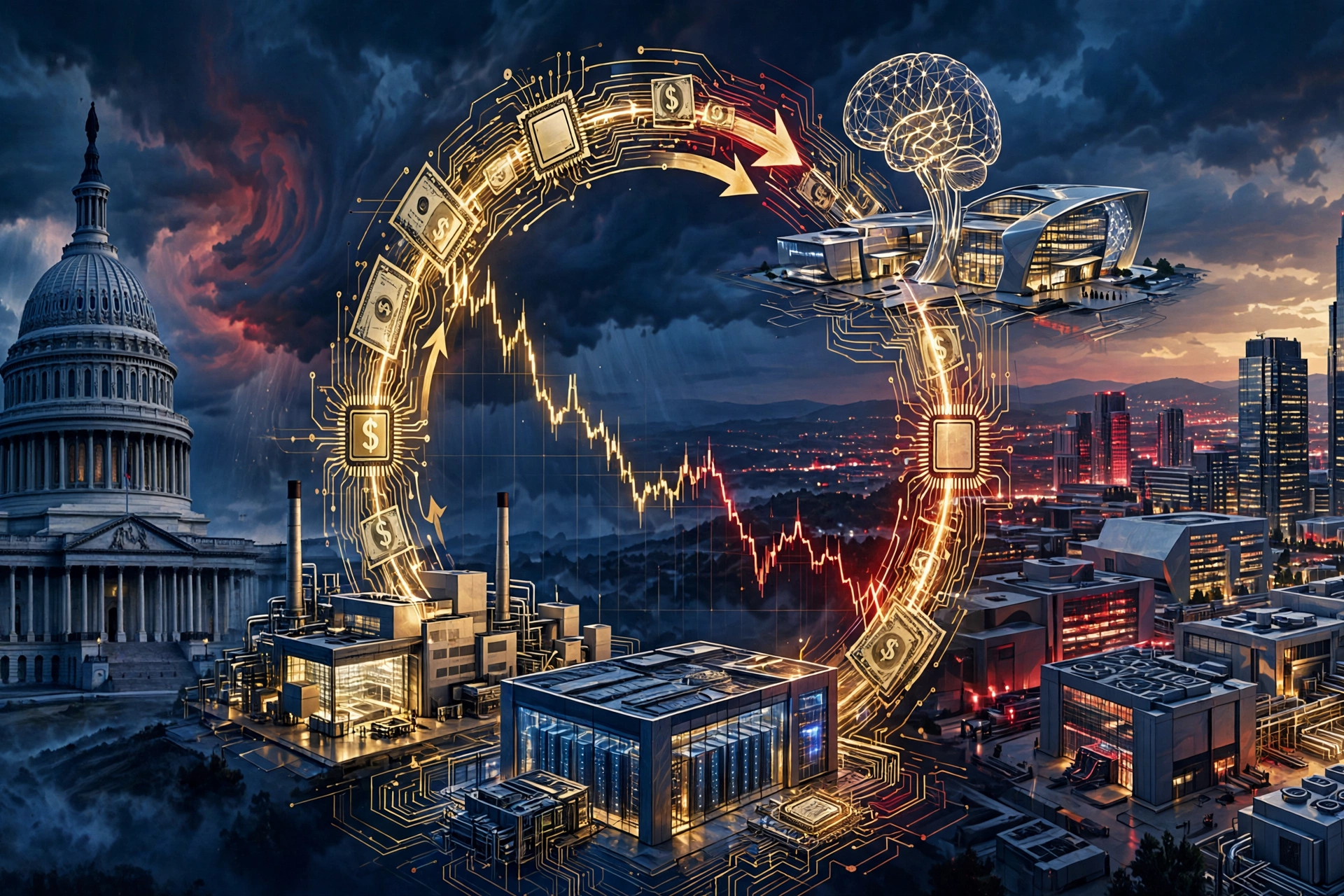
The more specific vulnerability is the loop critics call "circular financing":
- Nvidia invests in frontier AI labs.
- Those labs sign multi-year compute contracts with cloud providers and neoclouds.
- Those providers buy Nvidia chips to fulfill the contracts, and in several cases also hold equity in the same labs.
Nvidia alone has invested around $50 billion in frontier labs, according to one survey of the loop, and its letter of intent to invest up to $100 billion in OpenAI ultimately became a $30 billion equity investment. Remaining performance obligations at Microsoft, Alphabet, Amazon and Oracle reached approximately $2.3 trillion at the end of Q2 2026, up 186% in a year, with roughly half of that backlog owed by OpenAI and Anthropic — equivalent to around ten times their combined annualized revenue, according to Jefferies' strategist cited in that survey.
Off-balance-sheet data-center leases add another layer: about $662 billion across the hyperscalers, according to Moody's figures cited in a separate debt-stack review.
Stress is already visible at the weaker links, not the strongest balance sheets. On October 15, 2026, Oracle's five-year credit-default-swap spread hit a record 288 basis points, CoreWeave's 2032 bonds traded near 77 cents on the dollar, and Korea's KOSPI fell 8% into a bear market. The same review notes that the top of the stack — Microsoft, Alphabet, Amazon, Meta — is still spending real profits and borrowing cheaply, while stress sits lower down, with borrowers whose debt depends on one customer, OpenAI, which is still burning cash.
In other words: the loop does not need Congress to break. It needs one disappointment — a missed funding round, slower revenue growth, a failed IPO, a canceled project — to test whether revenue, not new financing, can service the commitments.
The five ways a Democratic Congress would hit the sector
1. Oversight and investigations first, legislation second
This is the most immediate channel. A law-firm briefing on a potential Democratic Congress expects minority staff on Oversight, Judiciary, Financial Services, Energy and Commerce, and the Select Committee on China to be ready to turn prepared requests into formal subpoenas on day one of the 120th Congress.
For tech specifically, it flags antitrust policies, content moderation, AI safety, data privacy, data-center costs, and whether Big Tech is shifting grid and infrastructure costs onto consumers. It also flags chip-export approvals and AI competition with China.
Hearings do not change a contract. They do change the cost of capital: they create headlines, force disclosure, invite regulators and litigants to follow up, and make lenders ask harder questions about concentration risk. For companies already facing record CDS spreads, that is a real, if indirect, tax.
2. AI safety regulation moves from stalled to plausible — but still contested
Democrats have already introduced the building blocks. Senators Mark Warner, Brian Schatz and Andy Kim introduced the Artificial Intelligence Risk Management and Security Act of 2026, which would create an AI Safety Board inside the Department of Commerce to evaluate frontier-model risks, develop technical standards, and set formats for publishing model details. Senator Maria Cantwell has introduced a separate framework charging NIST with developing standards against catastrophic harms such as AI-enabled cyberattacks and loss of human control.
House Democrats, led by Rep. Sam Liccardo, have separately urged consideration of transparency and evaluation requirements for frontier models, "kill switch" mechanisms for emergent risks, and possible antitrust waivers to allow industry-wide safety collaboration.
Supporters argue this is overdue consumer and national-security protection for systems moving faster than Washington. Industry critics, and the Trump administration, argue mandatory regulation would slow U.S. development against China and favor a voluntary, standards-based approach. The administration's opposition alone means a sweeping mandatory regime is unlikely to become law before 2029 — but a Democratic Congress could pass it, force a veto fight, and, crucially, keep state-level AI laws alive by refusing federal preemption.
That last point matters. Without a federal preemption deal, companies face a patchwork of state rules on AI safety, privacy and data-center siting. Compliance cost, not a single federal ban, is the likely burden.
3. Antitrust: more cases, more scrutiny of the loop itself
Democratic antitrust policy has historically been more aggressive on mergers, self-preferencing, and vertical integration — exactly the structure of the AI loop, where a chip supplier is also an investor, a customer, and in some cases a guarantor.
Congress cannot break up a company by resolution. It can fund and pressure the FTC and Justice Department, hold hearings on specific deals (Nvidia–OpenAI, Microsoft–OpenAI, Amazon–Anthropic, Broadcom–Anthropic financing), and demand disclosure of cross-holdings, capacity commitments and guarantees. One August 2026 disclosure already in the public debate — a residual-value guaranty of up to $105 billion backing the lessor of an OpenAI Ohio data center if OpenAI defaults — shows the kind of contingent liability that oversight loves to surface.
Even without a breakup, antitrust risk can slow the loop: deals get delayed, restructured, or priced with a regulatory discount.
4. Data centers: power, permitting and who pays for the grid
This may be the most concrete near-term pressure. Democrats argue data-center expansion should not push grid costs onto households and small businesses. A Democratic bill, the GRID Savings Act from Sen. Martin Heinrich, would require data centers to bear those costs, going further than a Republican proposal that only recommended it.
Polling cited in recent coverage found 69% of registered Democratic voters supported limits on data-center construction, versus 43% of Republican voters — but support for limits is bipartisan enough that this is not a purely partisan fight.
For Silicon Valley, the transmission is straightforward: higher power costs, slower permitting, local opposition, and more expensive project finance for the next wave of campuses. The weakest projects — those already dependent on a single tenant or on cheap debt — get hit first. The strongest hyperscalers can absorb it; neoclouds and single-tenant developers cannot as easily.
5. Taxes: the agenda exists, the votes to enact it do not — yet
Democratic tax proposals reviewed before the election include:
- taxing long-term capital gains and qualified dividends at ordinary income rates for people earning more than $1 million;
- raising the stock-buyback excise tax from 1% to 4% (the Stock Buyback Accountability Act of 2026, introduced by Sens. Schumer, Wyden and Warren);
- an AI token-usage or product-revenue excise tax proposed by Rep. Greg Casar, kicking in at 2% when unemployment exceeds 5%;
- a one-time 50% equity tax on companies generating over $200 million annually in AI-related gross receipts, proposed by Sen. Bernie Sanders;
- a low single-digit excise tax on data-center gross receipts, proposed by Sen. Ron Wyden, alongside eliminating certain data-center tax incentives.
Democrats themselves are divided on these ideas, and no comprehensive AI tax had advanced by late September 2026. A Democratic Congress could pass some of them and force vetoes, but enactment before 2029 would require either presidential signature or a veto-proof, bipartisan coalition that does not currently exist.
The market effect, however, does not wait for enactment. If investors start pricing a 2029 Democratic trifecta as more likely, valuations that depend on low buyback taxes, generous AI capex deductions, and cheap data-center incentives get marked down early. That is a sentiment and multiple effect, not an immediate cash tax.
What this does — and does not — do to circular financing
Congress cannot directly unwind a $300 billion Oracle–OpenAI contract or a multi-year CoreWeave lease. What it can do is raise the price of keeping the loop spinning:
- Disclosure: hearings and SEC/FTC pressure on how remaining performance obligations, off-balance-sheet leases, equity stakes and guarantees are reported. If lenders reprice concentration risk, the loop's funding cost rises.
- Bank and private-credit scrutiny: Financial Services Committee oversight of who is lending to neoclouds, on what collateral, and with what covenants. A chill in private credit hits the weakest links first.
- Tax and energy costs: even vetoed bills signal future costs, which lenders and rating agencies factor into new deals.
- Political risk premium: every new commitment signed in 2027–28 would be underwritten with the knowledge that a future Congress and president might regulate it.
The counter-argument, and it is strong, is that the loop's fate will be decided by revenue, not by Congress. If OpenAI and Anthropic grow into their commitments, the loop deleverages itself and political risk fades. If they do not, a Democratic Congress would be an accelerant to a repricing that was already coming — not its cause.
Three scenarios
Base case — friction, not fracture. Oversight intensifies, AI safety bills pass one chamber or both and are vetoed or watered down, data-center power costs rise at the margin, and tax proposals stay as signals. Hyperscaler capex continues, but marginal projects are delayed and financing costs stay elevated. The October 2026 stress at Oracle and CoreWeave persists as a warning, not a crisis.
Bad case for tech — the loop cracks under political weight. A high-profile hearing surfaces a guarantee or commitment that spooks lenders, private credit pulls back from neoclouds, a major funding round reprices, and data-center bonds sell off. Valuations compress sharply, capex plans are cut, and the AI trade's leadership narrows to the cash-rich hyperscalers. This requires a revenue disappointment to coincide with the political pressure — politics alone is unlikely to trigger it.
Mild case — gridlock as a shield. A Democratic Congress blocks Republican deregulation but cannot enact its own program, the White House continues a voluntary AI approach, and state preemption talks stall. For incumbents, divided government is historically a form of stability: no sweeping new tax, no breakup, no mandatory safety regime — just noise.
Bottom line
How bad would it be? Bad for sentiment, financing costs and marginal projects; not, on its own, fatal to Silicon Valley or to AI.
The industry's real vulnerability is financial, not political: trillions in commitments, hundreds of billions in new debt, and a revenue base at the center of the loop that is still an order of magnitude smaller than the obligations built on it. A Democratic Congress would not create that vulnerability. It would make it more expensive to ignore, harder to refinance quietly, and more likely to be repriced in public.
If you are long the AI buildout, the question to watch after November 4 is not "what bill passes." It is "what does the next funding round, the next bond sale, and the next earnings report say about whether revenue is catching up to commitments — and does Congress give lenders a reason to ask that question louder?"

About SocialNewsXYZ
An Indo-American News website. It covers Gossips, Politics, Movies, Technolgy, and Sports News and Photo Galleries and Live Coverage of Events via Youtube. The website is established in 2015 and is owned by AGK FIRE INC.
