
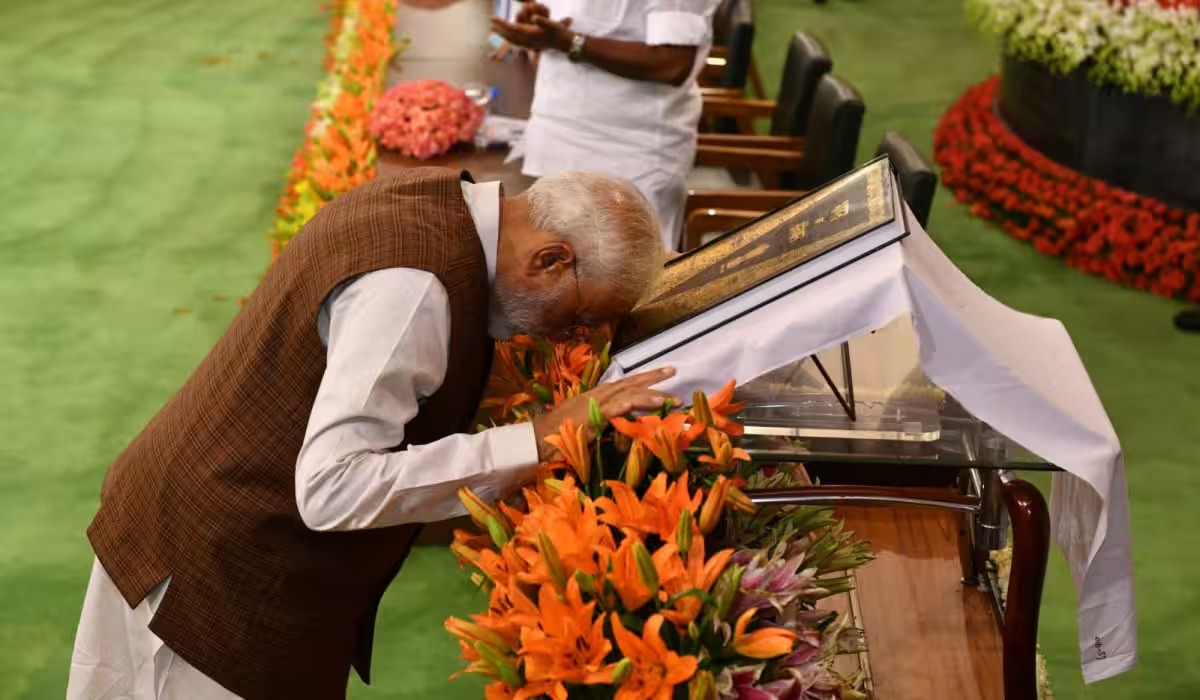
New Delhi, Nov 26 (SocialNews.XYZ) Prime Minister Narendra Modi on Thursday penned an Op-Ed on the occasion of Constitution Day, highlighting the uniqueness of the Indian Constitution, its significance in his personal journey, and the steps taken by the NDA government to strengthen constitutional values and promote social and economic justice.
The Prime Minister also launched a sharp attack on the Congress, accusing the party of repeatedly undermining constitutional principles during its decades in power. He said the principal opposition party had increasingly transformed itself from a 'Virodh Paksh' (opposition) into an 'Avrodh Paksh' (obstructionist).
PM Modi said that a constitutional democracy assigns an important and clearly defined responsibility to the Opposition, but disrupting democratic proceedings cannot be considered a substitute for fulfilling those responsibilities.
Taking to X, the Prime Minister outlined the key themes of his article, including the distinctive character of the Constitution and the Constituent Assembly, his personal association with the constitutional framework, the NDA government's efforts to strengthen constitutional institutions and provisions, and initiatives aimed at advancing social and economic justice.
"In this OpEd, I highlight the following: UNIQUENESS of our Constitution and Constituent Assembly. How the Constitution of India is an INSEPARABLE part of my journey. Ways the NDA Government has STRENGTHENED the Constitution. Efforts towards boosting SOCIAL AND ECONOMIC JUSTICE," he wrote.
"I have also highlighted: How the Constitution was trampled over by those who ruled the nation for 5 decades. How one party has devolved from being a Virodh Paksh to AVRODH PAKSH," he added.
Sharing his article, PM Modi recalled that the Constituent Assembly adopted the Indian Constitution on November 26, 1949, and paid tribute to Dr Rajendra Prasad, Dr B.R. Ambedkar and all members of the Assembly who contributed to drafting the country's foundational document.
"On 26th November 1949, the Constituent Assembly adopted our Constitution. Today, we remember Dr. Rajendra Prasad, Dr. Babasaheb Ambedkar and every member of the Constituent Assembly. Their greatness lay in drawing extensively from the rich traditions and civilisational wisdom of Bharat while framing a modern Constitution," he said.
The Prime Minister emphasised that India's diversity, comprising different religions, languages, traditions and schools of thought, makes it essential for the Constitution to connect with citizens beyond Parliament and the judiciary.
He said the government's efforts over the past decade had focused on making constitutional values an integral part of people's lives, particularly among the younger generation, and strengthening the spirit of national unity.
"For a nation as diverse as Bharat, with its numerous faiths, languages, customs and schools of thought, it is important that the Constitution have a resonance far beyond the precincts of Parliament and the courts. Our endeavour has been to deepen its connect with the collective consciousness of our people, especially our youth and strengthen the spirit of unity essential to India's bright future. That is why over a decade ago, our Government decided to mark 26th November as Constitution Day," PM Modi said.
Reflecting on his personal journey, the Prime Minister described the Constitution as an inseparable part of his life and said it had provided opportunities to people irrespective of their family background or financial circumstances.
Recalling his childhood and the modest conditions in which he grew up, PM Modi expressed gratitude towards the constitutional framework, saying it had enabled individuals from disadvantaged backgrounds to aspire to positions of responsibility in public life.
"For crores of Indians, including me, the Constitution of India is an inseparable part of our life journeys. Whenever I look back at my childhood, the humble circumstances in which I grew up, the struggles that were a part of everyday life, I am filled with an overwhelming sense of gratitude towards our Constitution," he said.
"That a child born into a family of modest means, with no privileges or advantages of birth, could one day be entrusted with the responsibility of serving the world's largest democracy speaks volumes about how extraordinary our Constitution is. It is due to our Constitution that circumstances of one's birth no longer determine the limits of one's future," he added.
PM Modi said his government had attempted to strengthen the Constitution by working towards the vision of social and economic justice envisaged by its framers. Referring to constitutional scholar Granville Austin, he described the Constitution as primarily a social document.
"The distinguished constitutional scholar Granville Austin described our Constitution as 'first and foremost a social document'. The quest for social and economic justice runs through the very fabric of our Constitution. Thus, what can be more satisfying than working towards the realisation of this cherished vision of the makers of our Constitution," he said.
Highlighting the government's welfare initiatives, the Prime Minister referred to a recent World Bank report, which, he said, showed that nearly 50 crore Indians had moved out of poverty. He said the improvement in living conditions had enabled millions of families to aspire to a better future for their children.
He cited the Pradhan Mantri Awas Yojana, Ujjwala Yojana, Ayushman Bharat, MUDRA, and PM-SVANidhi as examples of initiatives aimed at translating constitutional ideals into tangible benefits for ordinary citizens.
According to PM Modi, providing permanent houses to families living in inadequate conditions was an expression of the constitutional promise of dignity, while the Ujjwala scheme had helped women move away from smoke-filled kitchens and improved their living conditions.
Similarly, he said Ayushman Bharat had enabled economically weaker families to access healthcare without the burden of substantial medical expenses.
"When Ayushman Bharat enables a poor family to access quality healthcare without the fear of debt, social justice becomes a lived reality. When MUDRA and PM-SVANidhi provide collateral-free credit to small entrepreneurs and street vendors, economic justice finds expression," he said.
He also highlighted the role of digital technology and the Unified Payments Interface (UPI) in expanding access to financial services and economic opportunities.
"When digital technology and platforms like UPI transcend all divides and place opportunities once available to a privileged few within the reach of every citizen, we advance the constitutional ideal of inclusivity," the Prime Minister said.
PM Modi further referred to constitutional amendments introduced during the NDA government's tenure, describing them as important steps towards strengthening the constitutional framework and addressing the aspirations of different sections of society.
He cited the 101st Constitutional Amendment, which paved the way for the introduction of the Goods and Services Tax (GST), and the 102nd Amendment, which granted constitutional status to the National Commission for Backward Classes.
The Prime Minister also referred to the 103rd Constitutional Amendment, which introduced reservation for Economically Weaker Sections (EWS), saying it addressed the concerns of economically disadvantaged families belonging to communities outside the existing reservation framework.
He said the government had also taken steps to make the Constitution more accessible to citizens by ensuring that updated versions were available in all 22 languages listed in the Eighth Schedule.
Another major reform highlighted by the Prime Minister was the replacement of colonial-era criminal laws with the Bharatiya Nyaya Sanhita. He said the new legal framework represented a shift from a system focused on punishment to one centred on justice and the rights of citizens.
"With the Bharatiya Nyaya Sanhita, we have sought to bring about a fundamental shift in our criminal justice system, moving from the colonial emphasis on punishment (Dand) to a citizen-centric pursuit of justice (Nyay)," he said.
The Prime Minister also underlined the importance of 'Kartavya', or citizens' duties, saying the government had sought to encourage a greater sense of responsibility towards society and the nation.
He cited initiatives such as Swachh Bharat, water conservation and environmental protection as examples of mass movements that reflected the spirit of civic responsibility.
However, PM Modi alleged that there had been several instances in India's political history when those entrusted with protecting the Constitution had instead weakened its provisions and undermined democratic principles.
Targeting the Congress, he referred to the First Constitutional Amendment of 1951, introduced by the government led by Jawaharlal Nehru, and the 42nd Amendment brought during the Emergency in 1976.
"This year marks 75 years since the First Amendment of 1951, when a government that was not popularly elected used its majority in the Provisional Parliament to restrict fundamental freedoms. Its timing, barely months before India's first general election, proves that it was intended to influence the electoral process and stifle public opposition," PM Modi said.
He also referred to the 42nd Amendment, arguing that it curtailed judicial review and significantly altered the balance of powers among constitutional institutions.
"I would also urge youngsters to study the 38th and 39th Amendments to know what a power-hungry and anti-constitutional leadership can do," he added.
The Prime Minister also criticised the repeated use of Article 356 to dismiss elected state governments, alleging that one political party had invoked the provision nearly 100 times.
He further raised the issue of Article 370 and Article 35A, saying their continuation for decades had prevented the full implementation of the Constitution in Jammu and Kashmir and deprived several communities, including Scheduled Castes, Scheduled Tribes, Other Backward Classes, and women, of certain rights.
PM Modi said the constitutional changes made in 2019 had corrected "a historical injustice".
Referring to the security situation in the country, the Prime Minister said Naxalism (Maoism) had prevented some of the poorest and most vulnerable sections of society, particularly in tribal regions, from exercising their constitutional rights.
He said the successful elimination of Naxalism during the current year was significant because it had allowed people in affected areas to access their rights without fear of violence.
PM Modi also criticised what he described as the continuing influence of 'ideological Naxalism', alleging that some elements were attempting to obstruct India's development journey.
The Prime Minister further accused the Congress of taking positions on reservation that, according to him, went against the constitutional vision of Dr Ambedkar.
"It is most appalling that the biggest party in the Opposition wants to reduce OBC reservation and bring Muslim reservations, something the makers of our Constitution, notably Dr. Babasaheb Ambedkar, were totally against," he said.
He also raised concerns over women's political representation, referring to a legislative proposal aimed at ensuring greater representation for women in legislative bodies.
PM Modi said the rejection of the legislation by the opposition was disappointing and alleged that it reflected a lack of commitment to constitutional values and women's empowerment.
"The journey of our Constitution would be incomplete without recognising the remarkable women who helped shape it. But what happened earlier this year should fill our hearts with shame. A legislation aimed at giving women adequate representation in legislative bodies was disallowed from being passed by the one Opposition party, once again showing its disdain for constitutional values. I assure the Nari Shakti of India that no force can prevent us from ensuring that justice is done to them," he said.
The Prime Minister stressed that the Opposition had an important responsibility in India's parliamentary democracy and should fulfil its role through constructive criticism and meaningful participation in legislative proceedings.
"Our constitutional democracy has a clearly defined role for the Opposition. Sadly, the leading Opposition party seems to have become more of an Avrodh Paksh (obstructionist) than a Virodh Paksh (opposition). They should know that disrupting democratic processes is no substitute for discharging constitutional responsibilities," PM Modi said.
PM Modi said India was at a crucial stage in its journey towards becoming a developed nation by 2047. He called upon citizens to place national interests above all other considerations and make their duties the guiding force behind their actions.
"Today, India stands at a defining moment. As we work towards Viksit Bharat by 2047, two simple yet powerful principles can guide our collective endeavours: India First in our thinking and Kartavya (Duties) in our actions. With these as our guiding principles and the Constitution as our source of strength, we can secure a bright future for generations to come," he said.
Source: IANS

About Gopi
Gopi Adusumilli is a Programmer. He is the editor of SocialNews.XYZ and President of AGK Fire Inc.
He enjoys designing websites, developing mobile applications and publishing news articles on current events from various authenticated news sources.
When it comes to writing he likes to write about current world politics and Indian Movies. His future plans include developing SocialNews.XYZ into a News website that has no bias or judgment towards any.
He can be reached at gopi@socialnews.xyz