
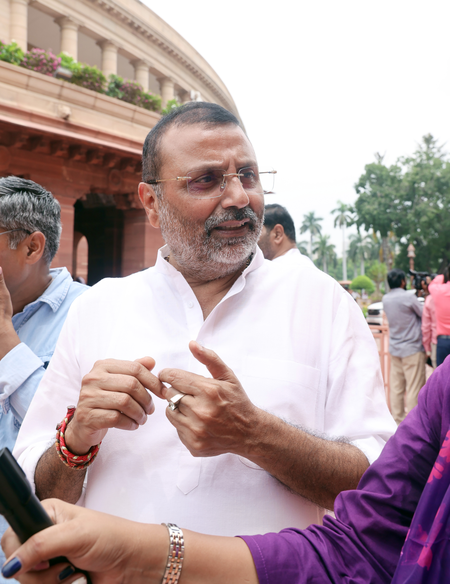
New Delhi, Nov 24 (SocialNews.XYZ) BJP MP Nishikant Dubey has raised questions over the circumstances surrounding the assassination of Mahatma Gandhi, questioning whether the then Prime Minister Jawaharlal Nehru had prior knowledge of the security threats and whether his government failed to act on Intelligence inputs ahead of the January 30, 1948, assassination.
In a post on X under the heading 'Congress' Dark Chapter, Chapter - 253', Dubey referred to the Justice Jeevan Lal Kapur Committee, which was constituted in 1966 to investigate fresh facts relating to Mahatma Gandhi's assassination.
Raising questions about the role of the then Congress government, Dubey wrote: "Was Mahatma Gandhi’s assassination carried out with Nehru’s knowledge? On November 21, 1966, the central government set up the Justice Jeevan Lal Kapur Committee to investigate new facts about Mahatma Gandhi’s assassination. Its report was released in 1969. On November 24, 1964, Ketkar made a sensational disclosure in Pune about the assassination, shaking the entire country.”
“Amid heated debate in Parliament, the central government promised to set up an enquiry committee. This committee was formed two years later, in 1966, and its report was released in 1969. The committee studied the reports of all previous committees and commissions that had investigated Mahatma Gandhi’s assassination. Justice Jeevan Lal Kapur’s report was not made public until 1977 because the committee had indirectly raised suspicions about Nehru as well,” he added.
Dubey further highlighted that the police investigating officer at the time, Nagarwala, revealed that on January 20, 1948, Madan Lal Pahwa had thrown a bomb in an attempt to assassinate Mahatma Gandhi.
“After Madan Lal’s arrest, it emerged that some young men from Pune wanted to kill Mahatma Gandhi. This report was submitted by Mumbai’s Home Minister to the then Chief Minister, Morarji Desai. Morarji Desai informed Justice Kapur’s committee that he had sent his special envoy to Delhi with the investigation report to Sardar Patel, and that Home Minister Sardar Patel had passed the report on to Prime Minister Nehru. Nehru took no action on this report, and Mahatma Gandhi’s security was reduced even further. The result was Mahatma Gandhi’s assassination on January 30, 1948. Before the enquiry commission, Manuben, Sarla Ben and others all accused the security arrangements and the central government of laxity,” he wrote.
“Should the country be informed, on the basis of all the judicial commissions’ reports, of the Nehru-Gandhi family’s role in Gandhi’s assassination?” Dubey asked.
In his post, Dubey specifically questioned whether the security warnings following the January 20, 1948, bombing attempt were adequately acted upon by the authorities.
He also referred to the statements made before the Kapur Committee by Morarji Desai, who was the then Bombay State Chief Minister, regarding the communication of the investigation report to Sardar Vallabhbhai Patel and subsequently to Pandit Nehru.
The BJP MP's remarks have brought renewed political attention to the historical circumstances surrounding Mahatma Gandhi's assassination and the findings of the enquiry commission.
Mahatma Gandhi was assassinated on January 30, 1948, in New Delhi by Nathuram Godse. The Justice J.L. Kapur Commission was appointed to examine additional evidence and circumstances relating to the assassination.
Source: IANS

About Gopi
Gopi Adusumilli is a Programmer. He is the editor of SocialNews.XYZ and President of AGK Fire Inc.
He enjoys designing websites, developing mobile applications and publishing news articles on current events from various authenticated news sources.
When it comes to writing he likes to write about current world politics and Indian Movies. His future plans include developing SocialNews.XYZ into a News website that has no bias or judgment towards any.
He can be reached at gopi@socialnews.xyz