
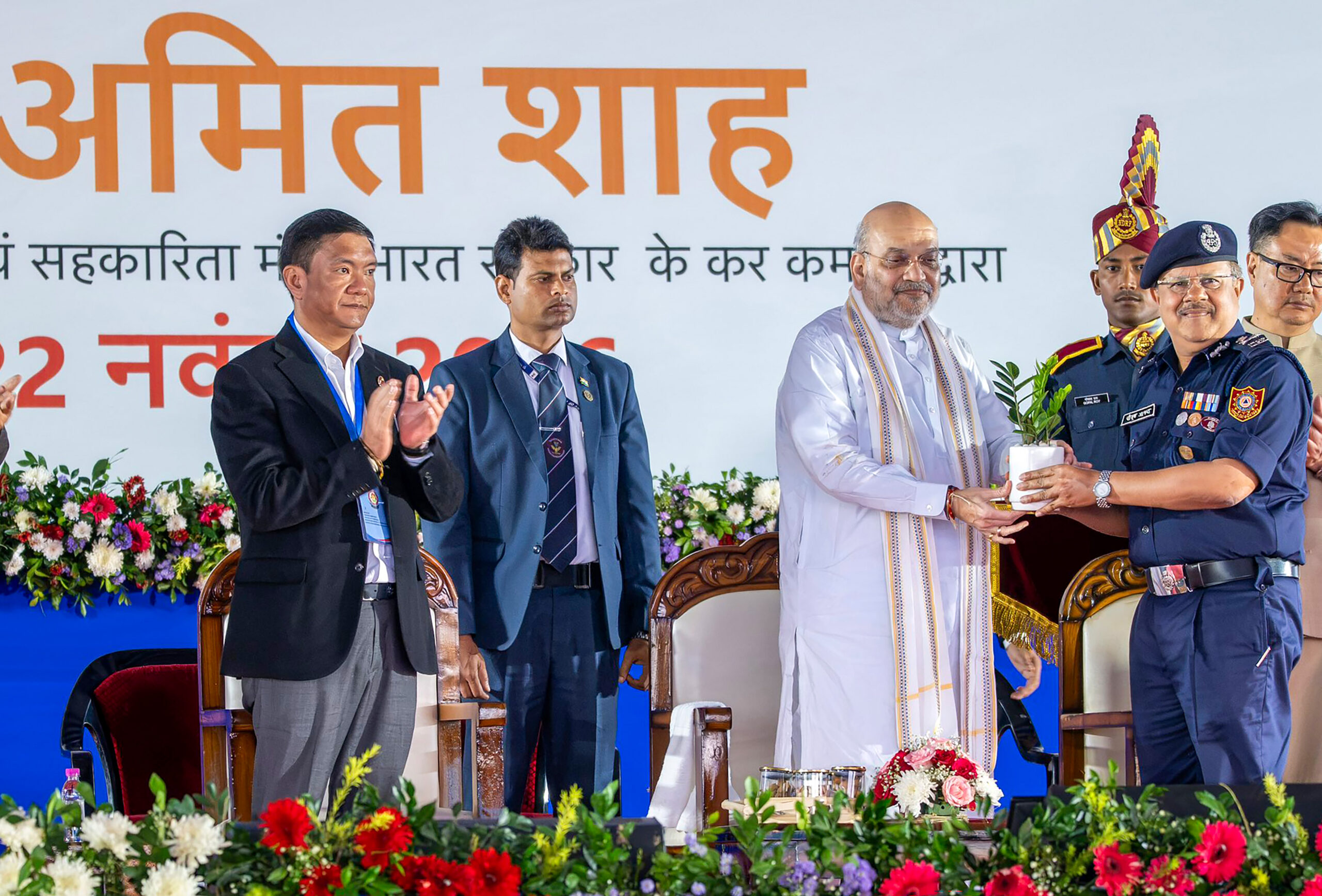
Itanagar, Nov 22 (SocialNews.XYZ) Union Home Minister Amit Shah on Sunday said that under Prime Minister Narendra Modi's leadership, the government has transformed India's approach to disaster management by shifting its focus from a relief-centric and reactive system to early warning, prevention, mitigation, preparedness, disaster risk reduction and, ultimately, a zero-casualty approach.
Inaugurating the 12th Battalion Campus of the National Disaster Response Force (NDRF) at Hollongi near Itanagar, the Home Minister said that under the Modi government, as soon as an alert is received through the early warning system, NDRF and State Disaster Response Force (SDRF) personnel reach out to assist people in vulnerable areas.
"Even before a disaster strikes, they evacuate not only citizens but also their livestock and move them to safe locations. I can confidently say that between 2014 and 2026, the NDRF, SDRF and all state governments, working together, have saved the lives of millions of people," Shah said.
According to the Home Minister, the NDRF was constituted following the enactment of the Disaster Management Act. However, he said, a significant transformation in its functioning began under the Modi government, which shifted the country's disaster management strategy from a relief-centric and reactionary approach to one focused on preparedness and prevention.
Shah said that earlier, whenever a disaster struck, governments would rush to provide relief and assistance to the affected people and subsequently concentrate on repairing the damage caused by the disaster. The emphasis, he added, was largely on responding to disasters after they occurred rather than taking advance measures to minimise their impact.
The Home Minister also highlighted the growing international recognition of the NDRF, saying that its personnel had brought pride to the national flag through their exemplary service not only in India but also in countries such as Japan, Nepal, Türkiye and Sri Lanka, among several others.
"Earlier, whenever a disaster struck, disaster response agencies from across the world would come to India to provide assistance. Today, whenever a disaster strikes anywhere in the world, our NDRF personnel proudly represent India and go there to rescue people. This is a major achievement of the Government of India," Shah noted.
An Olympic-size swimming pool and a dedicated diving tank have also been constructed at the Hollongi campus to provide specialised training to NDRF personnel and enhance their capabilities in water-related rescue operations.
According to the Home Minister, the swimming pool will also be opened free of charge to swimmers and swimming athletes from Itanagar and other parts of Arunachal Pradesh, providing them with an opportunity to train and develop their sporting abilities. "I am confident that if any swimmer wins a medal at the 2036 Olympics, the journey to that achievement will begin with the waves created in this very pool," he stated.
Shah further said that the entire campus and all buildings of the 12th Battalion had been constructed in accordance with earthquake-resistant standards, keeping in view the vulnerability of the Northeast region to earthquakes and other natural disasters. "The first defence against natural disasters begins with the infrastructure of our 12th Battalion," the Home Minister said, adding that the campus would strengthen disaster preparedness not only in Arunachal Pradesh but also across the entire Northeast and several adjoining regions.
He said the facility would play an important role in providing the necessary training to NDRF personnel from all Northeastern states, thereby enhancing their operational capabilities and ensuring a coordinated response to natural disasters across the region.
Highlighting improvements in the country's early warning systems, Shah said that earlier, cyclone warnings were generally issued only 24 or 48 hours in advance. However, with the help of modern technology and improved forecasting capabilities, such warnings can now be issued up to seven days in advance.
"With the assistance of the NDRF, we safely evacuate all citizens from cyclone-affected areas," he said, adding that several cyclones had struck the country over the past four years without claiming a single life. "This is the outcome of our advanced preparedness," Shah stated.
The Home Minister further informed that between 2014 and 2026, the NDRF had significantly expanded its operational presence and now had a deployment footprint at more than 70 locations across the country. This expansion, he said, had strengthened the country's ability to respond swiftly and effectively to disasters in different regions.
Shah told the gathering that no disaster could be prevented, nor could the damage caused by it be effectively minimised, without proper institutional preparedness and coordination among the agencies concerned. "Since 2014, the Modi government has brought all stakeholders -- from the National Disaster Management Authority (NDMA), NDRF, SDRF and the Ministry of Home Affairs to village-level Patwaris in the states -- together to deliberate on and formulate policies," he said.
The Home Minister emphasised that disaster management required the active participation of every level of administration, from national institutions and state-level agencies to local authorities and grassroots functionaries, to ensure timely action and effective coordination during emergencies.
Shah said that the Ministry of Home Affairs (MHA) had established a robust mechanism for policy formulation and its effective implementation in coordination with the SDRF, NDRF and the entire state administrative machinery. He added that the government's emphasis on institutional preparedness, technological advancement, early warning systems and coordinated action had helped strengthen India's disaster response capabilities and move the country closer to its goal of minimising casualties and damage during natural disasters.
Chief Minister Pema Khandu, Union Minister of Parliamentary Affairs Kiren Rijiju, Deputy Chief Minister Chowna Mein, Union Home Secretary Govind Mohan, NDRF Director General Piyush Anand and senior officials from the Home and Cooperation Ministries also attended the event.
Source: IANS

About Gopi
Gopi Adusumilli is a Programmer. He is the editor of SocialNews.XYZ and President of AGK Fire Inc.
He enjoys designing websites, developing mobile applications and publishing news articles on current events from various authenticated news sources.
When it comes to writing he likes to write about current world politics and Indian Movies. His future plans include developing SocialNews.XYZ into a News website that has no bias or judgment towards any.
He can be reached at gopi@socialnews.xyz