
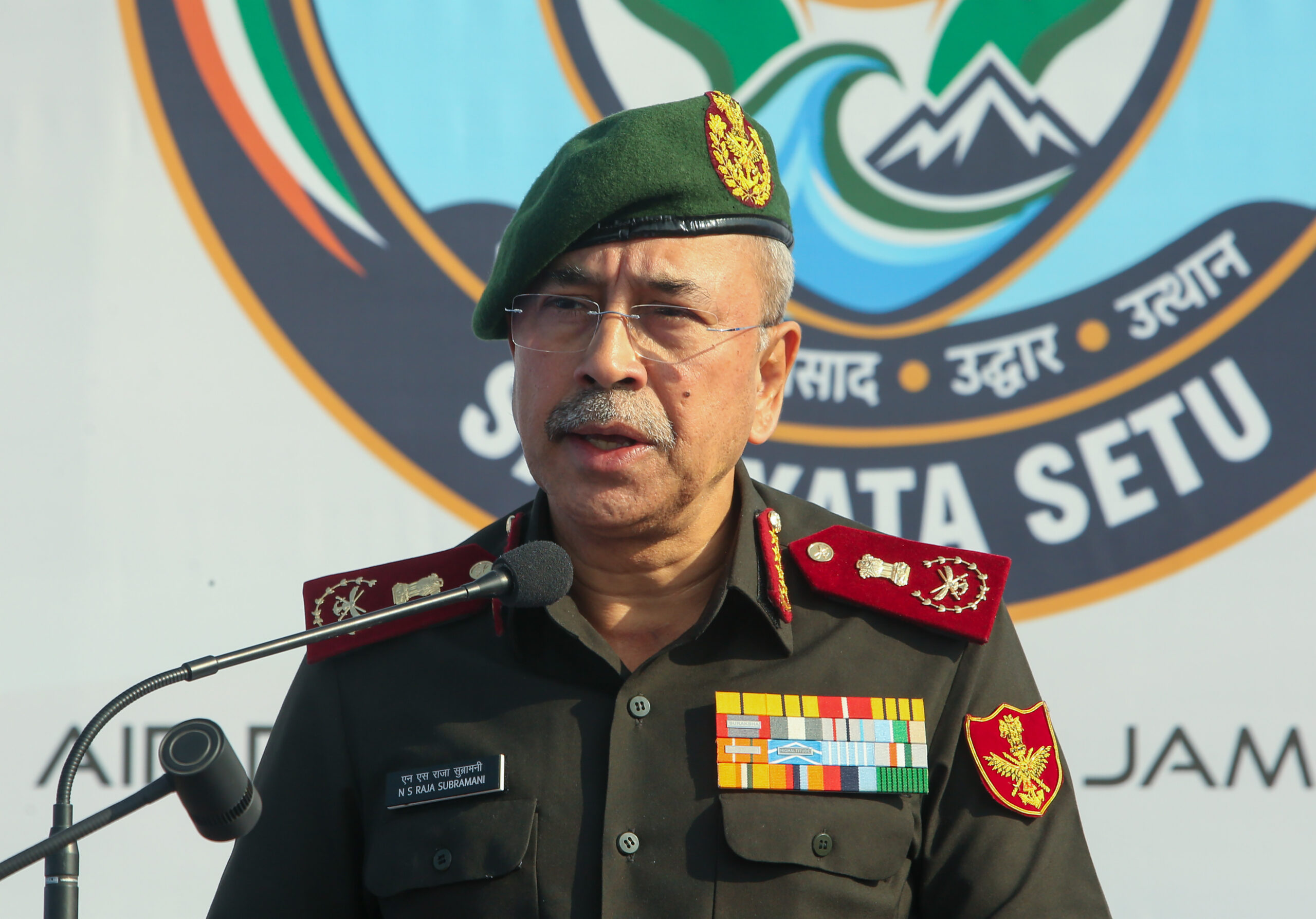
Jamnagar, Nov 19 (SocialNews.XYZ) Chief of Defence Staff (CDS) General N.S. Raja Subramani on Thursday stressed the need for collective preparedness, seamless coordination and technology-enabled capabilities to respond to disasters, as the Indian Armed Forces conducted the main demonstration of the Annual Joint Humanitarian Assistance and Disaster Relief (HADR) Exercise-2026, ‘Sahayata Setu’, at an Air Force Station in Gujarat's Jamnagar.
Addressing the exercise, the CDS said disasters did not recognise geographical boundaries and responses therefore needed to transcend them, emphasising the importance of cooperation among participating countries and agencies.
“The participation of friendly foreign countries in this exercise further reinforces the importance of collective preparedness. Disasters do not recognise geographical boundaries, our response hence needs to transcend them. Our endeavour must be to build a self-reliant and technology-enabled HADR capability where jointness is practised before a crisis, coordination is seamless during one, and assistance reaches those in distress without delay,” he said.
He said the effectiveness of the exercise would ultimately be determined by the ability to translate coordination into timely action during an actual disaster.
India’s approach to humanitarian assistance and disaster response, he added, was guided by its 'Neighbourhood First' policy and the vision of MAHASAGAR, with the country seeking to remain a dependable first responder in the Indian Ocean region and the wider Indo-Pacific.
“I am very happy to be here today. Humanitarian assistance and disaster relief is an expression of India’s commitment to human security, both in India and in our wider neighbourhood,” General Subramani said, adding that the exercise was in keeping with Prime Minister Narendra Modi’s vision, who had emphasised disaster risk reduction through his 10-point agenda in 2016.
“The underlying principle is clear: preparedness must be collective, response must be coordinated, and no effort should be spared in saving precious lives,” he said.
The three-day exercise, conducted from November 17 to 19 under the aegis of Headquarters Integrated Defence Staff (HQ IDS), was organised by the Indian Air Force under the guidance of HQ IDS and Headquarters South Western Air Command (HQ SWAC), in coordination with participating national agencies and friendly foreign countries.
The main event featured a static display, a FICCI exhibition and a Multi-Agency Capability Demonstration (MACD) on the dispersal-area tarmac.
The demonstration was designed to showcase how different agencies and their capabilities could work together in response to a simulated large-scale disaster, involving widespread damage and humanitarian needs.
The scenario depicted a severe cyclone, with an aerial demonstration showing the evacuation of an aircraft from the cyclone zone, followed by a presentation of cyclone landfall, flooding and the demolition of man-made structures in the simulated disaster area.
The Indian Air Force's Jaguar aircraft, remotely piloted aircraft and other platforms were deployed for aerial reconnaissance, while helicopters and aircraft conducted tactical reconnaissance and relayed information to the ground.
Army and Air Force para jump instructors also carried out a parachute demonstration before the main exercise began.
The rescue phase involved an IAF Mi-17 helicopter airlifting an Army rescue and medical team of 10 personnel into the affected area.
The helicopter also demonstrated a low-hover jump and insertion of Army troops and Air Force Guards as part of the emergency response team. An aerial firefighting demonstration using a Bambi Bucket was also conducted, followed by the landing and offloading of a light strike vehicle.
A Chinook helicopter transported a bridge section to the designated position, while an IAF C-130 dropped a combat rubberised rescue craft and the Indian Navy deployed marine commandos at sea.
The helicopters subsequently repositioned for fuel bridging to support ground operations. The rescue and evacuation operations involved the Army Aviation Light Helicopter conducting a slithering operation to insert a rescue team, while an IAF Cheetah helicopter rescued survivors stranded on an isolated rooftop.
An Indian Navy Dornier aircraft dropped dinghies at sea for survivor rescue. Army rescue teams demonstrated the use of rescue robots and rescue dogs to locate survivors, while the Army, National Disaster Response Force (NDRF) and State Disaster Response Force (SDRF) carried out cutting, lifting, debris removal and casualty evacuation operations.
Army engineers prepared a temporary helipad and positioned a bridge section to facilitate the movement of rescue vehicles.
The maritime search and rescue component involved the Indian Navy and Air Force in locating survivors, winching them, and transferring them to an offshore hospital ship.
The Indian Coast Guard's Advanced Light Helicopter (ALH) also demonstrated live winching operations.
During the relief and restoration phase, an IAF C-295 carried out an assault landing and inserted Army vehicles before evacuating critical civilian casualties, including two stretcher cases and six seated critical patients.
A Navy Dornier dropped a dinghy, while an IAF C-17 carried out an assault landing to insert heavy NDRF equipment. Army logistics teams demonstrated the delivery of essential supplies, including blood, to a field hospital through a designated operating corridor.
The Navy and its ALH also demonstrated relief and restoration operations from a naval ship to the mainland. The exercise concluded with all participating agencies taking part in the culmination programme, followed by the National Anthem.
The exercise aimed to strengthen collective preparedness, improve interoperability and promote coordinated disaster response through technological innovation.
It also included a QUAD HADR working-level meeting in the presence of delegates from Australia, India, Japan and the United States.
"The exercise sought to demonstrate the importance of timely assistance and cooperation among nations and agencies during emergencies, with the broader objective of strengthening international partnerships and improving the ability to save lives during disasters," officials noted.
Source: IANS

About Gopi
Gopi Adusumilli is a Programmer. He is the editor of SocialNews.XYZ and President of AGK Fire Inc.
He enjoys designing websites, developing mobile applications and publishing news articles on current events from various authenticated news sources.
When it comes to writing he likes to write about current world politics and Indian Movies. His future plans include developing SocialNews.XYZ into a News website that has no bias or judgment towards any.
He can be reached at gopi@socialnews.xyz