
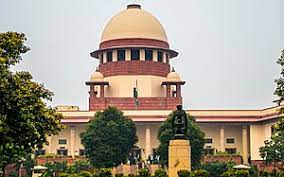
New Delhi, Nov 6 (SocialNews.XYZ) The Supreme Court on Friday refused to entertain a public interest litigation (PIL) seeking directions for prescribing constitutional safeguards and objective standards governing the appointment of Ministers facing serious criminal charges at the Centre and in the states.
A Bench of Chief Justice of India (CJI) Surya Kant and Justices Joymalya Bagchi and V Mohana, while hearing the plea, expressed reservations about laying down guidelines for the appointment of Ministers, observing that criminal cases could sometimes be initiated against political leaders by their opponents as part of the democratic process.
During the hearing, Justice Bagchi questioned whether it would be appropriate for the apex court to frame guidelines curtailing the discretion of the Prime Minister or Chief Ministers in appointing members to their respective Cabinets.
In response, advocate Nisha Tiwari, appearing for the petitioner, submitted that the exercise of such discretion must be reasonable and guided by certain parameters. "All that I am saying is that the exercise of discretion has to be reasonable. There have to be certain parameters governing that discretion," the counsel submitted.
However, Justice Bagchi cautioned that judicially framing such guidelines could involve the Supreme Court in a difficult constitutional exercise, particularly given the possibility of criminal prosecutions following a change of government.
The counsel reiterated that there should be reasonable limits on the appointment of persons facing criminal cases as Ministers, submitting that voters do not necessarily endorse the appointment of legislators with criminal antecedents to the Cabinet merely by electing them.
"Whenever I cast my vote, I do not necessarily endorse somebody with criminal antecedents becoming a Cabinet Minister. With respect, there has to be a reasonable limit. That is all I am saying," the counsel submitted.
However, the apex court proceeded to dismiss the PIL.
The petition, filed by Dilip Kumar Sharma under Article 32 of the Constitution, had sought appropriate directions for prescribing constitutional safeguards governing the appointment of persons facing serious criminal charges as Ministers under Articles 75(1) and 164(1).
It contended that the absence of objective suitability standards at the post-electoral stage had resulted in a situation where persons facing serious criminal proceedings could be appointed to the Council of Ministers and entrusted with sensitive portfolios.
Citing data compiled by the Association for Democratic Reforms (ADR), the plea claimed that 47 per cent of sitting Ministers across the country had declared pending criminal cases, while 27 per cent faced serious criminal charges.
The petitioner argued that the appointment of Ministers facing criminal proceedings to sensitive portfolios, particularly those involving control over police and prosecution machinery, could create structural conflicts of interest and undermine the right to a fair and impartial trial under Article 21.
The plea relied on the 2014 Constitution Bench judgment in Manoj Narula vs. Union of India, in which the Supreme Court declined to read an implied disqualification into Articles 75(1) and 164(1) but stressed the constitutional expectation that the Prime Minister and Chief Ministers would exercise restraint while appointing persons with serious criminal antecedents as Ministers.
It contended that the convention of political self-restraint recognised in the judgment had failed to produce the desired results and that a transparent framework was now necessary.
The petition also referred to recommendations made by various committees and commissions, including the Vohra Committee, the National Commission to Review the Working of the Constitution, the Second Administrative Reforms Commission and the Justice J.S. Verma Committee, concerning the criminalisation of politics and restrictions on persons facing serious criminal charges from occupying public office.
It further referred to three Bills introduced by the Union government in Parliament in 2025, proposing the removal of a Prime Minister, Chief Minister or Minister who remains under arrest for more than 30 days in connection with a serious criminal offence.
However, the petitioner contended that an arrest-based threshold would be insufficient, as it would not address situations where persons facing serious criminal charges continued to hold ministerial office without being arrested.
The PIL had sought a framework requiring objective suitability assessments before ministerial appointments, disclosure of reasons through a public "Suitability Memorandum" and safeguards against allocation of portfolios where a conflict of interest could arise from pending criminal proceedings.
It clarified that the reliefs sought did not involve creating a fresh electoral disqualification or judicially rewriting the constitutional provisions governing ministerial appointments, but were intended to ensure transparency, accountability and the protection of the integrity of the criminal justice system.
Source: IANS

About Gopi
Gopi Adusumilli is a Programmer. He is the editor of SocialNews.XYZ and President of AGK Fire Inc.
He enjoys designing websites, developing mobile applications and publishing news articles on current events from various authenticated news sources.
When it comes to writing he likes to write about current world politics and Indian Movies. His future plans include developing SocialNews.XYZ into a News website that has no bias or judgment towards any.
He can be reached at gopi@socialnews.xyz