
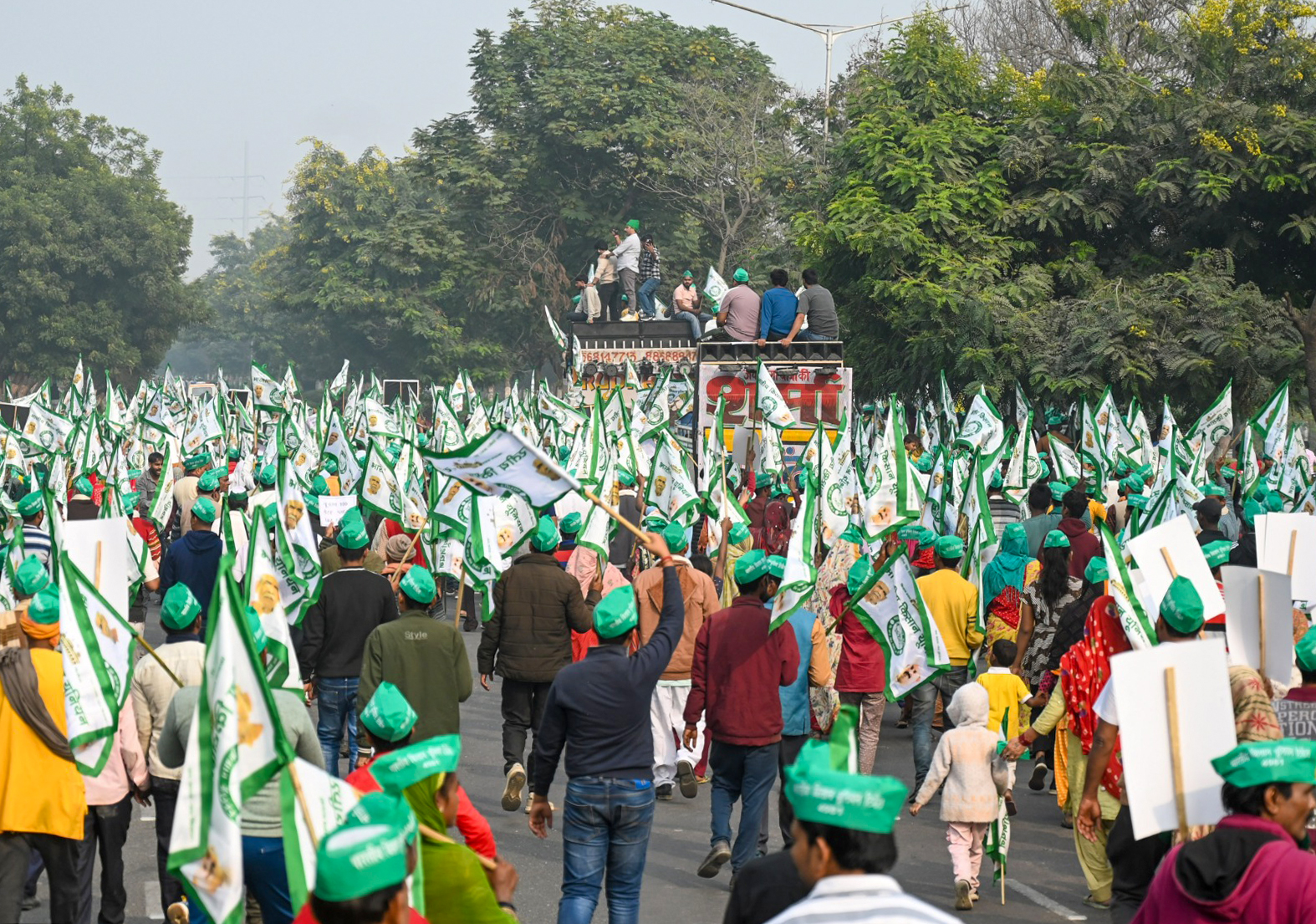
New Delhi, Oct 23 (SocialNews.XYZ) During the 2020-2021 protests against the three agricultural laws, an umbrella platform was formed to coordinate various organisations and unions involved in the demonstrations, which now continues its role but has extended from a focused farmers’ campaign into a broader political mobilisation directed against the Bharatiya Janata Party (BJP)-led government.
During the demonstrations, the Samyukta Kisan Morcha (SKM) emerged as one of the most influential mass movements in contemporary India, leading the year-long protests against the Union government’s three farm laws.
Its greatest achievement came in November 2021 when the Centre finally announced the repeal of the laws, marking a rare instance of a major piece of legislation being withdrawn after sustained public agitation. Since then, the platform has witnessed several fissures and erosions, yet remains a powerful national platform with organisational reach across several states.
The SKM has made several major demands, including the enactment of a law guaranteeing Minimum Support Price (MSP) for farmers’ produce in accordance with the M.S. Swaminathan Committee’s formula.
It seeks the implementation of the C2+50 per cent formula, claiming a recommendation made by the National Commission on Farmers, chaired by agricultural scientist M.S. Swaminathan, for fixing MSP. Under this formula, they want MSP set at 50 per cent above the comprehensive cost of cultivation (C2).
The C2 cost is the broadest measure of production cost and includes all paid-out expenses on seeds, fertilisers, pesticides, hired labour and irrigation (A2), the imputed value of family labour (FL), as well as the rental value of owned land and interest on owned capital.
Farmer organisations such as the SKM argue that only C2+50 per cent provides a fair and remunerative return to cultivators, while the government generally calculates MSP using the lower A2+FL cost benchmark. This said difference lies at the heart of the ongoing debate over MSP and remains one of the principal demands of farmer unions. The repeal of the farm laws in 2021 gave the coalition tremendous political and moral capital.
Now, the platform further seeks comprehensive farm loan waiver, withdrawal of the four Labour Codes and the Electricity Privatisation Bill, restoration and expansion of the Mahatma Gandhi National Rural Employment Guarantee Act (MGNREGA), among other demands. It also continues to mobilise opposition to free trade agreements, claiming they affect income from agriculture. Many of these demands may be seen as linked to farmers’ welfare.
Critics argue that while these demands remain unresolved, SKM’s energies are increasingly devoted to political campaigns that move beyond agriculture. Evidence for this perception can be found in the organisation’s own recent resolutions and protest programmes.
Incidentally, the SKM earlier decided to join Friday’s demonstrations with larger stirs planned later, accusing authorities of undermining democratic rights, and extended support to student and youth protesters.
The organisation also sought broader electoral reforms and amendments to the law governing the appointment of election commissioners.
Thus, an organisation born out of farm sector anxieties is now devoting significant organisational resources to issues traditionally associated with civil rights groups and Opposition politics.
The trend is not new. In recent years, SKM has increasingly framed its struggles within a larger ideological contest against what it calls corporate-communal policies.
In a convention earlier this year, it explicitly called for rallying people against the “BJP-RSS-led” ruling framework and linked farmers’ concerns with labour rights, trade agreements, privatisation, and wider economic policies. The coalition also participated in nationwide “Jail Bharo” actions alongside trade unions, targeting government economic and labour policies.
The mobilisation brought together farmers, workers, students and other groups under a broader anti-government agenda that extended well beyond agriculture. Its supporters emphasise that such expansion is natural because farming issues are connected to wider questions of democracy, labour rights and economic policy. They maintain that farmers cannot isolate themselves from decisions affecting trade, elections, federalism and public institutions.
Critics, however, contend that this approach risks diluting the movement's original focus, while core agricultural demands remain unfulfilled. From their perspective, every mobilisation dedicated to electoral controversies or broader political causes is energy diverted from the pressing economic problems confronting farmers.
What began as a united platform opposing three farm laws and achieved a landmark victory has today elevated into a national political force. The question now confronting the movement is whether it can remain rooted in farmers’ concerns while increasingly participating in broader political battles where ongoing protests are over electoral issues, rather than purely agrarian concerns.
Source: IANS

About Gopi
Gopi Adusumilli is a Programmer. He is the editor of SocialNews.XYZ and President of AGK Fire Inc.
He enjoys designing websites, developing mobile applications and publishing news articles on current events from various authenticated news sources.
When it comes to writing he likes to write about current world politics and Indian Movies. His future plans include developing SocialNews.XYZ into a News website that has no bias or judgment towards any.
He can be reached at gopi@socialnews.xyz