
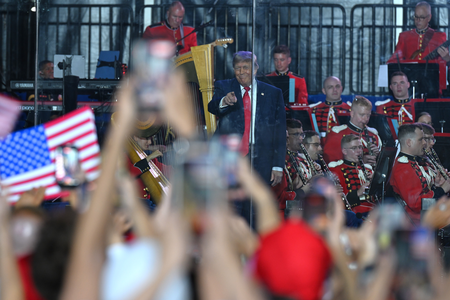
New York, Oct 20 (SocialNews.XYZ) US President Donald Trump's name is not on midterm ballots, but his calls to voters to imagine if it was and vote for Republican Party candidates is turning the election into a referendum on his presidency as it nears the tumultuous half-way point.
“Pretend that I am on the ballot”, he has told crowds at his campaign stops for his party's candidates, hoping that would boost the sagging fortunes of his candidates.
A fortnight from the midterm elections on November 3, the picture is dim for his party – and by extension, his standing, according to numerous polls.
Polls show Democrats poised to capture the House of Representatives while the Senate is a toss-up with narrow margins in key races.
The economy is the main drag on Trump because of tariffs and the Iran war he dragged the US – and the world – into, sending energy prices soaring, and with it virtually everything else a voter would need.
A CBS News poll released earlier this month reported 70 per cent of registered voters said his policies are making prices go up.
Trump, who dismissed Democrats' campaign line of affordability – a reference to high prices – now admits it is a factor, but justifies it, saying, "It's a small price to pay for keeping the world safe, keeping our country safe”.
His desperation over the election is writ large in his Moscow diesel deal.
A year ago, he attacked India, claiming it doesn't “care how many people in Ukraine are being killed by the Russian War Machine” and imposed sanctions on it.
Now to tame the price spiral, he called Russia's President Vladimir Putin to ask for diesel and has said Moscow would initially supply of 300,000 tonnes of diesel, and follow up with another 500,000 tonnes next month.
Trump's job disapproval rating is hovering dismally around the 60 percentage point in several opinion polls, battered by the higher prices.
RealClear Politics' aggregation of polls shows his disapproval rating at 59.3 per cent, with 62.9 per cent believing the country was on the "wrong track".
Trump is aware the final two years of his presidency will depend on the midterm election, which will determine control of Congress.
He has acknowledged that the threat of impeachment, which tainted his first term, looms again.
He said at a recent campaign rally, “If we don’t win, they’ll end up impeaching me”.
While the Democrats are unlikely to collect two-thirds of the Senate votes to remove him from office if the House impeaches him, just the trial in the lower chamber will sap energy from his administration.
Cabinet officials like Secretary of War Pete Hegseth also face impeachment threats -- with one already pending.
However, this entire scenario needs the caveat that it depends on the reliability of the polls, which have in the past tended to overstate the Democratic standing.
RealClear Politics aggregation of surveys shows that in generic Congressional polls, which survey voter sentiments without going into specific constituencies, the Democrats are ahead by 8.3 per cent.
Even Fox News, the conservative network, put the Democrat edge at nine per cent.
The RealClear Politics interpretation of the House polls gives the Democrats possible 227 seats, a nine-seat majority, and Republicans a shot at 186 seats, while 22 seats still hang in the balance in the "tossup" category where polls are very close and give either party a chance to pick them up.
CBS News, based on its polling, estimates Democrats getting 229 seats, and the Republicans 206.
The Senate race is not so clear, and that is where Trump and the Republicans are concentrating their energy.
Unlike in the House, only about a third of the 100 seats in the Senate, where the terms are six years, come up for election every other year.
Including the seats not in the polls this year, and the 35 that are, RealClear Politics map shows both parties tied with 46 seats each, with eight "tossup" seats that could decide which party gets controls.
Generally, a third of the electorate nationally is estimated to be staunchly Democrat and another third, the MAGA (Make America Great Again) supporters of Trump, leaving the decision nominally to the other third, although the ratios vary by state, with some skewing blue or Democrat and others red or Republican with varying degrees of party fervour.
A red flags for the Republicans is polls showing an erosion of support among Trump's voters in 2024, seen in Democrat candidates making headway in states he had won by solid margins.
In Ohio, RealClear Politics average shows Republican governor candidate Vivek Ramaswamy trailing his Democrat opponent by 3.5 per cent, whereas he had been considered a shoo in, when he quit the Department of Government Efficiency last year to run for the job.
The Republican candidate for Senate is running 2.8 per cent behind the Democrat in the state Trump had carried by 11.5 per cent.
Trump went against the sitting Republican Senator John Cornyn in the Texas primary and endorsed Ken Paxton, a controversial state attorney general who had faced a state legislature impeachment.
Now Democrat James Talarico is ahead by a narrow 2.2 per cent in the deep red state Trump won in 2024 by 14 percent.
But neither of these cases – and others like them – it is a definite win for the Democrats, only putting these states -- and constituencies -- in play.
Republicans are working hard to turn things around.
Trump has campaigned intensively in these red states, hoping to rouse his supporters to go the polls, even telling them to vote by mail, although he has been skeptical about the integrity of postal ballots and tried to limited them.
Voting patterns show a slump in the midterm elections without a presidential candidate on the ballot, and Trump wants to make sure his supporters aren't lethargic about voting.
The Democrats are tying the Republican candidates to Trump, hoping to exploit his low approval rating, especially on the economic front.
Some Republican candidates are putting some distance from Trump on some issues.
Iowa Republican Senate candidate Ashley Hinson and Ohio Senator Jon Husted have aired differences with Trump on the Iran War, which they want ended quickly.
On Trump's changed Russian policy, Republican Senate candidates Susie Graham in South Carolina and Mike Rogers in Michigan are distancing themselves.
Rogers, whose state has close economic links with Canada, also showed his displeasure with Trump's policies towards that country.
Even on immigration, a core Republican policy, Representative María Salazar called for restraint, complaining the policies went too far.
But guilt by association can cut both ways.
Republicans have retaliated, linking Democratic Party radicals like New York Mayor Zohran Mamdani and Representatives Ilhan Omar of Minnesota and Ocasio-Cortes of New York to that party's candidates.
Some have disowned them, like Cait Conley, a Houe canddiate in New York who declared she wouldn't campaign with Mamadani or Ocasio-Cortes.
Trump has called Democrats "communists" and "socialists".
Source: IANS

About Gopi
Gopi Adusumilli is a Programmer. He is the editor of SocialNews.XYZ and President of AGK Fire Inc.
He enjoys designing websites, developing mobile applications and publishing news articles on current events from various authenticated news sources.
When it comes to writing he likes to write about current world politics and Indian Movies. His future plans include developing SocialNews.XYZ into a News website that has no bias or judgment towards any.
He can be reached at gopi@socialnews.xyz