
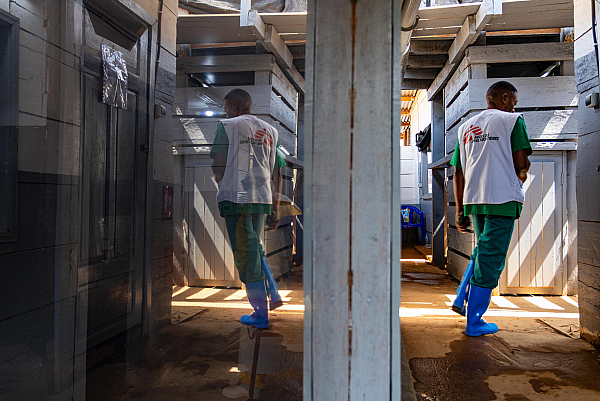
- The Ebola disease outbreak in Democratic Republic of Congo is disproportionately impacting children, with the youngest children facing the highest risk of death.
- Children are also being left behind in the research of innovative medical tools.
- Ongoing and future studies on Bundibugyo virus, the virus driving this outbreak, must include children.
Children are paying a devastating price in the Ebola disease outbreak unfolding in northeastern Democratic Republic of the Congo (DRC). While children face a higher risk of death from Ebola than adults, they also represent a significant proportion of the people affected by the current outbreak.
According to Epicentre, Médecins Sans Frontières’ (MSF’s) epidemiological research centre, nearly one in four confirmed Ebola cases in North Kivu province is a child. MSF is deeply concerned by the disproportionate impact of the disease on children and calls for more attention to their specific vulnerabilities, in both the medical and research response.
While Ebola remains a deadly disease for all age groups, the youngest children face the highest risk of death. In North Kivu, children have been particularly affected by the current outbreak: 24% of confirmed cases are among children under five years of age, compared with 13% in Ituri province, while infants under one year old account for 13% of cases, compared with 6% in Ituri.
At the Ebola treatment centre (ETC) in Butembo, North Kivu, MSF teams have observed that the case fatality rate among children was particularly high. Between June and September 2026, 24 out of 30 children – most of whom were under the age of five – died from the Bundibugyo virus in this ETC alone. The rapid progression of the disease in communities and limited access to specialised care at health facility level are contributing to such alarmingly high fatality rates.
“General health facilities often lack the specialised expertise, equipment, and infection prevention and control measures needed to identify and safely manage suspected cases,” explains Stéphanie Hoffmann, project coordinator for MSF in Butembo. “Most of the paediatric cases admitted in our ETC in Butembo, North Kivu, over the summer, had already been hospitalised for other illnesses in several facilities during the days or weeks before their admission. Their family members did not have Ebola themselves, and it is highly likely that these children contracted the disease inside healthcare facilities.”
Strengthening infection prevention and control measures in health facilities, ensuring the availability of personal protective equipment, and reinforcing the training of healthcare workers in non-Ebola health centres across at-risk areas are critical to maintaining essential services while preventing healthcare-associated transmission.
While efforts have been made to reduce the emotional toll of isolation on children in ETCs, including the creation of visibility areas where parents can see and communicate with their hospitalised children, being admitted to an ETC remains a deeply distressing experience for young patients. Children may be too young to understand their situation or meet their own basic needs.
To help address this situation, MSF has recruited and trained caregivers who provide daily support and comfort to children inside several MSF-supported ETCs while wearing full personal protective equipment. These caregivers come from diverse backgrounds, including, but not limited to, being Ebola survivors. Today, 13 caregivers are supporting children at the Kitatumba ETC in Butembo. While far from a perfect solution, this initiative provides essential human contact and emotional support for children facing the outbreak.
“On top of enormous challenges caring for young patients, medical facilities are dealing with a lack of paediatric dosing guidance, and limited availability of child-friendly formulations of investigational medicines,” says Dr Guyguy Manangama, epidemiologist and deputy director of operations at MSF. “A child-centred approach must be at the heart of medical care, operational planning, and research efforts.”
Children have been disproportionately affected by the current outbreak, yet they are left behind when it comes to access to innovative medical tools. Historically, children are often excluded from clinical research or included only after significant delays, creating dangerous gaps in evidence and access to potentially lifesaving interventions.
“Treatments, vaccines, and other preventive tools should be evaluated for use in children from the outset of research efforts and made available to them without delay,” says Dr Manangama. “Yet in the current outbreak, children are still being left behind, with very limited access to vaccination trials and campaigns, as well as the latest therapeutic innovations despite bearing a significant burden of disease.”
“Children cannot continue to wait for data generated in adults before benefiting from advances in Ebola care and prevention,” says Dr Manangama.
MSF urges national authorities, research institutions, pharmaceutical developers, and international funders to prioritise the inclusion of children in all ongoing and future Bundibugyo virus studies. Ensuring equitable access to research and new medical tools, including vaccines, is essential to reducing preventable deaths and improving outcomes for one of the most vulnerable groups.
The impact of the outbreak on children extends beyond Ebola infection itself. Disruptions to essential health services can rapidly increase risks from vaccine-preventable diseases, malnutrition, and other common childhood illnesses. Preserving routine immunisation, nutrition programmes, and access to general healthcare must therefore be considered a core component of the outbreak response, not an afterthought.
Distributed by APO Group on behalf of Médecins sans frontières (MSF).
