
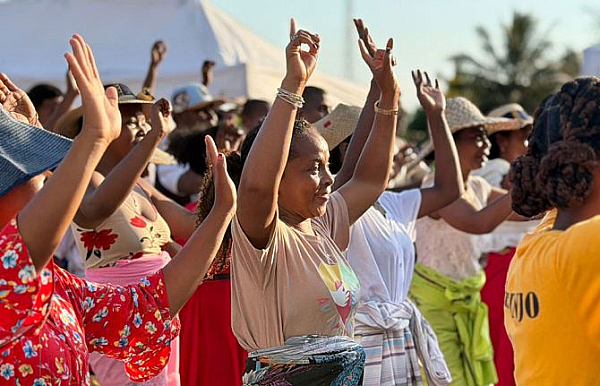
Not too long ago, across Madagascar, in regions facing severe drought and extreme poverty, some young girls were in dire straits, unable to buy basic necessities, some-times having to exchange unprotected sex for commodities as commonplace as a single tomato.
For many years, Madagascar's HIV response was focused primarily on key populations including men who have sex with men, sex workers, people who use drugs and prisoners. But on the ground, warning signs were emerging that the picture was changing.
"We began seeing clear indications that the epidemic was no longer confined to traditionally defined key populations but was increasingly affecting bridge populations and the wider community," said Jude Padayachy, Secretary of State, Ministry of Health, Seychelles and former UNAIDS Country Director for Madagascar, Seychelles and Comoros.
By 2024, Madagascar had recorded a 151% increase in new HIV infections since 2010. At the same time, HIV treatment coverage remained at just 24%, among the lowest in the region and far below UNAIDS' target of 95%. Weak surveillance systems, low HIV prevention and limited capacity to test for HIV meant that the country did not have a clear picture about the true scale and changing nature of the epidemic.
Changing the response required better surveillance and service delivery, but also political leadership and commitment and the willingness to challenge assumptions that had shaped the HIV response for years. "Overcoming the initial resistance to shift our strategic approach required robust evidence and persistent dialogue," said Mr Padayachy.
Over several years, UNAIDS worked alongside the Government of Madagascar, communities, civil society organizations and development partners to strengthen surveillance systems, improve data collection and build a stronger evidence-base to inform the decision-making.
"UNAIDS played a vital role in helping Madagascar strengthen the evidence-base for our HIV response and foster dialogue around this evidence," said Norosa Rakotoherimora, Programme Manager, STI and HIV Control, Ministry of Health, Madagascar.
Then came a critical turning point.
In 2026, new data revealed that HIV prevalence among pregnant women attending antenatal care services had reached 1.1%. This is above the 1% threshold that signals a generalized epidemic. The finding was a powerful signal that HIV transmission was reaching beyond the populations traditionally at the centre of Madagascar's response. The young girls exchanging unprotected sex for a single tomato were outside of the picture the HIV response had been built around. The epidemic could no longer be understood only through the lens of key populations.
The new evidence transformed the national conversation. It created an opportunity to bring the next National Strategic Plan in line with the reality of the epidemic, including expanding HIV prevention efforts, strengthening community action, increasing access to testing for HIV and engaging sectors far beyond health.
The new evidence is also influencing conversations with international partners, including The Global Fund to fight AIDS, Tuberculosis and Malaria, as Madagascar's HIV response is increasingly considered as a more widespread epidemic.
While the story is not yet over, the country has a clearer picture of the challenge it faces and a stronger basis for how it responds.
Madagascar's experience shows how data combined with sustained advocacy, leadership and political commitment, can change how a country understands its epidemic, how it responds and ultimately, how many lives it can save.
Today, UNAIDS no longer has a country office in Madagascar, however, that did not end its support. The UNAIDS Regional Support Team for East and Southern Africa has kept the work going, continuing to provide technical support and helping to ensure the HIV response follows the evidence.
Distributed by APO Group on behalf of United Nations Programme on HIV/AIDS (UNAIDS).
