
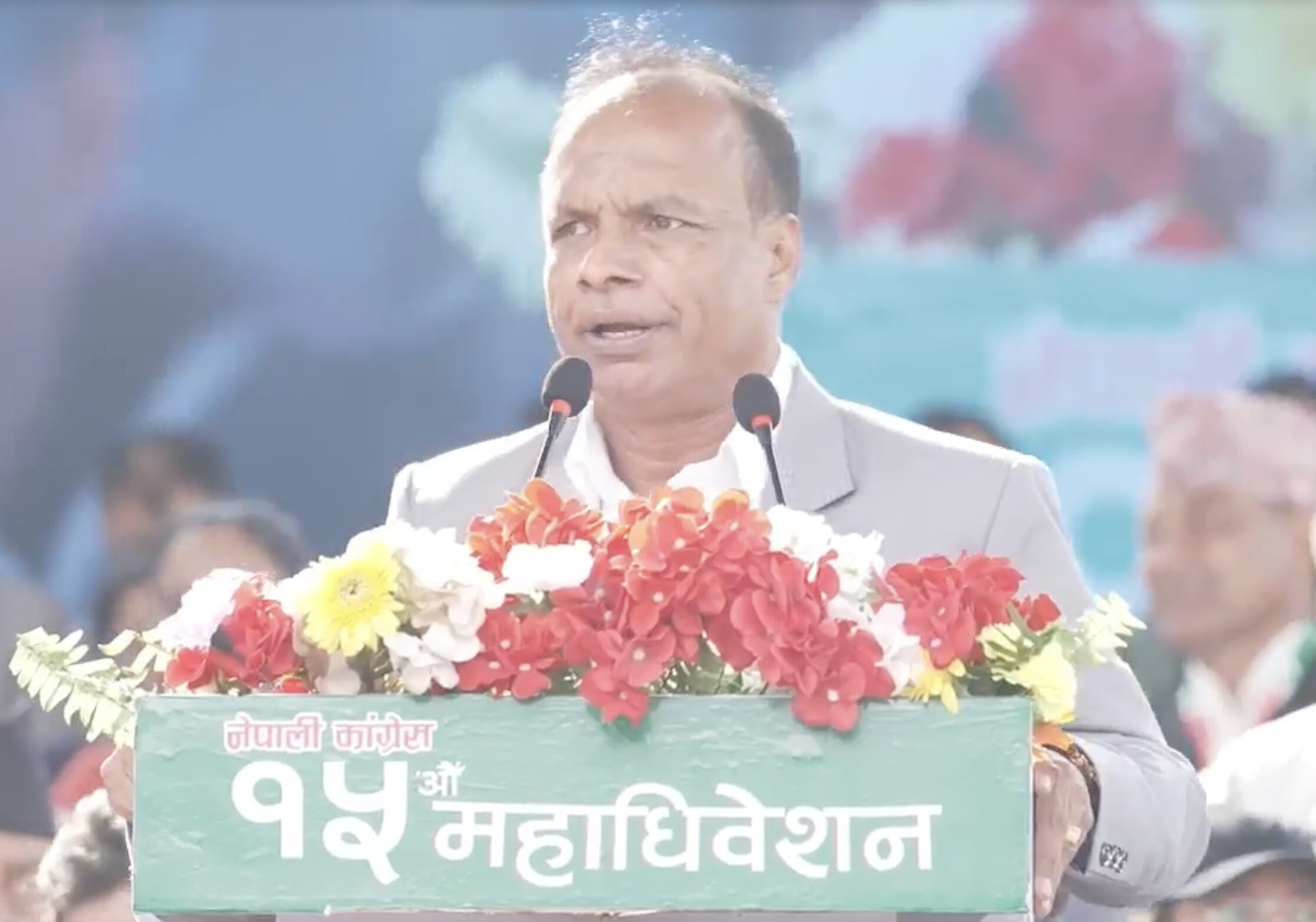
Kathmandu, Oct. 4 (SocialNews.XYZ) A general convention organised by a faction of Nepal’s Nepali Congress began in Kathmandu on Sunday, while another faction is scheduled to hold its own general convention in December, highlighting continued divisions within the country’s grand old party.
The faction led by party President Gagan Kumar Thapa is holding the Nepali Congress’ 15th General Convention, while another faction led by former Prime Minister Sher Bahadur Deuba is scheduled to hold its general convention from December 7 to 9.
A rebel group led by Thapa organised a special general convention of the party in January this year, which removed Deuba as party president and elevated Thapa to the post, further deepening divisions within the party.
The legality of the special general convention and Deuba’s removal as party president is currently under review by the Supreme Court. However, the Election Commission recognised the Thapa-led faction ahead of the March 5 elections, allowing it to field candidates.
The elections, however, proved disastrous for the grand old party, as well as other established parties, including the Communist Party of Nepal (Unified Marxist-Leninist), or CPN-UML, led by former Prime Minister KP Sharma Oli, and the Nepali Communist Party led by former Prime Minister Pushpa Kamal Dahal.
The newly emerged Rastriya Swatantra Party (RSP) became the largest political force, securing a near two-thirds majority in the 275-member House of Representatives, the lower house of Parliament.
Nepali Congress President Thapa himself suffered a crushing defeat in the parliamentary elections from the Saptari-4 constituency, losing to an RSP candidate. His defeat has raised questions about his political standing and leadership of the party, further fuelling discontent within rival factions.
Thapa, who is once again expected to contest for the party presidency, said during the inauguration session of the convention on Sunday that his party should be able to answer the current questions raised by citizens, as he acknowledged the failure to do so in recent years.
With old political parties, including his own, facing questions over alleged corrupt practices during their decades in power, Thapa argued that a party is not new or old based on when it was established.
“The party that can answer citizens’ questions is the new one. The party that can work with citizens is the new one,” he said.
He said the Nepali Congress must change its working methods, language, thinking, and political culture while remaining rooted in the values associated with its founding leaders, BP Koirala and Ganesh Man Singh.
He also spoke about divisions within the party and his efforts to bring former president Deuba into the fold of a unified party.
He said Deuba had been invited to inaugurate the convention.
“Honouring Sher Bahadur Deuba is not about how many times you salute at his doorstep; it is about how much you have strengthened and elevated the party he built,” he said.
Although leaders of several other political parties attended the convention, former Prime Minister Deuba was absent. Former Prime Minister KP Sharma Oli also skipped the inaugural session.
Rabi Lamichhane, president of the ruling RSP, said many Nepali Congress supporters had voted for the RSP, as many RSP leaders had previously been associated with the Congress.
He said he could also have become a member of the Nepali Congress before forming his own political party, had there been space for the younger generation to flourish.
Former Prime Minister and Nepali Communist Party coordinator Dahal urged the Thapa-led faction of the Nepali Congress to move forward by accommodating the rival group.
“Let all Nepali Congress leaders and cadres be united and brought together to build a formidable force,” Dahal said. “I would still like to wish you success in your efforts to bring the remaining colleagues into the fold as well.”
The general convention is taking place at a time when the Nepali Congress is the distant second-largest party in Parliament and remains divided, a situation that could affect its electoral prospects in the upcoming local elections, which are likely to be held early next year.
In the 275-member House of Representatives, the RSP secured 182 seats, followed by the Nepali Congress with 37 seats and the CPN-UML with 25.
Following its electoral setback, the Thapa-led Nepali Congress appears to have acknowledged the need to bring younger leaders into the party’s top leadership. The Gen Z-led protests last year paved the way for a new political leadership in the country, led by Prime Minister Balendra Shah.
This time, the Nepali Congress has adopted a provision included in its statute at the last special general convention to ensure the representation of people under 35 in the party’s leadership structure.
The party statute also guarantees a minimum one-third representation for women and greater representation of marginalised and minority communities in the Central Working Committee.
Alongside leadership selection, this year’s general convention has given priority to discussions on the party’s future political direction, organisational reform and the role of the younger generation.
Slogans such as “The Congress has changed, we will change the country” and “Congress 2.0” have been used to convey a message of taking the party forward in a new style.
Source: IANS

About Gopi
Gopi Adusumilli is a Programmer. He is the editor of SocialNews.XYZ and President of AGK Fire Inc.
He enjoys designing websites, developing mobile applications and publishing news articles on current events from various authenticated news sources.
When it comes to writing he likes to write about current world politics and Indian Movies. His future plans include developing SocialNews.XYZ into a News website that has no bias or judgment towards any.
He can be reached at gopi@socialnews.xyz