
For many businesses, the decision to use solar power to reduce electricity costs is taking a backseat to how the project will be funded.
After several years of rapid renewable energy uptake driven by load shedding concerns, the commercial solar market is entering a more measured phase. While the economics of solar remain attractive for many organisations facing rising electricity tariffs, access to flexible and appropriate financing structures is playing a dominant role in determining which projects proceed and which remain on hold.
As such, for project developers, installers and commercial energy customers, understanding the funding landscape has become as important as understanding system design and energy generation. Financing arrangements can influence project affordability, risk allocation, cash flow and the speed at which projects reach implementation.
“Our reporting this year shows that African businesses are, in effect, building their own grid. Roughly 80% of distributed solar capacity on the continent now serves commercial and industrial customers. The challenge now for this market to understanding whether the funding structure behind a project fits the business that must live with it for the next ten or twenty years,” says Nicolette Pombo-van Zyl, Editor-in-Chief of ESI Africa.
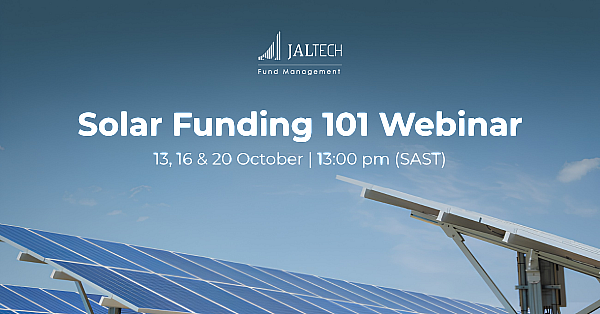
These considerations will be explored in an upcoming webinar hosted by Jaltech, in partnership with ESI Africa. This discussion will examine how businesses can navigate the commercial solar funding market and identify financing solutions that align with their operational and financial requirements.
The growing importance of funding choices
As energy users look to manage long-term electricity costs, they are faced with a range of funding structures, each with distinct advantages and trade-offs. Selecting the right option requires balancing project economics with organisational objectives, capital availability and customer expectations.
The webinar will provide a practical overview of the funding options available for commercial solar projects, examining the strengths and limitations of different financing approaches and how businesses can assess which model is most suitable for their circumstances.
The session will also consider what funders assess when evaluating projects and the steps businesses and project developers can take to improve the likelihood of securing finance.
“Across ESI Africa’s coverage of energy infrastructure funding, one theme keeps coming up: capital is available, but it goes to projects that are prepared for it. That holds for a utility-scale plant and for a rooftop system on a factory. Partnering with Jaltech on this webinar is about giving developers and energy users the practical knowledge to turn a sound solar business case into a project a funder will back,” says Pombo-van Zyl.
Moving projects from planning to implementation
While solar technology has become more widely understood and accessible, project funding remains a common point of uncertainty within the commercial and industrial energy sector.
“A power purchase agreement, a lease, a bank loan or an upfront capital investment can each be the right answer, depending on a company’s cash flow, its appetite for risk and who it wants carrying the operational burden. Upfront cost is still the biggest hurdle we hear about, and the businesses that move fastest are the ones that understand these trade-offs before they approach a funder,” says Pombo-van Zyl.
For developers and energy professionals, the ability to match customer requirements with the right financing structure can influence project viability and accelerate decision-making. Equally, businesses considering solar investments need a clearer understanding of how commercial finance is accessed, what information funders require and where different funding models are most effective.
These practical considerations sit alongside broader industry discussions around energy affordability, investment readiness and the commercial pathways required to support continued growth in distributed renewable energy. Similar themes are being explored across ESI Africa’s energy coverage and industry engagement activities as organisations seek to balance cost certainty, energy security and long-term sustainability objectives.
Webinar details
Solar Funding 101 with Jaltech
Presenter: Jonty Sacks, Partner at Jaltech
Dates: 13, 16 and 20 October 2026
Time: 13:00 (SAST)
Duration: 30 minutes
Platform: Zoom
During the session, participants will gain practical insight into:
Commercial solar funding options currently available in the market
The advantages and disadvantages of different funding structures
How to assess customer requirements and align them with suitable funding solutions
What funders look for when evaluating projects
The process of securing commercial solar finance
Register here (https://apo-opa.co/4ANlUfC)
Those unable to attend the live session are encouraged to register to receive access to the webinar recording after the event.
As ESI Africa, created by VUKA Group, continues to examine the commercial realities shaping renewable energy adoption, access to finance remains a central factor in determining how quickly businesses can move from energy ambitions to implemented projects.
Distributed by APO Group on behalf of VUKA Group.
About Jaltech:
Founded in 2010, Jaltech is an alternative investment fund manager, managing over R2 billion+ of retail investors’ capital. The team is made up of entrepreneurs and financial professionals with a wealth of knowledge and experience in managing alternative investments. www.Jaltech.co.za
About ESI Africa:
ESI Africa is a leading multimedia platform serving Africa’s power, energy, water, transport and utility sectors. Through industry analysis, interviews, webinars, special reports and multimedia content, ESI Africa connects sector professionals with the people, projects, technologies and developments shaping infrastructure across the continent. ESI Africa forms part of VUKA Group. www.ESI-Africa.com
About VUKA Group:
VUKA Group connects people and organisations to information and each other, creating business opportunities across key industries in Africa. Through events, digital platforms, media and targeted industry networks, VUKA Group brings together decision-makers, innovators, investors and industry stakeholders. www.weAreVUKA.com
