
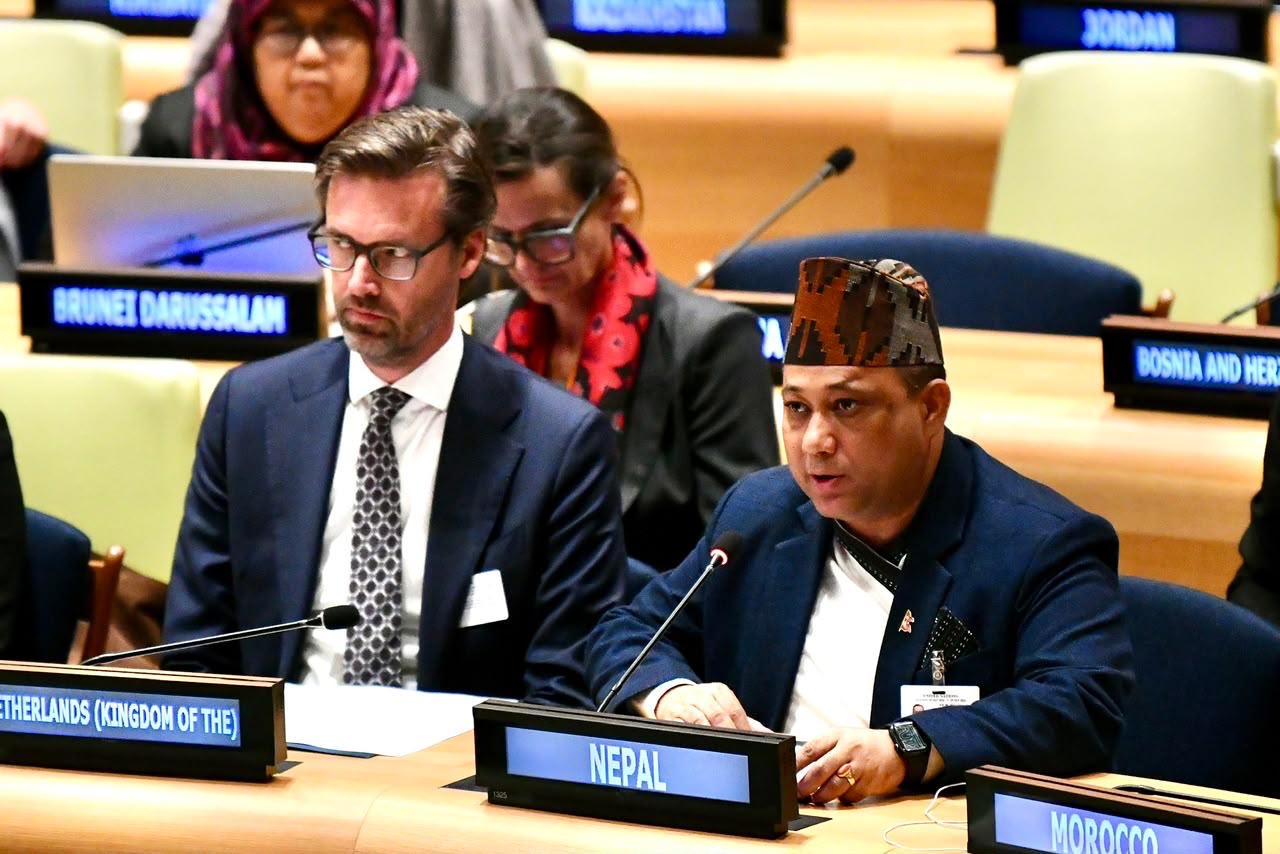
Kathmandu, Sep 25 (SocialNews.XYZ) Nepal’s Foreign Minister Sishir Khanal said Nepal’s engagement with India would focus on converting geographical proximity into production and structured economic interdependence, as he outlined the country’s vision of a multi-engagement strategy with India, China and the broader global community.
Addressing an event organised by the Asia Society under the theme 'Steering Nepal’s Future in Asia’s Rising Century' in New York on Wednesday, Foreign Minister Khanal said Nepal had adopted the policy of “Thick Connectivity and Thin Borders” in its relations with India.
“Guided by our policy of ‘Thick Connectivity and Thin Borders,’ we are moving towards structured, reciprocal interdependence,” he said, highlighting the more than 1700 km open border Nepal shares with five Indian states — Uttarakhand, Uttar Pradesh, Bihar, West Bengal and Sikkim — which together are home to more than 400 million people.
He highlighted hydropower as a major area of economic cooperation, saying Nepal’s perennial rivers have around 43 GW of economically viable hydropower potential.
“By scaling toward 28,000 megawatts by 2035, Nepal can power regional industrial decarbonization, exporting clean electricity to India and onward to Bangladesh,” he said.
Khanal also said Nepal could attract manufacturing investment by developing Special Economic Zones along the border, offering access to low-cost green electricity and international markets.
“For global and Indian firms seeking resilient supply chains, locating manufacturing in Nepal’s border Special Economic Zones provides a structural edge,” he said.
On Nepal’s engagement with China, its northern neighbour, Khanal said Nepal’s focus would be on turning geography into connectivity and diversification.
“With China, our approach is pragmatic, commercially grounded, and focused on long-term resilience. Our objective is not simply to open roads to the north; it is to transform Nepal from a landlocked economy into a land-linked economy,” he said.
Khanal said Nepal was pursuing a multidimensional Trans-Himalayan connectivity network with China involving roads, tunnels, dry ports, aviation, digital links and cross-border rail.
“But connectivity must ultimately be measured not in kilometres of infrastructure, but in the movement of goods, services, investment, tourists, and opportunity,” he said.
Khanal also called for greater cooperation with China on Himalayan science, including glacial monitoring, disaster early warning, hydrological information, climate adaptation and resilient infrastructure, particularly as Nepal suffered catastrophic floods on August 26.
He said Nepal also wanted deeper cooperation in digital connectivity, technology transfer and innovation, ensuring that the mountains do not become a barrier to the next generation of Nepali enterprises.
“Guided by transparent financing, rigorous feasibility, and value-for-money principles, Nepal will pursue every opportunity for mutually beneficial cooperation while preserving our sovereign autonomy,” he said.
Nepal’s connectivity with India and China is often viewed through the lens of competing efforts by the two Asian powers. Khanal, however, said Nepal did not view its northern and southern connectivity corridors as competing strategic choices.
“We do not see our northern and southern corridors as competing directions. We see Nepal land-linked to two of the world’s largest markets, home to nearly three billion people. Our ambition is to turn this geography into a gateway for commerce and opportunity,” he said.
Khanal said the Nepali government’s strategy was also to deepen partnerships with the United States, Europe, Japan, ASEAN and the Gulf nations as part of expanding Nepal’s global reach and turning multi-engagement into an advantage.
He identified digital services as another potential area for Nepal to expand its global economic role, arguing that data and software face relatively little transit friction.
“Nepal can leverage its clean electricity and cool climate to become a trusted digital hub, including through a Fintech and AI Sandbox,” he said.
Khanal also described Nepal’s five-million-strong diaspora as a strategic economic asset.
He said the government wanted to move beyond viewing Nepalis abroad primarily as sources of remittances and instead channel their capital and expertise into productive sectors.
He said these measures would be pursued under the doctrine of “developmental autonomy,” which he described as Nepal’s statecraft, with a focus on expanding economic capabilities, creating jobs and achieving middle-income status within the next decade.
Khanal said Nepal’s policy of multi-engagement was aimed at expanding the country’s strategic room for manoeuvre and economic dignity rather than choosing sides among major powers.
“This brings us to the governing doctrine of our statecraft: Developmental Autonomy,” Khanal said. “We have set ourselves a clear national goal of achieving middle-income status in the next 10 years and high-income, developed status by 2050.”
Source: IANS

About Gopi
Gopi Adusumilli is a Programmer. He is the editor of SocialNews.XYZ and President of AGK Fire Inc.
He enjoys designing websites, developing mobile applications and publishing news articles on current events from various authenticated news sources.
When it comes to writing he likes to write about current world politics and Indian Movies. His future plans include developing SocialNews.XYZ into a News website that has no bias or judgment towards any.
He can be reached at gopi@socialnews.xyz