
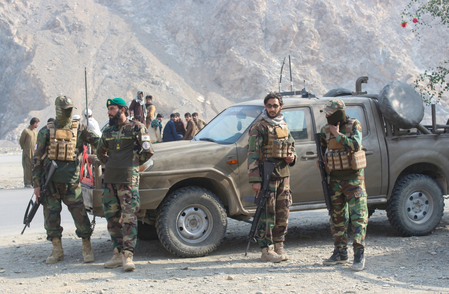
New Delhi, Sep 22 (SocialNews.XYZ) Pakistani jets have reportedly been repeatedly pounding its own territories, targeting people it calls its own to quell a movement for separate Balochistan, while sneaking in a few raids across the Durand Line to bomb neighbouring Afghanistan.
While the aerial bombardment of Pakistan’s largest province by area is to quell the uprising, those inside Afghanistan are what Islamabad claims to be targeting: the Tehrik-e-Taliban Pakistan (TTP) that it alleges is operating from the neighbour’s soil.
Islamabad accuses the Afghan Taliban of sheltering the TTP, while Kabul insists Pakistan’s problems are internal.
As in earlier air raids, Kabul has reiterated that the strikes have once again killed civilians, with TOLO news reporting late Monday that the Taliban administration has stressed that it will “respond appropriately”.
Quoting the United Nations Assistance Mission in Afghanistan (UNAMA), the report added that so far this year, over 1,100 civilian deaths and injuries have been documented in Afghanistan from cross-border armed violence.
The aftermath is being seen in escalating fighting along the Durand Line again, where the border has been closed for almost a year since the Taliban reacted with heavy attacks after the Pakistan Air Force carried out earlier cross-border bombing. Since then, there have been several clashes, exchanges of artillery fire, and the closure of key border trade routes, worsening economic ties between the two neighbours.
With skirmishes along the Pak-Afghan border crossings, entry corridors including Torkham and Chaman were closed due to the fighting, halting trade and stranding trucks carrying food and goods. This reportedly worsened commodity shortages in Afghanistan and hurt Pakistan’s exporters.
The border remains disputed, deeply rooted in Afghanistan’s refusal to recognise the Durand Line, a colonial-era boundary drawn in 1893, which has fuelled mistrust for decades.
The “Line” was drawn by Sir Mortimer Durand to demarcate land between the then British India and Afghanistan.
It runs across about 2,600 km, from the China border in the east to Iran at its western end. But successive Afghan governments have since refused to recognise it as an international border, arguing it unfairly divides Pashtun tribes. Kabul claims the border and the agreements over it as void, alleging that the emir of Afghanistan Abdur Rahman Khan was then forced to accept it.
In Pakistan, Khyber Pakhtunkhwa (KP), located in the country’s northwest, is its third-largest province by population, accounting for about 16.9 per cent of the country's total population. Pashtuns are the dominant group in this region.
Though it is the historic heartland of Pashtuns, migration has created large Pashtun communities in Sindh and Punjab.
They also form a significant population in northern Balochistan and in urban centres like Karachi.
Islamabad insists the Durand Line is a legitimate boundary, inherited at independence in 1947, but Kabul argues that this agreement was made under duress and, thus, not enforceable.
In July 1949, Afghanistan’s parliament declared the Durand Line agreement void, calling it an “imaginary line” and that all agreements regarding this border were untenable.
During the 1970s–1980s, Afghanistan accused Pakistan of interfering in its internal affairs mainly because Islamabad actively supported Afghan Islamist groups opposed to Kabul’s governments, from President Daoud Khan to Mohammad Najibullah, especially during the Soviet occupation.
Pakistan’s alignment with the United States and backing of the Mujahideen fighters deepened the rift, while the unresolved Pashtun issue and the Durand Line dispute added fuel to the mistrust.
Afghanistan became a proxy war zone between the United States and the erstwhile USSR, with Pakistan acting as a frontline state. Even after Soviet withdrawal in 1989, Kabul continued to view Pakistan as interfering in Afghan politics.
When the Taliban first took Kabul in 1996, Pakistan was one of three countries, alongside Saudi Arabia and the UAE, to officially recognise the regime. Relations soon soured over the Durand Line, and after the 9/11 attacks in 2001, Islamabad was forced to abandon open support for the Taliban, joining the US-led “War on Terror”.
After the Taliban reassumed power with the withdrawal of US-led troops in August 2021, Pakistan’s Director-General of Inter-Services Intelligence (ISI) Lt. Gen. Faiz Hameed made headlines when he was photographed casually sipping tea in Kabul.
The image symbolised Pakistan, then under the Imran Khan regime, sharing possible cooperation and alignment with the Taliban. However, the optimism quickly faded as relations deteriorated sharply, especially over the Durand Line and the alleged presence of TTP fighters in Afghanistan.
Meanwhile, Imran Khan remains incarcerated over alleged corruption convictions, and his ISI chief was arrested and court-martialled over reported charges of indulging in politics, violating the Official Secrets Act, abuse of authority, and links to controversial military decisions.
Source: IANS

About Gopi
Gopi Adusumilli is a Programmer. He is the editor of SocialNews.XYZ and President of AGK Fire Inc.
He enjoys designing websites, developing mobile applications and publishing news articles on current events from various authenticated news sources.
When it comes to writing he likes to write about current world politics and Indian Movies. His future plans include developing SocialNews.XYZ into a News website that has no bias or judgment towards any.
He can be reached at gopi@socialnews.xyz