
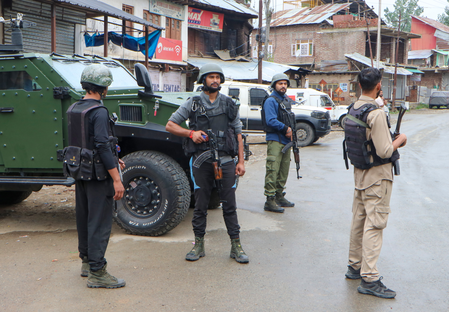
New Delhi, Sep 19 (SocialNews.XYZ) India's counter-terrorism operations have undergone a strategic shift, transitioning from a reactive security apparatus to a pre-emptive, intelligence-driven doctrine aimed at dismantling terror modules before execution, according to senior security officials.
Since coming to power, the Narendra Modi government at the Centre has maintained a zero-tolerance policy towards terrorism. A significant shift has been the move by the security establishment handling terror-related cases towards a more pre-emptive approach, aimed at identifying and neutralising threats before they can materialise.
An official said that recent events relating to terror clearly indicate that the national counter-terrorism strategy policy for Response against Hostile Activities and Radicalism, or PRAHAAR, that was introduced in February this year has already started to take effect.
The official said that the clear directive to the agencies is not to wait for an incident to take place and then react to the same.
“The focus is on preventing terror attacks and ensuring that terror modules do not grow to such an extent that bringing them under control becomes a Herculean task,” the official added.
An Intelligence Bureau official said that this is the same pattern that is being applied across the country, especially in Jammu and Kashmir.
The Inter Services Intelligence (ISI) has been in overdrive mode and plotting big strikes in the Valley. In the last several months, it has tried to work on its overground worker (OWG) network, while also trying its best to get the infiltrations moving. However, the success has been very low thanks to the new doctrine that focuses on busting these plans rather than reacting after something has taken place, the IB official said.
“In the past couple of months, security agencies in Jammu and Kashmir have neutralised terrorists, busted multiple modules and ensured that the overground worker network remains grounded. These have been among the major challenges facing Jammu and Kashmir, and the agencies have ensured that plotting and carrying out terror attacks is now harder than what the ISI may have anticipated,” the official added.
Another official said that while terror attacks remain one part of the problem, the bigger challenge confronting the country is radicalisation. He said the issue is not confined to any particular region but has spread across the country.
Although unconnected, these radicalisation modules have thrived in states such as Maharashtra, Andhra Pradesh, Telangana, Bihar, Delhi, Rajasthan, West Bengal and Kerala, the official said.
The Islamic State, in particular, has focused only on radicalisation and has been largely successful in infiltrating the minds of the youth in a big way.
As the security agencies realised the scale at which the problem was taking place, immediate action was taken, and these modules were busted.
The busting of the pan-India radicalisation module in Andhra Pradesh is an example of how the agencies have been handling such cases. The module was threatening to become a massive problem but was nipped in the bud in the nick of time.
Officials said security agencies no longer wait for terror modules to grow before taking action.
“If intelligence is actionable, the agencies move immediately to disrupt the module and prevent it from developing further,” the officials added.
Similar action was reported in Gujarat when a Jaish-e-Mohammad-linked module was busted. This was a self-styled module that subscribed to the views of the Jaish-e-Mohammad.
The security agencies, after busting this module, found extremist material in large numbers. This module was becoming a ticking time bomb, but was busted just in time. The approach has been the same when it comes to tackling terror and radicalisation from the Bangladesh side.
Multiple attempts made by the Harkat-ul-Jihadi Islami (HuJI) and the Jamaat-ul Mujahideen Bangladesh (JMB) have been thwarted. These groups were looking to target West Bengal and the northeastern states.
An official said that this was an important shift in India’s counter-terrorism and anti-radicalisation strategy.
While PRAHAAR has ensured a pre-emptive, rather than reactive, strategy, it has also ensured seamless integration between the Intelligence agencies, the state police and the central agencies, an official said.
Source: IANS

About Gopi
Gopi Adusumilli is a Programmer. He is the editor of SocialNews.XYZ and President of AGK Fire Inc.
He enjoys designing websites, developing mobile applications and publishing news articles on current events from various authenticated news sources.
When it comes to writing he likes to write about current world politics and Indian Movies. His future plans include developing SocialNews.XYZ into a News website that has no bias or judgment towards any.
He can be reached at gopi@socialnews.xyz