
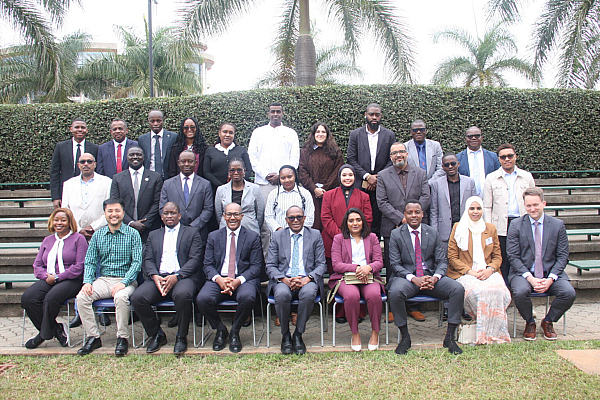
The COMESA Monetary Institute (CMI), in collaboration with the International Monetary Fund (IMF) and the Office for National Statistics (ONS), UK Statistics Authority, conducted a training on Big Data for Macroeconomic Statistics from 31 August to 4 September 2026 in Nairobi, Kenya.
The training was attended by officials from ten (10) COMESA member central banks, namely: Democratic Republic of Congo, Djibouti, Egypt, Eswatini, Kenya, Mauritius, Rwanda, Sudan, Uganda, and Zambia.
Speaking during the opening session, Dr. Lucas Njoroge, Director of the CMI, emphasized the growing importance of big data in supporting evidence-based policymaking. He noted that rapid advancements in digital technologies have increased the availability of high-frequency and non-traditional data sources, including financial transactions, mobile money records, geospatial information, and other digital datasets. These data sources present valuable opportunities to enhance macroeconomic statistics, strengthen policy analysis, and improve decision-making processes within central banks.
The Director underscored the need for central banks to adopt new analytical tools and methodologies to effectively process and utilize large and complex datasets. He highlighted the increasing recognition among COMESA central banks of the strategic value of big data in improving the timeliness, accuracy, and relevance of economic and monetary analysis.
The training aimed to strengthen the capacity of COMESA member central banks to leverage big data sources, particularly transaction data such as mobile money transactions, for monetary and economic analysis. Participants received practical training in the application of data science techniques, management and analysis of unstructured datasets, and the use of innovative analytical tools to generate high-frequency economic indicators. Among the key areas covered were the use of financial transaction data for economic monitoring, processing of satellite imagery and geospatial information, development of Automatic Identification System (AIS)-based trade indicators, and application of the IMF’s PortWatch platform to support economic surveillance and policy analysis.
At the conclusion of the programme, participants reported improved knowledge and skills in leveraging alternative data sources for macroeconomic analysis and exposure to innovative big data tools. The training also provided an important platform for sharing country experiences and lessons learned in the implementation of big data initiatives, fostering greater regional collaboration and supporting convergence in monetary policy implementation across COMESA Member States.
Comments from the participants:
“The training was highly relevant and timely, providing practical insights into the use of big data for macroeconomic statistics and policy analysis.”
“The sessions on mobile money transaction data, satellite imagery, and geospatial analytics enhanced my understanding of alternative data sources for economic monitoring.”
“The hands-on exercises and case studies greatly improved my ability to process and analyze large and unstructured datasets.”
“The training provided valuable exposure to innovative tools such as the IMF PortWatch platform and AIS-based trade indicators, which can support our work in economic surveillance.”
“Interaction with participants from different COMESA central banks enabled useful knowledge sharing and the exchange of best practices.”
“The programme successfully balanced theoretical concepts with practical applications, making the learning experience highly effective.”
Distributed by APO Group on behalf of Common Market for Eastern and Southern Africa (COMESA).
