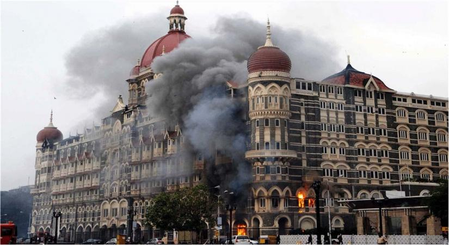
New Delhi, Nov 29 (SocialNews.XYZ) Tracing India's response to terrorism from 26/11 Mumbai terror attacks to Operation Sindoor, reveals that the country which was once largely characterised by defensive measures and diplomatic responses, has now moved towards targeted military operations against terrorist infrastructure across the border, according to a media report.
At the recent Anti-Terror Conference of the National Investigation Agency (NIA), Union Home Minister Amit Shah emphasised the need for a coordinated, whole-of-government approach to dismantle the entire terror ecosystem, including its cross-border handlers, financial networks, organised crime linkages and local facilitators.
Congratulating the police and the armed forces for making the country safer, including for the killing of Latif Bhatt in Jammu and Kashmir, the last known locally active terrorist, Home Minister Shah focused on the importance of preventive action by security forces to thwart terrorist incidents.
According to a report by 'Page 3 news', data from the South Asia Terrorism Portal indicates a substantial reduction in the number of terrorists, security personnel and civilians killed in terror-related incidents over the years.
It noted that if the December 1999 hijacking of Indian Airlines flight IC-814 exposed the "threat" posed by Pakistan-based terrorist organisations to India, the Mumbai attacks marked a "turning point" in the nation's internal security debate.
The 26/11 attacks were a series of coordinated terrorist shootings and bombings in Mumbai from November 26 to 29, 2008, carried out by ten heavily armed members of the Pakistan-based militant group Lashkar-e-Taiba (LeT).
After the Bharatiya Janata Party (BJP)-led government came to power in 2014, the country witnessed a more assertive approach to counter-terrorism, the media report noted.
Referring to the surgical strikes following a terrorist attack on Indian Army's Uri military camp, the report said: "The operation (in Uri) was widely seen as a departure from India's earlier approach, signalling its willingness to undertake targeted military action across the Line of Control in response to major terror attacks."
It also noted that the air strikes against a Jaish-e-Mohammed facility in Pakistan's Balakot, carried out after 40 Central Reserve Police Force (CRPF) personnel were killed in a suicide attack on their convoy in Jammu and Kashmir's Pulwama, reflected further expansion of India's military response to Pakistan-sponsored terrorism.
Operation Sindoor was launched by the Indian armed forces on May 6 and 7, 2025, in retaliation for the Pahalgam terror attack in which 26 innocent people were killed by Pakistan-backed terrorists.
During the operation, Indian forces carried out a series of precision strikes targeting nine high-value terror camps located in the neighbouring country and Pakistan-occupied Kashmir.
'Page 3 news' mentioned that Operation Sindoor demonstrated the "expanded scope of India’s response to major terrorist attacks, extending beyond diplomatic measures and targeted operations along the Line of Control".
Therefore, the report concludes that decline in reported fatalities among civilians and security personnel, together with the increasing use of targeted operations against terrorist infrastructure, "reflects important changes in the security landscape".
However, it cautioned that cross-border terror networks, their support structures and changing methods of operation continues to test India’s security apparatus.
Source: IANS
Gopi Adusumilli is a Programmer. He is the editor of SocialNews.XYZ and President of AGK Fire Inc.
He enjoys designing websites, developing mobile applications and publishing news articles on current events from various authenticated news sources.
When it comes to writing he likes to write about current world politics and Indian Movies. His future plans include developing SocialNews.XYZ into a News website that has no bias or judgment towards any.
He can be reached at gopi@socialnews.xyz
This website uses cookies.


