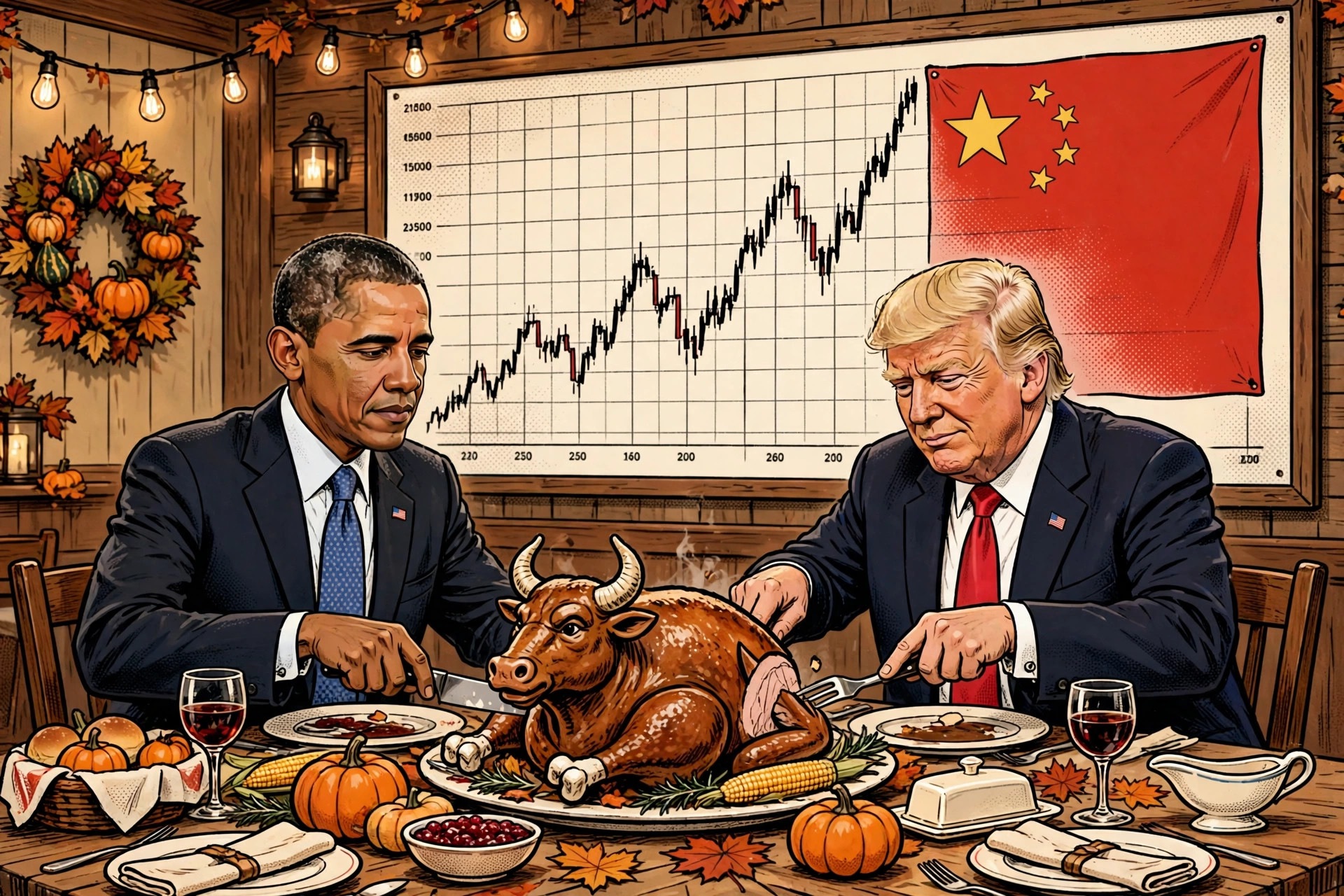
The 2008 rescue was sold as a one-time emergency. Eighteen years later, Washington owns pieces of 41 companies — and the president's office is picking winners.
Here is the irony of American politics in one sentence: a Democratic president taught Washington to bail out Wall Street, and a Republican president is now teaching Washington to own Wall Street.
It started in the fall of 2008. The financial system was collapsing, and Washington decided that some firms could not be allowed to fail. Congress authorized a $700 billion rescue fund. The government took stakes in banks, rescued the insurer AIG, and — under the Obama administration that inherited the crisis — rescued General Motors and Chrysler.
The promise, every time, was the same: this is a one-time emergency. The government would get in, stabilize the patient, and get out. And to Washington's credit, it mostly did get out. The bank stakes were sold. The government exited GM and AIG. The rescues were wound down.
But the market learned a different lesson than the one Washington thought it was teaching.
The lesson was not "never again." It was "be big enough, and the government will catch you."
That is how a desperate, one-time move became a permanent feature of American finance. The banks that were too big to fail in 2008 are bigger today. Traders learned to gamble with the downside insured by the taxpayer. Risk stopped being risk when the people taking it knew the bill would never land on their desk. A generation of gamblers grew up believing they were too big to fail — because, for eighteen years, they have been right.
Every president since has talked about ending too-big-to-fail. None of them did. The precedent was too useful, and the next crisis was always someone else's problem.
What is happening now is different in kind, not just in degree. The Trump administration is not rescuing companies in a crisis. It is buying into them in the normal course of business — and doing it in public, deal by deal, negotiated by the president himself.
In August 2025, the government took a 10 percent stake in Intel, worth $8.9 billion, converting grants Congress had authorized under the CHIPS Act into ownership Congress never voted for. Washington is now Intel's largest single shareholder.
In July, the Pentagon took a $400 million equity position in MP Materials, the rare-earths miner, becoming its largest shareholder, with warrants that could take the government's stake to 15 percent.
In June, the administration let Japan's Nippon Steel buy U.S. Steel only in exchange for a "golden share" — a special share that gives the president veto power over the company's decisions, from plant closures to executive pay to the company's name. Three months later, the president used it, blocking U.S. Steel from idling a plant in Granite City, Illinois.
Nvidia and AMD were told they could sell advanced chips to China again only if the government took 15 percent of the revenue. By December, the price for the more powerful H200 chip had risen to 25 percent.
Commerce Secretary Howard Lutnick has said similar deals may be coming, specifically naming defense companies.
The Cato Institute, which tracks the federal government's equity portfolio, counted 14 companies in it in January 2026. By November, it counted 41 — in semiconductors, minerals, steel, drones, quantum computing, energy, and rocket motors. Forty-one companies, in under two years, with no act of Congress authorizing a national equity portfolio and no public debate about whether the United States should have one.
This is what state capitalism looks like. It does not arrive with a manifesto. It arrives as a portfolio.
In China, the state holds the commanding heights of the economy, party committees sit inside private companies, government funds direct capital to favored firms, and officials can veto a plant closure or a merger. The American version is arriving with a different flag and the same mechanics: the government as shareholder, the government as veto, the government as the counterparty every CEO must please.
The difference between the two systems was never that China intervened and America didn't. America intervened in 2008, in an emergency, and told itself it would stop. The difference was that the intervention was supposed to end. What we are watching now is the end of the ending.
Free markets do not die in a crash. They die in a portfolio — one stake, one golden share, one revenue cut at a time. The market that made America rich was the one nobody in Washington owned. The question this Thanksgiving is whether it survives being owned.
Happy Thanksgiving, America.
An Indo-American News website. It covers Gossips, Politics, Movies, Technolgy, and Sports News and Photo Galleries and Live Coverage of Events via Youtube. The website is established in 2015 and is owned by AGK FIRE INC.
This website uses cookies.



