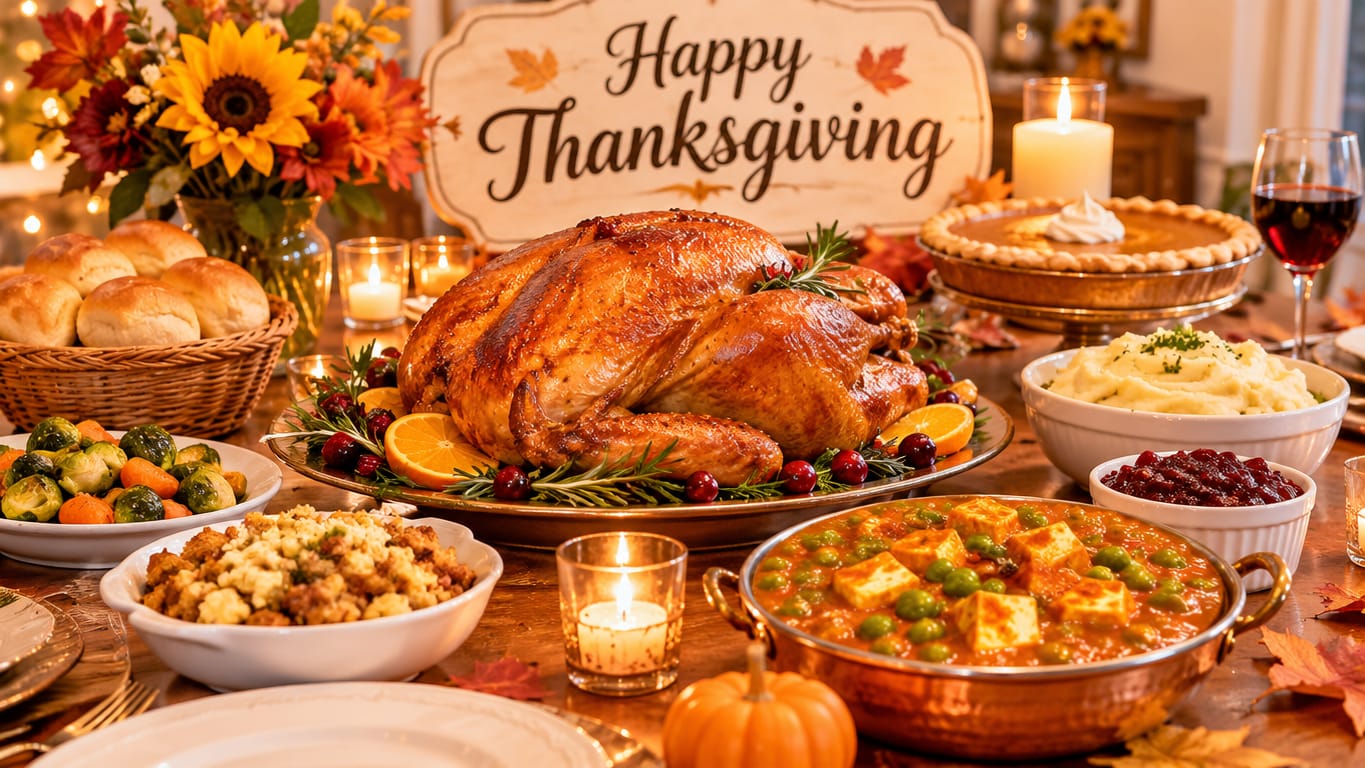
Washington, Nov 24 (SocialNews.XYZ) Turkey cooked with Indian spices, cranberry sauce alongside matar paneer, and volunteers preparing meals for people in need, Indian American accounts of Thanksgiving describe a holiday adapted through food, family and service.
As the United States prepares to celebrate Thanksgiving on Thursday, November 26, temple gatherings and community food drives offer places to share a meal beyond the family dining table.
ISKCON of Houston has announced its annual Thanksgiving feast for November 26 and says everyone is invited. In Brooklyn, ISKCON of New York City is organising a Thanksgiving dinner at Govinda’s that evening, with a menu including quinoa pulao, baked paneer kebab, vegetable quiche and cheesecake. Its proceeds will support a book-distribution campaign.
In Jersey City, volunteers gathered on November 14 to prepare meals through Let’s Share a Meal. The organisation listed the gathering as its annual Thanksgiving and Guru Nanak Dev Ji seva drive.
The New Jersey nonprofit describes its work as rooted in the Sikh traditions of seva, or selfless service, and langar, a communal kitchen open to all. Its volunteers prepare and distribute food to people in need.
At home, adapting the holiday has sometimes begun with learning how to cook an unfamiliar bird.
In an account published on journalist Lavina Melwani’s website in 2016, Shirley Khemlani recalled preparing her first turkey after moving to New York in 1979.
“I’d never seen that kind of a bird and the size really intimidated me,” she said, explaining that she sought recipes from neighbours.
Sunita Advaney, interviewed in the same account, recalled asking her immigrant parents about Thanksgiving when she was seven. Her father bought a bird and the accompaniments, beginning a family tradition.
Years later, when she learned to cook, the family prepared two turkeys: one traditional and another coated with tandoori spices and stuffed with biryani and boiled eggs.
The same report described Meena Patel’s accommodation of different preferences in her Gujarati family: she prepared a vegetarian spread and asked her non-vegetarian sister-in-law to bring a turkey for the children who wanted one.
Chefs have experimented with similar combinations.
In a 2019 interview with The Splendid Table, Maneet Chauhan described a Thanksgiving restaurant menu that grew from Nashville’s familiar combination of meat and three side dishes into “Thanksgiving meat and nine”.
Her menu included turkey tikka masala, a paneer alternative, vegetable pulao-biryani stuffing, cranberry five-spice chutney and sweet potato raita.
Chauhan also recalled her first Thanksgiving in the United States, when a faculty member invited students unable to travel home to join a family meal. The hospitality remained part of her understanding of the holiday.
For food writer Priya Krishna’s family, cranberry sauce found a place alongside Indian vegetarian dishes.
In a 2018 Bon Appétit essay, Krishna described a Thanksgiving spread featuring matar paneer, squash, chickpeas and puri. Her mother recognised cranberry sauce’s resemblance to chutney, and it became a fixture at the table. Krishna wrote that she saw no need to add Indian spices to make it belong.
The holiday’s American history also carries different meanings.
George Washington designated November 26 as a day of thanksgiving in 1789. Abraham Lincoln proclaimed an observance on the last Thursday of November in 1863. Congress established the fourth Thursday as the federal holiday in legislation signed by President Franklin D. Roosevelt in December 1941.
For some Indigenous Americans, Thanksgiving is also a day to remember dispossession and violence. Native Americans and others have gathered in Plymouth, Massachusetts, for a National Day of Mourning since 1970, according to Pilgrim Hall Museum.
The Smithsonian’s National Museum of the American Indian encourages teaching that includes Wampanoag perspectives often missing from familiar accounts of the “first Thanksgiving”.
For the families described in the food accounts, participation has allowed room for different traditions and dietary choices. This Thursday’s advertised temple menus reflect that flexibility: in Brooklyn, paneer kebab and quinoa pulao will share a Thanksgiving table with vegetable quiche and cheesecake.
Source: IANS
Gopi Adusumilli is a Programmer. He is the editor of SocialNews.XYZ and President of AGK Fire Inc.
He enjoys designing websites, developing mobile applications and publishing news articles on current events from various authenticated news sources.
When it comes to writing he likes to write about current world politics and Indian Movies. His future plans include developing SocialNews.XYZ into a News website that has no bias or judgment towards any.
He can be reached at gopi@socialnews.xyz
This website uses cookies.


