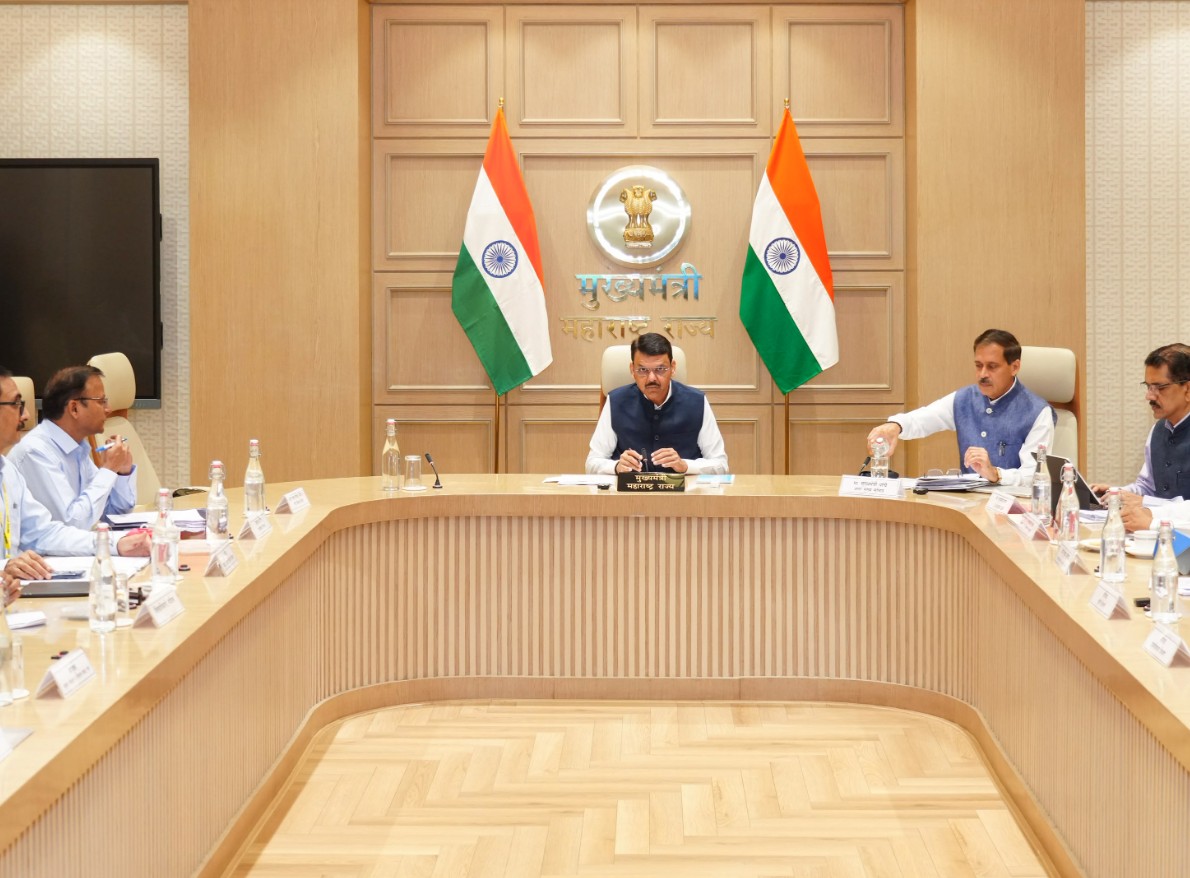
Mumbai, Nov 19 (SocialNews.XYZ) Maharashtra Chief Minister Devendra Fadnavis on Thursday said that the state government has formulated a comprehensive action plan to raise groundwater levels by percolating every drop of rainwater into the soil, rejuvenating old water conservation structures, and building new ones.
Under the Central Government’s Jal Sanchay: Jan Bhagidari campaign, the state will complete the construction of 34,83,940 groundwater recharge structures by May 2027.
The CM directed all departments to work in coordination and meet the stipulated targets within the deadline. The directives were issued during a high-level review meeting on the implementation of the Jal Shakti Abhiyan (Jal Sanchay: Jan Bhagidari 3.0) chaired via video conferencing by Union Jal Shakti Minister C R Patil.
Addressing the meeting, CM Fadnavis noted that Maharashtra is facing a severe drought crisis triggered by the El Niño effect, with nearly 90 percent of the state reeling under drought conditions and suffering substantial crop losses.
Anticipating a surge in drinking water demand in the coming months, the state is prioritising water conservation to turn this crisis into an opportunity—focusing heavily on rejuvenating old water bodies, repairing lakes, and constructing farm ponds and recharge pits.
CM Fadnavis said that the state government will launch the third phase of its flagship Jalyukt Shivar scheme across 18,000 selected villages. To maximise effectiveness, funds and works from Jalyukt Shivar 3.0, the Pradhan Mantri Krishi Sinchayee Yojana (PMKSY), MGNREGA, and other schemes will be converged.
CM Fadnavis stated that these projects will undergo scientific planning, mapping, and on-ground execution. The CM directed that all departments—including Rural Development, Forest, Public Works (PWD), Urban Development, Agriculture, and Water Supply—will operate under the leadership of District Collectors.
The forest department will be responsible for the construction of forest check dams (vanbandhare) and forest ponds (vantale). The public work and urban development departments have been assigned the work to implement rooftop rainwater harvesting systems across private residences and government buildings.
Further, the government will focus on the revival of seasonal rivers stretching 50 kilometers or more that flow only during the monsoon and remain dry for the rest of the year.
In light of the prevailing drought, CM Fadnavis urged the Centre to go beyond existing norms and provide special financial assistance to Maharashtra for repairing existing structures and creating new farm ponds and recharge pits.
Reviewing the Jal Jeevan Mission, the Chief Minister acknowledged that fund utilisation has been slower than expected and announced instructions to raise expenditure to 50 percent by December. To ensure the long-term sustainability of the mission, the state is focusing on two critical pillars: securing reliable water sources and ensuring the timely payment of electricity bills. He also proposed a joint Centre-state meeting to study state-specific challenges, noting that a "one-size-fits-all" approach cannot resolve localised hurdles.
Furthermore, the state plans to channel local area development funds from public representatives into water conservation and organise state-level awards and competitions—similar to Jalyukt Shivar and the Water Cup—to foster healthy competition and mass public participation. Progress towards the May 2027 deadline will be regularly monitored by the Chief Secretary, Additional Chief Secretaries, and respective department heads.
Union Jal Shakti Minister C R Patil emphasised realising Prime Minister Narendra Modi’s vision of trapping village water within the village and farm water within the farm through public participation. He urged officials to pair community involvement with scientific methodologies and technical guidance. "If every citizen undertakes small water conservation measures in their homes and farms, it can lead to a massive rise in groundwater levels," he said.
He recommended partnering with premier technical institutions like the IITs for proper design, technical guidance, and training to ensure rainwater is stored for year-round use. He also instructed officers to personally intervene to clear implementation bottlenecks while maintaining continuous focus on sanitation and toilet construction.
Source: IANS
Gopi Adusumilli is a Programmer. He is the editor of SocialNews.XYZ and President of AGK Fire Inc.
He enjoys designing websites, developing mobile applications and publishing news articles on current events from various authenticated news sources.
When it comes to writing he likes to write about current world politics and Indian Movies. His future plans include developing SocialNews.XYZ into a News website that has no bias or judgment towards any.
He can be reached at gopi@socialnews.xyz
This website uses cookies.

