New Delhi, Nov 19 (SocialNews.XYZ) Droppings of the Himalayan marmot could provide valuable information about environmental conditions in the higher Himalayas and help scientists understand the impacts of climate change on fragile alpine ecosystems, an official statement said on Thursday about a study conducted by an autonomous institute of the Department of Science and Technology.
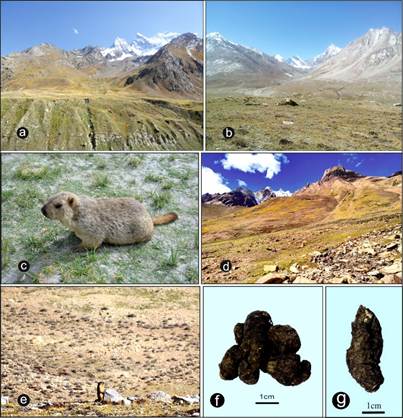
Researchers from the Birbal Sahni Institute of Palaeosciences (BSIP) studied pollen grains, fungal spores and elemental signatures preserved in the faeces of the Himalayan marmot (Marmota himalayana), an herbivorous mammal that inhabits high-altitude cold dry regions of the Himalayas, the statement from Ministry of Science & Technology said.
"Based on the generated data, it was found that the Himalayan marmot could be a strong indicator species for understanding vegetation and climate changes in the higher Himalaya," the statement noted.
This study also confirmed that changes in the habitat of marmots can indicate shifts in altitude in relation to changing environmental conditions. This combination of pollen, fungal spores and elemental analysis provides a valuable modern reference for future palaeoecological and coprolite studies.
The study published in PLOS ONE would serve as a modern reference for reconstructing past ecological change and assessing potential impacts of climate change, the statement said.
The findings may also help with biodiversity conservation by improving understanding of marmot habitat requirements and informing conservation strategies for associated wildlife, including the snow leopard, for which marmots are an important prey species.
It can also contribute to environmental monitoring, climate research and sustainable management of fragile Himalayan ecosystems, the statement noted.
The study identified pollen grains and fungal spores preserved in faeces through palynological analysis. It also used statistical methods for comparing samples from two Himalayan regions and Field Emission Scanning Electron Microscopy coupled with Energy-Dispersive X-ray Spectroscopy (FESEM–EDS) to identify elemental composition.
—IANS
aar/pk
Source: IANS
Gopi Adusumilli is a Programmer. He is the editor of SocialNews.XYZ and President of AGK Fire Inc.
He enjoys designing websites, developing mobile applications and publishing news articles on current events from various authenticated news sources.
When it comes to writing he likes to write about current world politics and Indian Movies. His future plans include developing SocialNews.XYZ into a News website that has no bias or judgment towards any.
He can be reached at gopi@socialnews.xyz
This website uses cookies.

