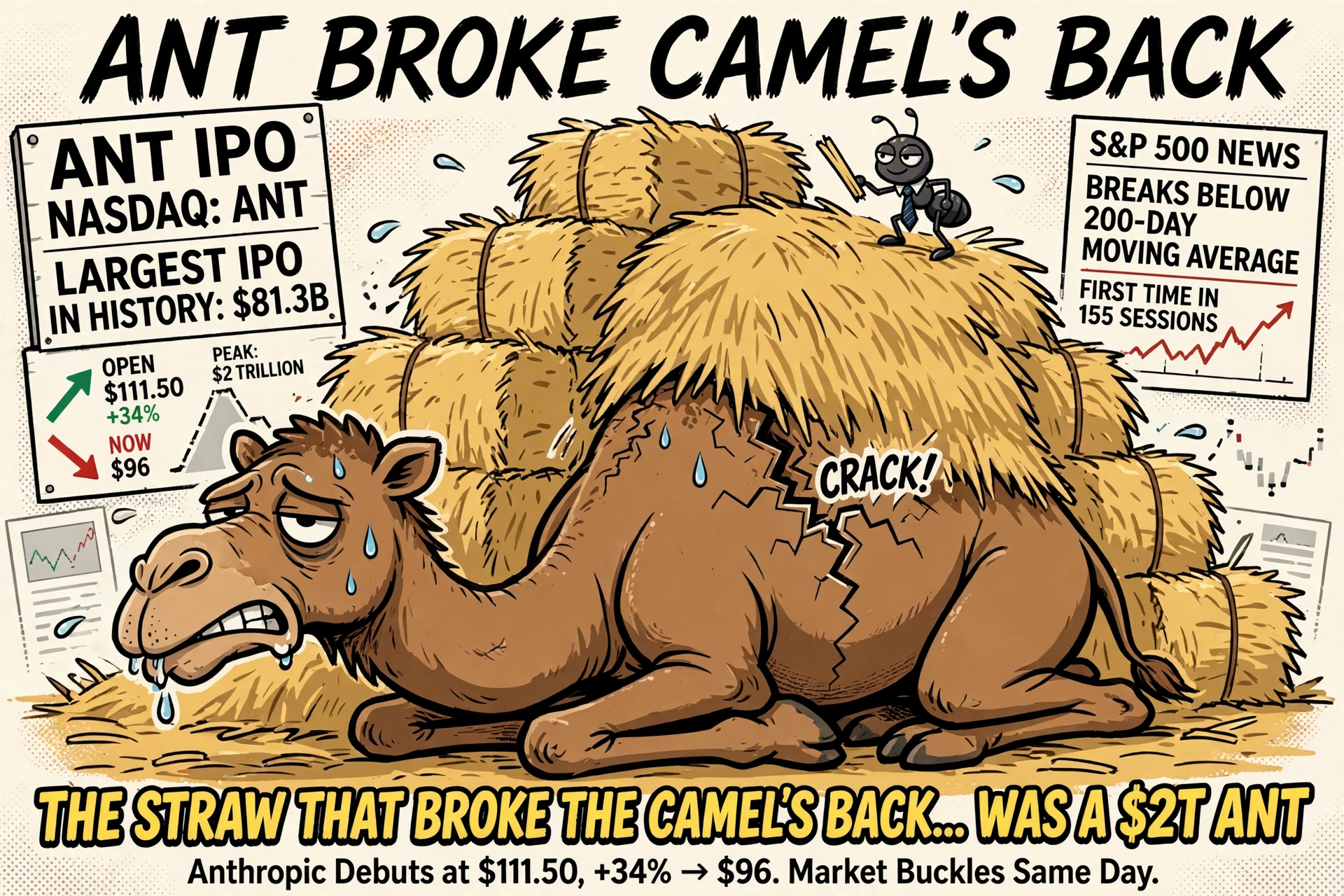
The biggest IPO in history arrived the week the market's spine gave way — and even its 34% debut pop couldn't hold.
On Thursday morning, Anthropic did what no company has ever done. The maker of the Claude chatbot priced the largest initial public offering in history — $81.3 billion, 980 million shares at $83 apiece — and then opened on the Nasdaq at $111.50, up 34.3% in minutes, briefly valuing the company at around $2 trillion. Dario and Daniela Amodei rang the bell. The world's first publicly traded frontier AI company had arrived.
By early afternoon, the stock was trading near $96.
That fade is the story. Not the pop — the fade. Because Anthropic's debut did not land on a strong market. It landed on a market whose back had just broken.
Two days before ANT started trading, on Tuesday, November 17, the S&P 500 closed at 7,340.53 — below its 200-day moving average of roughly 7,345. It was the first close below that line since April 7, ending 155 straight sessions above it: the longest stretch of calm the index had enjoyed in years. On Wednesday, the index closed below it again, at 7,323.63, down 0.23% for a fifth straight loss.
The sequence matters, and it is worth getting right: the break came on the 17th, Anthropic priced on the 18th, and the stock traded on the 19th. The IPO did not cause the break. It was the last straw on a camel that was already loaded — and the fact that the biggest offering in history could not hold its own opening pop on its first day is what makes the timing more than a coincidence.
A camel's back does not break from one straw. It breaks from the load. And the load this autumn was extraordinary.
First, the AI funding machine itself. Anthropic's own numbers tell the story: $33.2 billion of revenue in the first nine months of 2026, roughly thirteen times the year before, an $81 billion run rate — and $895 billion of committed compute spending against it, with a nine-month net loss of $104 billion driven mostly by the changing value of convertible securities. Alongside the IPO, the company raised a further $26 billion in a concurrent private placement — from Nvidia, Alphabet, AMD, Broadcom, Micron, Microsoft and TSMC. Its own chip suppliers bought the stock at the IPO price. The Federal Reserve's own staff, in the minutes released Wednesday, flagged exactly this pattern — AI-related debt, off-balance-sheet leasing and circular financing — as a financial-stability vulnerability.
Second, the market had stopped rewarding good news. On Tuesday, Nvidia reported $115.8 billion of quarterly revenue, up 103% year over year, beating expectations by roughly $7 billion. The stock fell 2.89% the next day. When the best quarter in the company's history gets sold, the rally is running on fumes.
Third, the Fed. Wednesday's minutes were hawkish — almost all officials expect more rate rises, with traders pricing roughly a 91% chance of a December hike. The 10-year Treasury yield stood at 5.07%. The market spent the year assuming cheaper money was coming. It is not.
Any one of these is a straw. Together, they are the load. And then the biggest IPO in history arrived, priced above its range, upsized, seven times oversubscribed according to Bloomberg — the purest possible expression of the exuberance that built the load in the first place.
That is what a last straw looks like. Not a disaster — a coronation. The AI trade's defining company, listing at the defining moment, at the defining price, and the market could not even hold the celebration through the afternoon. ANT opened at $111.50, touched $114.99 within minutes, and slid to $95.05 within the hour. It was still up roughly 15% on its IPO price by early afternoon, and nothing about the company had changed between noon and one o'clock. What changed was the market's willingness to pay up for the story.
The 200-day moving average is not magic. It is a line on a chart, and technicians will tell you that breaks of it after long stretches above have often been followed by stronger-than-average returns — strategist Ryan Detrick counts 34 prior cases of a break after 150 or more sessions above, and forward returns ran better than average after them. That is the honest counterpoint, and it matters: as of Wednesday's close, the index was 6.3% below its October 6 record of 7,818.93. That is a correction, not a crash. If it falls further, the next target analysts are watching is 7,000 to 7,100 — right around the January high of 6,978.60, the level the market held before the war in Iran began in February.
But a spine is still a spine. For 155 sessions, every dip found a buyer above that line. Then, in the week the most anticipated listing in history arrived, the buyers stopped. The camel did not fall because of Anthropic. It fell because it could no longer carry the weight of its own story — and Anthropic's arrival, with its $2 trillion valuation and its $895 billion of promised spending, was the moment the weight became visible.
Three things now decide whether this was a break or a blip. Whether the S&P 500 reclaims its 200-day average in the coming sessions — a quick reclaim would make this a footnote. Whether ANT holds above its $83 IPO price in its first weeks — a slide below it would say the public market has repriced the AI trade. And whether the Federal Reserve follows through on December 9, when it is next expected to raise rates.
The camel's back broke on a Tuesday. The world found out on a Thursday, when the biggest IPO ever opened up 34% — and then gave half of it back before lunch.
An Indo-American News website. It covers Gossips, Politics, Movies, Technolgy, and Sports News and Photo Galleries and Live Coverage of Events via Youtube. The website is established in 2015 and is owned by AGK FIRE INC.
This website uses cookies.


