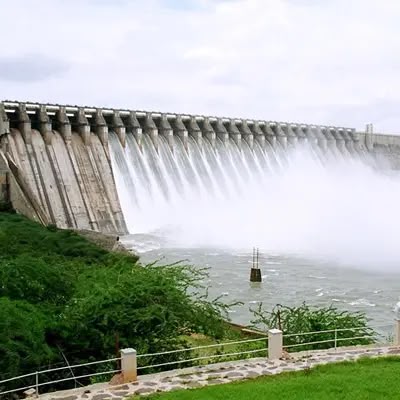
Mumbai, Nov 18 (SocialNews.XYZ) Maharashtra's live water storage in dams has fallen sharply to 923.60 TMC, or 64 per cent of capacity, as of November 17, compared to 1,309.93 TMC (90 per cent) during the corresponding period last year, raising concerns over water availability during the upcoming rabi season and summer months, according to a presentation by the state's Water Resources Department before the Cabinet.
The department clarified that live storage is usable storage, excluding dead storage below the outlet level. The department's presentation is crucial when the state government has declared drought in 304 talukas. The government is also in the process of implementing a series of mitigation measures.
Marathwada is worst hit. The Chhatrapati Sambhajinagar division — covering Marathwada — has seen the steepest collapse, from 90 per cent to just 36 per cent. Amravati (52 per cent) and Nagpur (56 per cent) are also well below last year.
Konkan (81 per cent), Pune (75 per cent) and Nashik (74 per cent) remain comparatively better, but all six divisions are below last year's level.
In the case of Mumbai and Thane Municipal Corporations, supply is at 84 per cent, down from 95 per cent last year. Modak Sagar dam is the major concern at 46 per cent, down 35 percentage points. Upper Vaitarna remains strongest at 94 per cent.
According to the presentation, there is statewide stress. At 64 per cent, Maharashtra enters the rabi season and summer months with over one-third of its live storage capacity empty, compared to only 10 per cent empty last year. Marathwada (Chhatrapati Sambhajinagar division) is in a critical situation at 36 per cent, with Beed, Dharashiv, Jalna, Latur, Parbhani and Solapur districts showing single-digit storage in small and medium dams. Minor projects, which sustain villages, are at 38 per cent. This points to pressure on local drinking water and rabi irrigation in the coming months.
Cities are relatively safer but lower. Pune, Nashik and Konkan divisions and the Mumbai-Thane system remain above 74 per cent, but all are 11-17 percentage points below last year.
Earlier, the state administration decentralised administrative powers, fast-tracked water and soil conservation projects, prioritised fodder availability for livestock, and set up district and taluka-level coordination committees.
The government has already declared drought in 304 talukas in the wake of deficit rainfall. For water conservation & infrastructure development, the administrative deadlines for works under the District Annual Plan (General) for 2026–27 have been extended, allowing administrative sanctions up to November 30, 2026.
Chief Secretary directives have empowered local secretaries and District Collectors to expedite technical sanctions. Under the MLA Local Area Development (LAD) program, District Collectors are authorised to sanction drought and water scarcity works up to Rs 25 lakh per project in rural and urban areas. Members of Parliament (MPs) have also been requested to recommend priority works under the MP LAD program.
In 304 talukas facing Trigger-1 and Trigger-2 conditions, soil and water conservation works -- including deepening and widening streams, building farm ponds, constructing recharge shafts, installing check dam gates, and creating rainwater harvesting structures -- are being executed via NGOs and through the VB G RAM G scheme.
Source: IANS
Gopi Adusumilli is a Programmer. He is the editor of SocialNews.XYZ and President of AGK Fire Inc.
He enjoys designing websites, developing mobile applications and publishing news articles on current events from various authenticated news sources.
When it comes to writing he likes to write about current world politics and Indian Movies. His future plans include developing SocialNews.XYZ into a News website that has no bias or judgment towards any.
He can be reached at gopi@socialnews.xyz
This website uses cookies.

