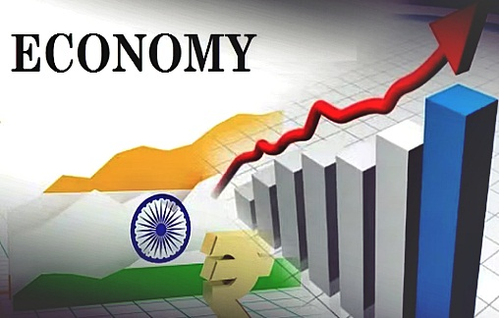
New Delhi, Nov 17 (SocialNews.XYZ) Between 2014 and 2026, India's economy has moved from being labelled as one of the "Fragile Five" emerging markets to becoming the world's fourth-largest economy by nominal GDP, and consistently the world’s fastest-growing major economy, according to a new report.
This transformation has been underpinned by a distinctive policy architecture — the JAM trinity (Jan Dhan–Aadhaar– Mobile), Direct Benefit Transfer (DBT), the Unified Payments Interface (UPI), Demonetisation, Make in India, and an unprecedented public infrastructure build-out — layered on top of a series of large-scale welfare and beneficiary schemes, and reinforced by structural reforms including the Insolvency and Bankruptcy Code, the Goods and Services Tax, and a 79-place jump in the World Bank's Ease of Doing Business ranking, according to a paper published in Global Outlook.
The same period has seen India's capital markets become the world's fourth-largest by market capitalisation and its startup ecosystem become the world's third-largest by unicorn count — independent, market-generated evidence that this reform architecture has translated into private capital formation, not government schemes alone, the paper authored by Sourav Chakraborty states.
The paper traces the development, benchmarks India's rise against the UK, Japan, and Germany, and examines the resilience of Indian growth through COVID-19 and subsequent global turmoil. It argues the phrase "Hindu Rate of Growth", coined by economist Raj Krishna in 1978 for slow growth of about 3.5 per cent in the pre-liberalistaion period, should be reclaimed rather than retired, and lists the benchmarks still ahead, from overtaking Germany to a $55 trillion economy by 2047.
Raj Krishna's phrase captured a specific, measurable reality of its era: roughly 3.5 per cent average annual GDP growth sustained across the 1950s–1980s, a rate below population growth in per-capita terms, produced by a licensing regime that rationed capacity, capital, and enterprise rather than allocating them by market signal, the paper states.
That reality no longer exists, and neither does the identity it implied — an economy defined by scarcity, bureaucratic gatekeeping, and stagnation. The India of 2014–2026 has averaged growth close to double Krishna's benchmark even through a global pandemic, has climbed from the 11th- to the 4th-largest economy in nominal terms in little over a decade, and has built, in UPI, a payments architecture that now clears more real-time transactions than any other nation on earth. These are not incidental statistics; they are the raw material of a new national economic identity — one defined by scale, formalisation, and digital infrastructure rather than by rationing and delay, the paper explains, the paper further states.
Economist M. Govinda Rao has described India's necessary transformation as one "from the lumbering elephant to a charging tiger." The paper adopts this phrase as a fitting shorthand for what "reclamation" means in practice, taking the same reform architecture (JAM, DBT, UPI, IBC, GST) as the mechanism by which the charge is being made.
Source: IANS
Gopi Adusumilli is a Programmer. He is the editor of SocialNews.XYZ and President of AGK Fire Inc.
He enjoys designing websites, developing mobile applications and publishing news articles on current events from various authenticated news sources.
When it comes to writing he likes to write about current world politics and Indian Movies. His future plans include developing SocialNews.XYZ into a News website that has no bias or judgment towards any.
He can be reached at gopi@socialnews.xyz
This website uses cookies.


