[category Top, Main Story, Finance]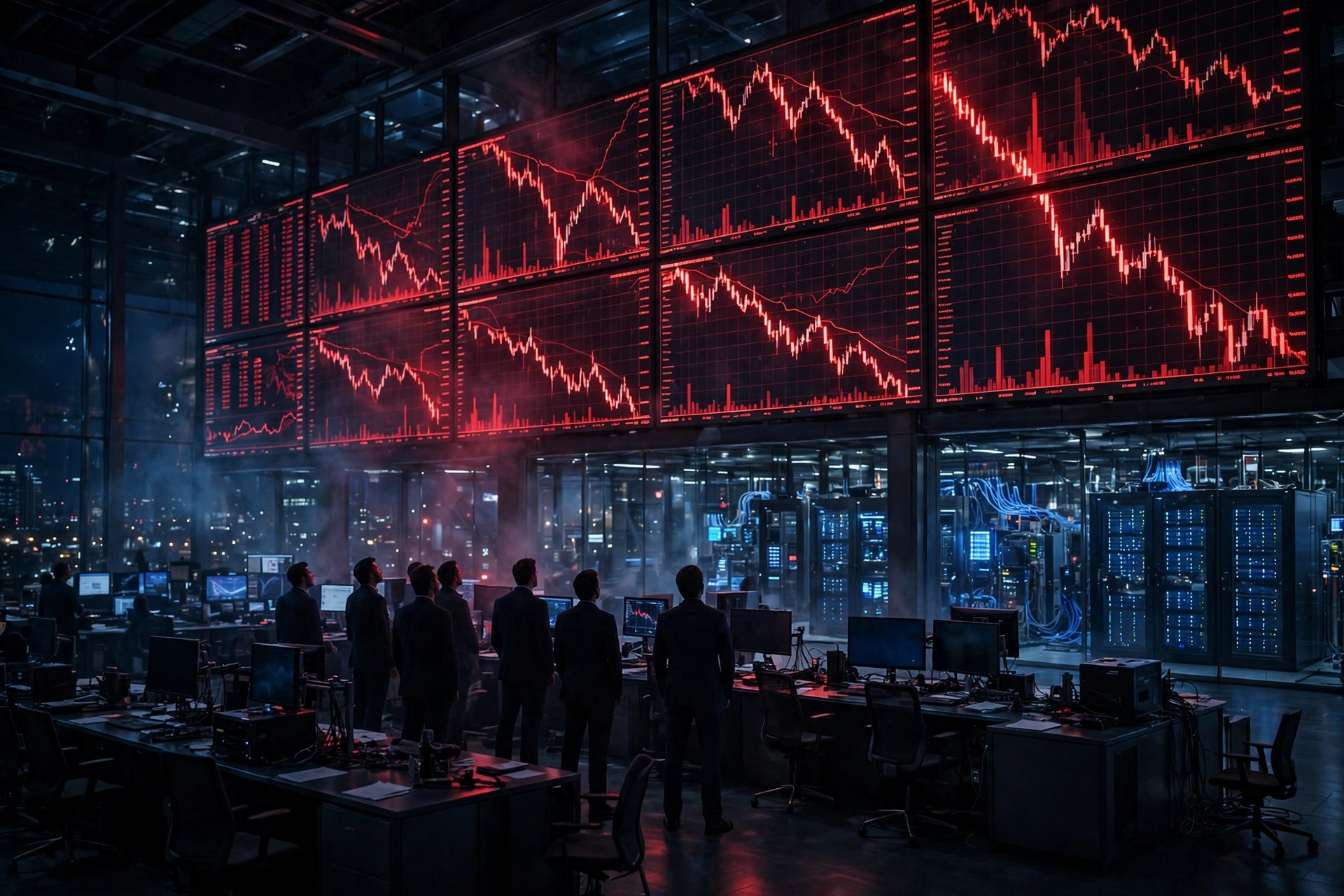
New York, November 6, 2026 — Wall Street got a live preview on Thursday. The Nasdaq plunged 5.52 percent, the S&P 500 fell 4.36 percent, and the Dow dropped 3.44 percent, wiping roughly $2.5 trillion off the Nasdaq and $2.9 trillion off the S&P 500 in a single session.
The trigger was not a bad earnings report or a Federal Reserve surprise. It was a reassessment of the artificial intelligence trade itself — the bet that has carried the US stock market for more than a year.
Investors are now asking a question that was easy to ignore while prices were rising: if the AI trade crashes, is the rest of the market safe?
The short answer is no — and Thursday showed why.
The so-called Magnificent Seven — Nvidia, Apple, Microsoft, Alphabet, Amazon, Meta and Tesla — now account for about one-third of the S&P 500. Their combined market value was nearly $24 trillion in August, about 34 percent of the index's roughly $70 trillion total. As of November 5, that share stood at 33.2 percent.
The top 10 stocks in the index make up about 40.4 percent. The other three are Broadcom, Micron and AMD — all AI names as well.
That concentration turns a sector sell-off into a market sell-off through simple arithmetic:
Those figures are before any spillover. Add the wider AI complex — chipmakers, memory suppliers, cloud infrastructure companies and power providers — and a 30 percent fall in AI stocks could easily translate into a 12 to 15 percent fall in the S&P 500.
That is a correction turning into a bear market, driven by one trade.
The Philadelphia Semiconductor Index fell 12.25 percent on Thursday, its biggest drop since March 16, 2020, during the Covid-19 market crash. Nvidia fell 9.26 percent, Broadcom 10.43 percent, AMD 17.26 percent and Micron 17.46 percent.
But the damage did not stop there. All 11 sectors of the S&P 500 closed lower. JPMorgan fell 4.19 percent, Walmart 1.12 percent and Chevron 1.86 percent. Bitcoin dropped 6 percent to $75,000. The VIX, Wall Street's fear gauge, spiked to 28.09 intraday, its highest since late March.
South Korea's Kospi plunged almost 9 percent at the open on Friday, triggering a 20-minute trading halt, after Samsung and SK Hynix were dragged down by the same fears.
The Nasdaq is now down as much as 14 percent from its all-time high reached only a month ago, and firmly in correction territory.
Behind the stock prices sits a spending boom of extraordinary scale. Amazon, Microsoft, Alphabet and Meta are committing a combined roughly $730 billion to AI infrastructure in 2026, up 78 percent from about $410 billion in 2025.
Amazon is guiding to about $220 billion in capital expenditure this year. Alphabet is guiding to $195 billion to $205 billion. Microsoft is guiding to about $175 billion. Meta is committing $130 billion to $145 billion.
That money flows to Nvidia, whose data-centre revenue grew from $15 billion in fiscal 2023 to $115 billion in fiscal 2025, and on to TSMC, Micron, SK Hynix, power utilities and data-centre construction. US data-centre construction spending hit a record $75.2 billion annualised rate in July 2026. AI spending now represents roughly 8 percent of US GDP, according to Bloomberg.
That is why analysts draw a sharp line between two kinds of crash.
A price crash with spending intact would be painful for portfolios and retirement accounts, and would dent consumer confidence through the wealth effect, but the economy would keep growing.
A spending crash is different. If the hyperscalers cut the $700 billion-plus buildout, Nvidia, AMD and Micron earnings would collapse, construction and power orders would dry up, and the debt taken on to fund the buildout would become a problem. That is the scenario in which a market correction becomes an economic slowdown.
Thursday's selling was driven by fear of the second scenario. Investors began positioning for a slower data-centre build-out after Democrats swept key midterm races, including the Texas governorship, raising the prospect of tougher rules on data-centre projects. Wall Street expects at least 10 to 15 gigawatts of planned AI data-centre capacity could be left idle next year.
The most exposed assets are the Nasdaq-100, chip and memory stocks, the so-called neoclouds that rent out computing power — CoreWeave fell about 10 percent and Nebius about 15 percent on Thursday — and markets in Korea and Taiwan that supply the AI chain.
Relatively less exposed are the equal-weight S&P 500, consumer staples, healthcare, utilities and value stocks that never took part in the AI rally. Over the three months to late August, the equal-weight index rose 6 percent while the Magnificent Seven fell 3 percent.
Even those stocks fell on Thursday, however, as contagion, margin calls and risk-off selling hit everything at once.
History offers two reference points. In the dot-com bust, the Nasdaq fell about 78 percent from peak to trough and the S&P 500 about 49 percent. In 2022, a milder technology de-rating took the Nasdaq down 33 percent and the S&P 500 down 19 percent.
A 2026 AI crash would likely land between those two for the S&P 500 — unless capital spending holds. If it does, the episode looks more like the sharp corrections in March and July this year, when the Nasdaq fell into correction territory and then reclaimed record highs.
The market's fate, in other words, does not depend mainly on stock prices. It depends on whether the $700 billion-a-year spending machine behind them keeps running.
Sources: Reuters, CNN, The Wall Street Journal, Charles Schwab, company earnings guidance.
An Indo-American News website. It covers Gossips, Politics, Movies, Technolgy, and Sports News and Photo Galleries and Live Coverage of Events via Youtube. The website is established in 2015 and is owned by AGK FIRE INC.
This website uses cookies.



