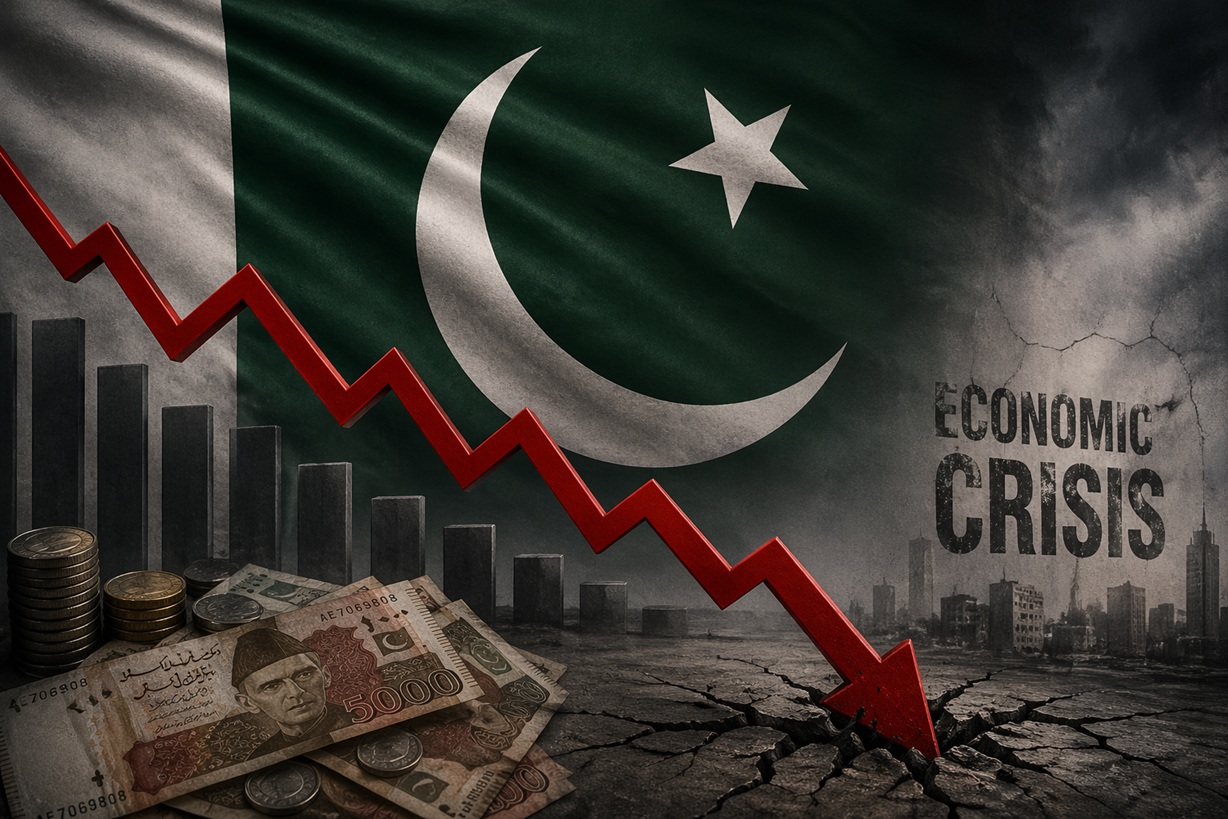
New Delhi, Nov 5 (SocialNews.XYZ) Pakistan's recurring currency devaluations have failed to produce lasting improvements in exports and economic performance because the country's deeper structural problems remain unresolved, according to a report.
An analysis by The Friday Times argues exchange rate adjustments alone cannot fix underlying economic weaknesses.
It describes Pakistan's economy as a vehicle whose performance depends on four key pillars: macroeconomic stability, foreign exchange flows, governance and economic freedom, and productivity and competitiveness.
Persistent fiscal deficits, high inflation, excessive government borrowing and weak tax collection have undermined economic stability and placed continuing pressure on the rupee.
At the same time, weaknesses in exports, investment and foreign exchange generation have limited the benefits typically expected from a weaker currency.
According to the report, the country’s dependence on imported fuel, machinery and industrial inputs reduces the effectiveness of devaluation as a tool for boosting exports.
While a weaker currency can make exports more competitive, it also raises production costs by making imported inputs more expensive, offsetting much of the intended advantage.
The report also highlights governance-related challenges, including regulatory hurdles, corruption, weak institutions, bureaucratic delays and an uncertain business environment, which it says discourage investment and reduce economic efficiency.
Productivity remains another major constraint, it added.
Gaps in education, technology adoption, infrastructure, energy reliability and industrial efficiency have weakened Pakistan's international competitiveness, making it difficult for businesses to expand exports despite exchange rate adjustments.
The report also warned that repeated devaluations often trigger higher inflation, increase the cost of servicing foreign debt and erode household purchasing power, disproportionately affecting lower-income groups in an import-dependent economy.
Pakistan risks remaining trapped in a cycle where weak productivity and governance create external imbalances, leading to devaluation, inflation and slower growth, before renewed pressure emerges on the currency.
“The strength of the rupee should therefore be an outcome of sound economic management, not an objective pursued through arbitrary controls,” according to The Friday Times.
Source: IANS
Gopi Adusumilli is a Programmer. He is the editor of SocialNews.XYZ and President of AGK Fire Inc.
He enjoys designing websites, developing mobile applications and publishing news articles on current events from various authenticated news sources.
When it comes to writing he likes to write about current world politics and Indian Movies. His future plans include developing SocialNews.XYZ into a News website that has no bias or judgment towards any.
He can be reached at gopi@socialnews.xyz
This website uses cookies.

