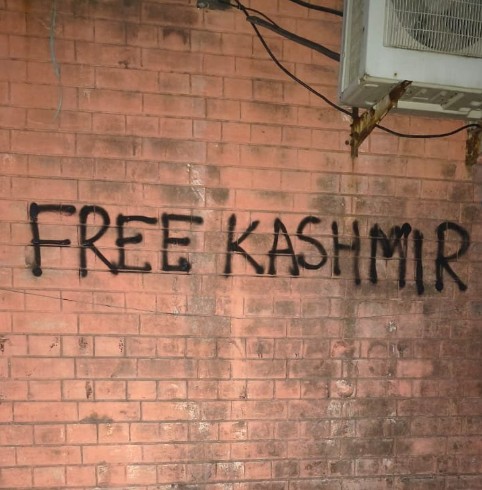
New Delhi, Oct 25 (SocialNews.XYZ) It is quite intriguing that 'Free Kashmir' posters and slogans keep appearing on university campuses and at political protests outside Jammu and Kashmir. These are often displayed alongside 'Free Palestine' slogans, with a message suggesting that people in the Union Territory continue to live an unsettled life.
The questions that promptly come to mind are: who is behind these slogans, and why do they keep resurfacing? There are groups and political lobbies that may have their own reasons for keeping the Kashmir issue alive, ranging from political gains to monetary benefits or religious interests. The motives may differ, but the question remains why such slogans find their way into protests held for entirely different reasons.
The latest instance was at Jamia Millia Islamia University in New Delhi, where students have been on a hunger strike demanding the restoration of student union elections. Amid the agitation, slogans reading "Free Kashmir" and 'Free Sharjeel Imam" appeared on campus walls. The protest soon became the centre of a separate controversy. While Congress said the slogans were not part of the agitation and demanded action against those responsible, the BJP accused opposition leaders of shielding individuals facing serious charges and alleged a larger conspiracy behind the episode.
The controversy comes as Jammu and Kashmir marks another anniversary of its accession to India on October 26. The day commemorates the signing of the Instrument of Accession by Maharaja Hari Singh in 1947, following which the state acceded to India.
The circumstances surrounding the accession are an important part of the history of Jammu and Kashmir. Pakistan had entered into a standstill agreement with the Maharaja's government, but subsequently carried out an armed tribal invasion of the state. The invasion began on October 22, 1947, as tribal raiders backed by the Pakistan Army advanced into Jammu and Kashmir, unleashing violence, looting and destruction.
Faced with the invasion, the Maharaja sought India's military assistance and signed the Instrument of Accession on October 26. India accepted it the following day, and Indian troops were airlifted to Srinagar to repel the invaders.
Sheikh Mohammad Abdullah, who emerged as a major political leader in the state and later became its Prime Minister, also supported the accession. He was the father of Farooq Abdullah, the former Chief Minister and current National Conference President.
The accession marked a decisive moment in the history of Jammu and Kashmir. But the political relationship between the state and the rest of India continued to evolve over the decades, with Articles 370 and 35A giving it a special constitutional status.
Over time, this special status became a contentious political issue. It contributed to the isolation of Jammu and Kashmir from the rest of the country, while its advocates saw it as a constitutional safeguard for the region's distinct position.
That arrangement changed on August 5, 2019, when the Narendra Modi-led government abrogated Article 370 and revoked the special status of Jammu and Kashmir. The state was subsequently reorganised into the Union Territories of Jammu and Kashmir and Ladakh.
The decision had long been considered politically difficult, and it drew strong reactions from several quarters. In the years that have followed, the UT has witnessed significant improvements in security, infrastructure, tourism and economic activity.
The figures on security are worth noting. According to data provided by the Union Ministry of Home Affairs in July 2024, organised stone-pelting incidents in Jammu and Kashmir fell from 1,328 in 2018 to zero in 2023. Organised hartals also declined from 52 to zero over the same period. Terrorist-initiated incidents came down from 228 in 2018 to around 35 in 2025. The Ministry also reported over 1.77 crore visitors in 2025.
These figures show how the security situation has changed, even though the threat of terrorism has not disappeared. They also provide a context for understanding why the post-2019 period is a turning point for the region.
Jammu and Kashmir has also witnessed major infrastructure projects, including the Udhampur-Srinagar-Baramulla Rail Link, the Vande Bharat Express service and the Zojila Tunnel project.
Tourism has emerged as an important part of the region's economy, while educational institutions, public services and opportunities for young people have received greater attention. The UT now has AIIMS, IIT, and IIM.
For ordinary residents, better connectivity, employment opportunities and a peaceful environment matter far more than political slogans. The return of displaced Kashmiri Pandits to their ancestral homes, along with their safety and security, remains another important issue that cannot be overlooked.
Despite these developments, slogans and graffiti demanding a 'Free Kashmir' continue to surface, including at places far removed from the Union Territory itself.
Interestingly, the slogans came as Farooq Abdullah made stinging remarks at his party's workers' convention in Baramullah. "They (the Indian state) are silent today due to pressure from the world. Our neighbour goes everywhere and says that the Kashmir issue has not been resolved. They are protecting us. Otherwise, their intentions are not right," he said.
These remarks come as India is to celebrate the 79th Accession Day anniversary on October 26.
There is a difference between raising questions about governance and using a slogan that challenges the very idea of Jammu and Kashmir's accession to India. Those who raise such slogans are part of a conspiracy to disturb peace in the UT and play with the people's emotions.
Jammu and Kashmir has paid a heavy price for decades of violence, terrorism and political uncertainty. Its people deserve peace, development and the opportunity to build a better future. They do not need their lives to become a convenient talking point every time a protest takes place anywhere.
The question, therefore, is not just who wrote 'Free Kashmir' on the walls of Jamia or earlier at JNU or Jadavpur University. It is about why this slogan keeps returning, who is trying to give it a platform, and what purpose it serves. And why does a demand, settled by choice in 1947, continue to be raised in this manner?
The questions cannot simply be brushed aside.
(Deepika Bhan can be contacted at deepika.b@ians.in)
Source: IANS
Gopi Adusumilli is a Programmer. He is the editor of SocialNews.XYZ and President of AGK Fire Inc.
He enjoys designing websites, developing mobile applications and publishing news articles on current events from various authenticated news sources.
When it comes to writing he likes to write about current world politics and Indian Movies. His future plans include developing SocialNews.XYZ into a News website that has no bias or judgment towards any.
He can be reached at gopi@socialnews.xyz
This website uses cookies.

