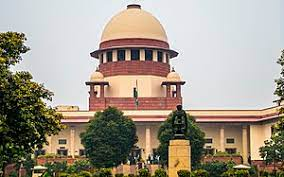
New Delhi, Sep 28 (SocialNews.XYZ) The Supreme Court on Monday issued notice on a plea challenging the Centre’s recent decision to impose Merchant Discount Rate (MDR) on specified high-value Unified Payments Interface (UPI) transactions above Rs 2,000, while declining to immediately stay the implementation of the framework at this stage.
A Bench of Chief Justice Surya Kant and Justices Joymalya Bagchi and V. Mohana sought responses within four weeks from the Union government, the Reserve Bank of India (RBI), the National Payments Corporation of India (NPCI) and the UPI & Services Steering Committee in the matter.
The plea, filed by advocate Anjan Datta through advocate Ashutosh Dubey, challenges the Centre’s Gazette Notification dated September 14, 2026, issued under Section 10A of the Payment and Settlement Systems Act, 2007, as well as the framework announced on September 15 for imposing MDR on specified person-to-merchant (P2M) UPI transactions above Rs 2,000.
Additional Solicitor General (ASG) N. Venkataraman, appearing for the Union government, submitted that the charges would come into effect from October 15 and that 96 per cent of transactions would not face the charge.
The Centre’s law officer also said charges for essential services had been capped at Rs 5. "It is not an expropriation", ASG Venkataraman submitted, explaining that the proposed charge was a settlement fee between payment aggregators and banks and that the government was not receiving any part of it.
He further submitted that banks incur costs while processing electronic transactions and that credit and debit card transactions attract charges, while UPI payments have so far been exempted from such charges, adding that the levy was necessary to keep the UPI ecosystem functioning efficiently.
After hearing the submissions, the CJI Kant-led Bench sought the relevant facts and material on affidavit and posted the matter for hearing after four weeks.
The counsel appearing for the petitioner sought an interim stay on the implementation of the framework, arguing that allowing the charges to take effect could give rise to corruption. However, the Supreme Court declined to grant a stay at this stage.
The plea challenges the proposed 0.4 per cent MDR on specified P2M UPI transactions above Rs 2,000, capped at Rs 300 for transactions of Rs 75,000 and above, with separate rates for certain sectors.
The petitioner has claimed that the framework is arbitrary and discriminatory and imposes a nationwide financial burden without adequate statutory safeguards.
The plea contends that the challenge is not to the objective of maintaining secure and resilient payment infrastructure, but to the manner in which the financial burden has been created, classified and distributed without disclosure of the complete operative instrument, statutory source, underlying cost study, methodology and safeguards.
It has questioned the basis for fixing the Rs 2,000 transaction threshold, Rs 1 lakh monthly-receipt classification, differential sector rates and Rs 75,000 cap, claiming that the empirical basis for these classifications has not been disclosed.
The petition has also questioned the threshold itself, highlighting that a transaction of Rs 2,001 would attract a percentage charge while a Rs 2,000 transaction would not. The petitioner has further challenged the role of the UPI & Services Steering Committee in determining the framework, arguing that essential rate-making and classification decisions cannot be sub-delegated without clear legislative policy, standards, publication and regulatory supervision.
The plea seeks production of the complete record relating to the decision, including the statutory basis, constitution and authority of the UPI & Services Steering Committee, its decisions and minutes, and the legal basis for prescribing the rates and distributing MDR among private ecosystem participants.
It also seeks quashing or suspension of the framework insofar as it imposes MDR on UPI transactions above Rs 2,000.
Alternatively, the petitioner has sought reconsideration of the framework after transparent consultation, publication of empirical data and an impact assessment, along with safeguards for micro and small enterprises.
The Centre has maintained that the revised framework is aimed at ensuring the financial sustainability of the UPI ecosystem.
The Union Finance Ministry had said that a small fee on high-value merchant transactions would help fund infrastructure, cybersecurity and support for small merchants in Tier III-VI towns and rural areas.
The Centre has also maintained that UPI would remain free for customers and that person-to-person transactions would continue to remain free irrespective of the transaction amount.
It said merchants earning up to Rs 1 lakh per month through UPI QR codes would continue to enjoy zero charges, while more than 95 per cent of merchant payments below Rs 2,000 would remain free.
The RBI has also described the introduction of MDR on large-value UPI transactions as a step towards strengthening the long-term sustainability of the digital payments ecosystem, while maintaining that all UPI transactions would remain free for users.
Source: IANS
Gopi Adusumilli is a Programmer. He is the editor of SocialNews.XYZ and President of AGK Fire Inc.
He enjoys designing websites, developing mobile applications and publishing news articles on current events from various authenticated news sources.
When it comes to writing he likes to write about current world politics and Indian Movies. His future plans include developing SocialNews.XYZ into a News website that has no bias or judgment towards any.
He can be reached at gopi@socialnews.xyz
This website uses cookies.


