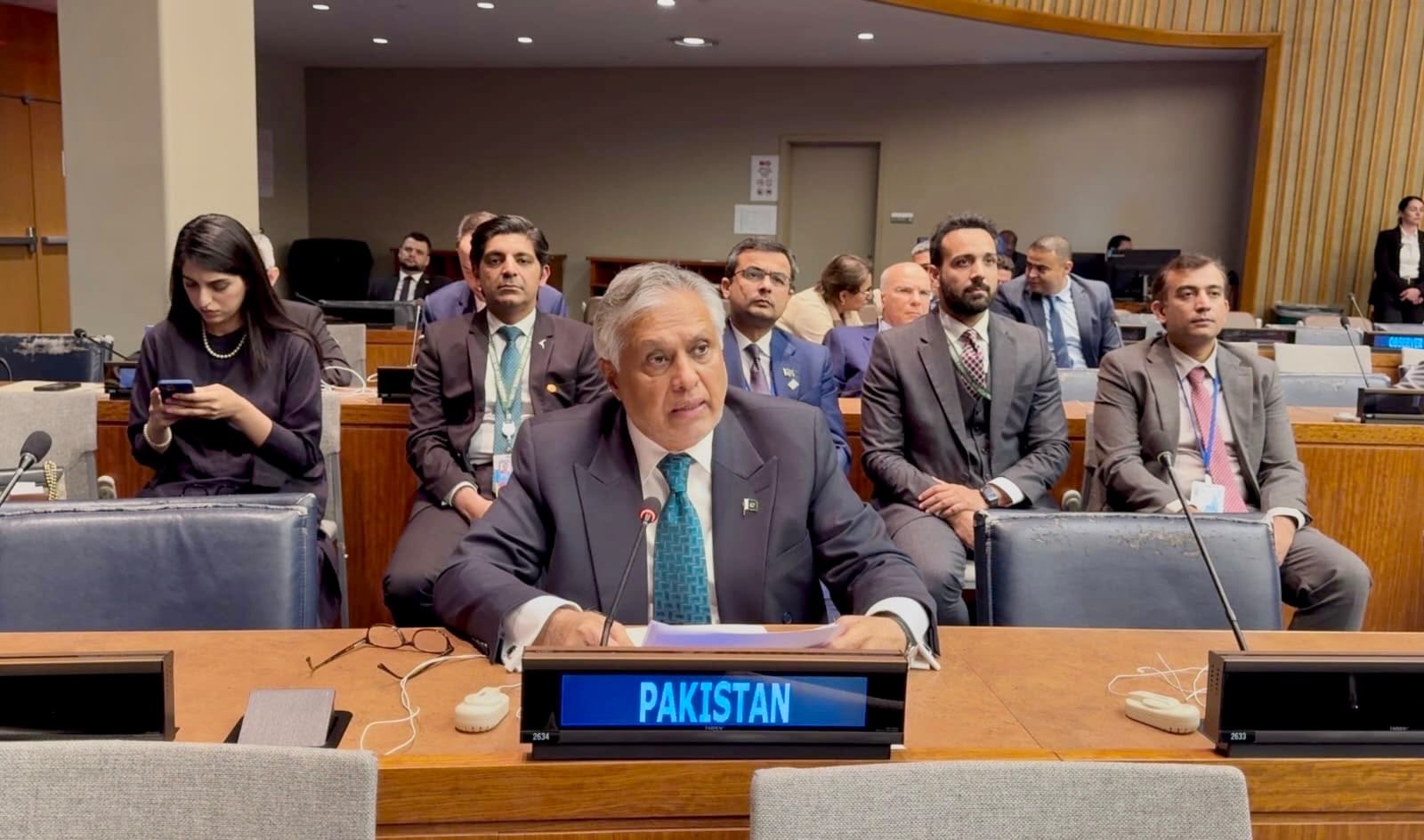
Islamabad/New Delhi, Sep 26 (SocialNews.XYZ) By invoking the Indus Water Treaty’s sanctity and warning of regional consequences, Pakistani Foreign Minister Ishaq Dar appears to externalise an issue rooted in domestic mismanagement, a report has stated.
The central challenge to water and food security in Pakistan has not been upstream engineering in the Indian Union Territory of Jammu and Kashmir, but Islamabad's governance approach that has repeatedly placed cross-border militancy and geopolitical grievances ahead of infrastructure, institutional capacity and responsible resource management, P K Saxena, former Indian Commissioner for Indus Waters, wrote in NatStrat.
“When Pakistan’s Foreign Minister Ishaq Dar warns that suspending the Indus Waters Treaty threatens ‘water security’, ‘food security’, and ultimately ‘national security’ for 250 million Pakistanis, this rhetoric is intended to convey statesmanship. However, this narrative reflects a persistent pattern in Islamabad's political discourse: invoking the river to deflect attention from ongoing governance failures, while prioritising the obstruction of India's development over domestic advancement,” wrote Saxena.
“The central question for Pakistan’s citizens is why a nation that began with comparable opportunities to India in 1947 has, by 2026, adopted terrorism as an instrument of state policy rather than prioritising development as a national objective. This divergence — one path toward institutional growth and the other toward a security apparatus focused on cross-border militancy — constitutes the precedent that merits international scrutiny, rather than the constructed narrative of treaty sanctity promoted by Dar,” he added.
Saxena argued that Islamabad’s diplomatic stance rests on the claim that Pakistan is an “existential victim” of its upstream geography. However, he said, the hydrological allocation defined by the 1960 Indus Waters Treaty contradicts this assertion.
“Pakistan receives over 80 per cent of the Indus system's total flow, approximately 135 million acre-feet (MAF) annually, compared to India’s allocation of 33 MAF. Given this substantial water endowment, Pakistan cannot be classified as water-poor by any hydrological standard. The country’s agricultural crisis arises not from upstream deprivation, but from governance failures and insufficient measures to conserve and manage the considerable water resources already available,” he noted.
According to Saxena, Pakistan’s political and security establishment frequently attributes periods of agricultural water stress to alleged Indian “hydro-hegemony,” portraying upstream run-of-the-river projects such as Kishenganga, Baglihar and Ratle as an existential threat. Engineering assessments, he said, do not support this contention.
Run-of-the-river projects do not consume or permanently divert water. Instead, they harness the kinetic energy of the river’s natural flow to generate electricity before releasing the water back into the river channel, resulting in no net loss of volume. India has also utilised only a fraction of the storage capacity it is permitted to develop on the Western Rivers under the Treaty, which is currently suspended, Saxena mentioned.
“The water scarcity experienced by Pakistani farmers primarily results from the rigid Warabandi allocation system, which concentrates water access among politically influential landholders at the head of canal reaches and leaves smallholders at the tail chronically deprived. This constitutes a domestic distributive issue unrelated to India,” he noted.
Source: IANS
Gopi Adusumilli is a Programmer. He is the editor of SocialNews.XYZ and President of AGK Fire Inc.
He enjoys designing websites, developing mobile applications and publishing news articles on current events from various authenticated news sources.
When it comes to writing he likes to write about current world politics and Indian Movies. His future plans include developing SocialNews.XYZ into a News website that has no bias or judgment towards any.
He can be reached at gopi@socialnews.xyz
This website uses cookies.


