United Nations, Sep 27 (SocialNews.XYZ) Canada, Australia, the Netherlands and several smaller countries have used the UN General Assembly to demand greater strategic autonomy as intensifying competition among powerful nations places economic cooperation and national sovereignty under pressure.
The speeches reflected growing concern that countries could be forced to choose between competing power centres or become excessively dependent on a single security or economic partner.
Canadian Foreign Minister Anita Anand delivered one of the strongest warnings.
“We are facing a rupture, not a transition,” Anand said, accusing major powers of retreating from global economic cooperation and dismantling economic integration.
Canada wanted a peaceful, prosperous and predictable international environment, she said. It had therefore chosen strategic autonomy to protect its ability to make sovereign decisions.
“We can no longer afford to be overly reliant on any one partner,” Anand said.
Canada was building partnerships with small states, middle powers and major powers to confront new challenges, she said. Ottawa had secured more than 20 economic and defence agreements over the past year and was increasing its security investments.
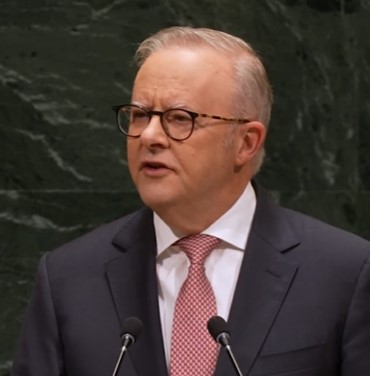
Australia also argued that international decision-making could not be left to the most powerful states.
Prime Minister Anthony Albanese said the UN’s mission could not be entrusted solely to great powers, the largest countries or the loudest voices. Nor could it be handed to wealthy companies or determined by the speed of technological change.
“As a middle power, Australia is showing leadership and working with others on fresh ideas,” Albanese said.
Australia was building relationships across the Indo-Pacific to strengthen national capabilities and offer countries sovereign choices free from coercion, he said. Those partnerships were intended to address economic security, energy, technology and transnational crime.
The Netherlands urged middle powers to assume a larger role as major powers increasingly pursued narrow national interests.
Prime Minister Rob Jetten called for greater cooperation on international law, climate change and accountability. Middle powers could help sustain institutions that were being weakened by geopolitical rivalry, he said.
Small island countries said they faced even greater risks because they lacked the economic and military capacity to absorb external shocks.
“Small States must never become collateral damage in the competition among larger Powers,” Dominica President Sylvanie Burton said.
She linked independence to economic resilience, saying reduced dependence on imported energy could protect vulnerable countries from international price shocks.
Seychelles President Mathew Herminie said smaller nations were seeking cooperation rather than strategic competition.
“Small States like ours do not seek strategic competition — we seek shared solutions,” he said.
Conflicts in which island countries had no role could still impose higher shipping, fuel and security costs on their economies, Herminie said. He called for stronger intelligence-sharing, maritime surveillance and law-enforcement assistance.
Maldives Vice President Hussain Mohamed Latheef said competition among major powers in the Indian Ocean must not restrict the choices of smaller states.
Sovereignty could be weakened without a border being crossed when external powers limited a country’s freedom to decide its own future, he said. The Indian Ocean should remain a region where commerce could move and countries could prosper.
Middle powers generally possess significant economic, diplomatic or regional influence but lack the reach of global superpowers. They often rely on issue-based coalitions and multilateral organisations to increase their influence and protect their room for independent decisions.
India has long described its approach as strategic autonomy. It maintains partnerships with the United States, Russia, Europe and countries across the Global South while participating in groupings including the Quad, BRICS and the G20. The UN speeches showed that similar language is now being adopted by a wider range of countries.
Source: IANS
Gopi Adusumilli is a Programmer. He is the editor of SocialNews.XYZ and President of AGK Fire Inc.
He enjoys designing websites, developing mobile applications and publishing news articles on current events from various authenticated news sources.
When it comes to writing he likes to write about current world politics and Indian Movies. His future plans include developing SocialNews.XYZ into a News website that has no bias or judgment towards any.
He can be reached at gopi@socialnews.xyz
This website uses cookies.

