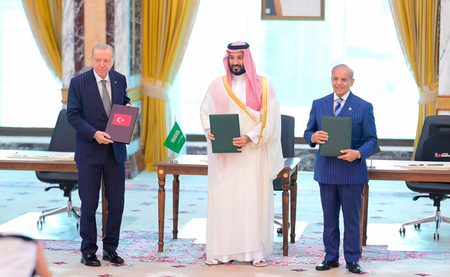
New Delhi, Sep 25 (SocialNews.XYZ) The Makkah Joint Defence Agreement between Saudi Arabia, Turkey, and Pakistan in Mecca is being discussed for its strategic significance and emerging challenges since being signed on August 7 this year amid the crisis in West Asia.
The agreement reportedly commits the three countries to regard an armed attack on any member as an attack on all, creating a collective defence framework that some observers have compared to NATO's Article 5 principle.
Iran's retaliatory attacks on Saudi Arabia soil, more importantly, the recent Houthi attacks, are the major test of the agreement.
Despite the treaty's collective-defence language, neither Pakistan nor Turkey entered direct combat operations.
Analysts suggest that the pact lacks clearly defined activation thresholds and that member states remain cautious about becoming involved in broader regional conflicts.
Among signatories, Pakistan, with its large armed forces, alongside its nuclear deterrent capability, has been under scrutiny for trying to balance relations with Iran.
Turkey, meanwhile, provides a rapidly expanding defence-industrial base and NATO-linked military experience, while Saudi Arabia contributes financial resources and geopolitical influence in the Gulf, analysts say.
Media reports now suggest that the signatories are preparing for an urgent meeting of their military chiefs that is being seen as a possible test for the agreement.
Foreign Ministers of the three countries met on the sidelines of the United Nations General Assembly (UNGA) in New York on Thursday to discuss the situation and possible actions under the treaty, reports added.
Differences in priorities, strategic outlooks and sources of threat limit its ability to develop into an effective defence framework.
These differences are likely to keep it within the boundaries of a political-security alliance focused primarily on intelligence sharing, joint training and exercises, air and missile defence, and joint defence production.
That was the assessment by the Qatar-based Arab Centre for Research and Policy Studies, published the same month following the agreement, on the Doha Institute for Graduate Studies website.
With many in the Gulf increasingly viewing the American military presence in the region as a liability, Turkey and Pakistan began to see an opening to replace the United States as security guarantor, a commentary on 'Diwan, Middle East Insights' from Carnegie said.
Having been excluded from the India-Middle East-Europe Economic Corridor (IMEC), both countries also understood that a new regional security architecture could carry economic benefits and place them firmly on the worldwide development-corridor track, it added.
Explaining further, it recounted that announced in New Delhi at the 2023 G20 summit, IMEC undercuts both Turkey and Pakistan by building trade routes around them where "According to Pakistani officials speaking privately, IMEC was a topic of discussion in Mecca in the run-up to the emergence of the agreement".
Additionally, Turkey and Pakistan grasped that there was an opportunity to expand their military-industrial complexes with Saudi funding, it said.
Separate assessments present similar interpretations ranging from the agreement being the foundation of a new regional security architecture capable of strengthening collective deterrence and reducing dependence on Western defence guarantees to it primarily being a political signalling mechanism designed to reassure partners and deter adversaries without necessarily creating automatic military obligations.
Given the crisis, the tri-nation agreement would well suit to establish peace rather than a regional flare up.
As per the Diwan article, Saudi Arabia and Pakistan are already believed to be working together to bring an end to US-Iranian hostilities and Turkey is mediating between the Afghan Taliban and Pakistan to resolve their outstanding border issues.
Ultimately, if Saudi Arabia, Pakistan, and Turkey prove able to align, or at least coordinate their stances on a significant number of issues, the Mecca accord could end up being looked back upon as having given birth to a new regional security order, it added.
Source: IANS
Gopi Adusumilli is a Programmer. He is the editor of SocialNews.XYZ and President of AGK Fire Inc.
He enjoys designing websites, developing mobile applications and publishing news articles on current events from various authenticated news sources.
When it comes to writing he likes to write about current world politics and Indian Movies. His future plans include developing SocialNews.XYZ into a News website that has no bias or judgment towards any.
He can be reached at gopi@socialnews.xyz
This website uses cookies.


