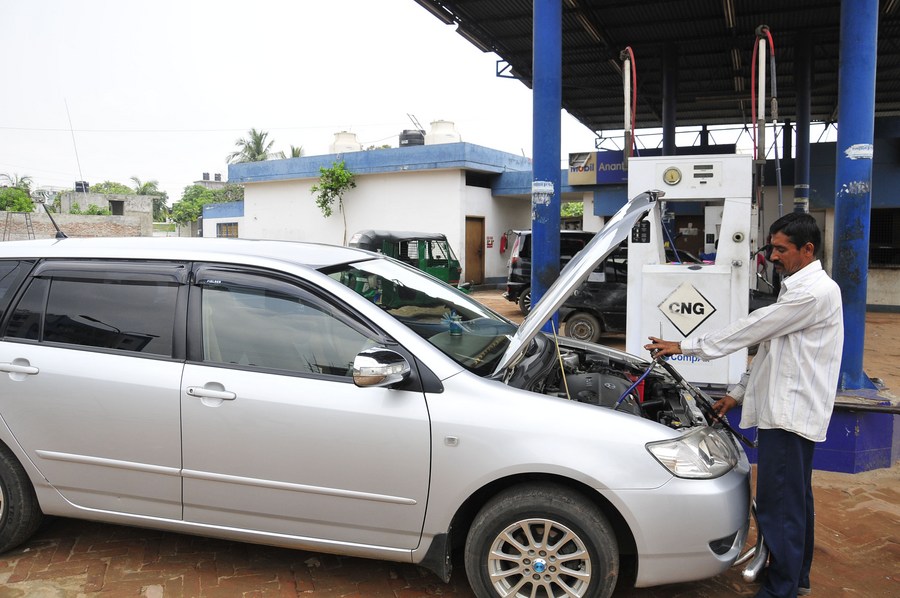
Dhaka, Sep 22 (SocialNews.XYZ) Bangladesh government’s latest fuel price hike threatens to trigger another wave of inflation, with higher transport, freight, irrigation and production costs expected to ripple across the economy, local media reported on Tuesday, citing experts.
The resulting rise in goods and services prices could further squeeze households and businesses already burdened by soaring expenses.
The latest Bangladeshi taka (Tk) 20-per-litre increase, which took effect Monday, has driven diesel, petrol, octane and kerosene prices to record retail highs. It is the third such fuel price hike since the Bangladesh Nationalist Party (BNP) government took office in mid-February, Bangladesh’s leading newspaper, The Daily Star, reported.
The price of diesel, the country’s most widely used fuel and a lifeline for transport, agriculture and industry, has jumped from Tk 115 to Tk 135 per litre.
Reports suggest that all four major liquid fuels have seen repeated price increases between January and September this year, with the latest revision driving prices up by nearly 36 per cent compared with January.
Addressing a press conference on Monday at the Secretariat in Dhaka, Bangladesh’s state minister for power, energy and mineral resources, Anindya Islam Amit said that retaining the previous prices had become financially sustainable.
Economists warn that the hike could fuel food prices, raise operating costs for firms already grappling with high borrowing costs, and further hamper a job market that has been struggling to recover for years.
Nazneen Ahmed, executive director of the Centre for Policy Dialogue (CPD) in Dhaka, said higher fuel prices would have far-reaching economic effects, raising costs from agricultural production and transportation to industrial operations.
“Think about how much the cost of operating a bus will increase from one end of the city to the other and the impact that will have on fares,” The Daily Star quoted Ahmed as saying.
Anu Muhammad, former economics professor at Jahangirnagar University, said the government could have lowered fuel-related taxes and fees rather than “putting the burden on the entire economy”.
“Judging by the government’s approach, it seems to be trying to become unpopular very quickly,” he said.
Mohammad Lutfor Rahman, an economics professor at Jahangirnagar University, said higher production costs due to a hike in fuel prices are likely to affect nearly every sector of the economy.
He said rising agricultural expenses would push up food prices, placing a disproportionate burden on daily-wage earners and private-sector employees whose incomes may not rise at the same pace.
“We may move towards stagflation, which means high inflation, declining purchasing power, rising inequality, and an increase in joblessness,” said Rahman.
As the job market remains stagnant and industrialisation is unlikely to gain momentum, he said, “the situation ahead may be challenging for Bangladesh”.
Source: IANS
Gopi Adusumilli is a Programmer. He is the editor of SocialNews.XYZ and President of AGK Fire Inc.
He enjoys designing websites, developing mobile applications and publishing news articles on current events from various authenticated news sources.
When it comes to writing he likes to write about current world politics and Indian Movies. His future plans include developing SocialNews.XYZ into a News website that has no bias or judgment towards any.
He can be reached at gopi@socialnews.xyz
This website uses cookies.


