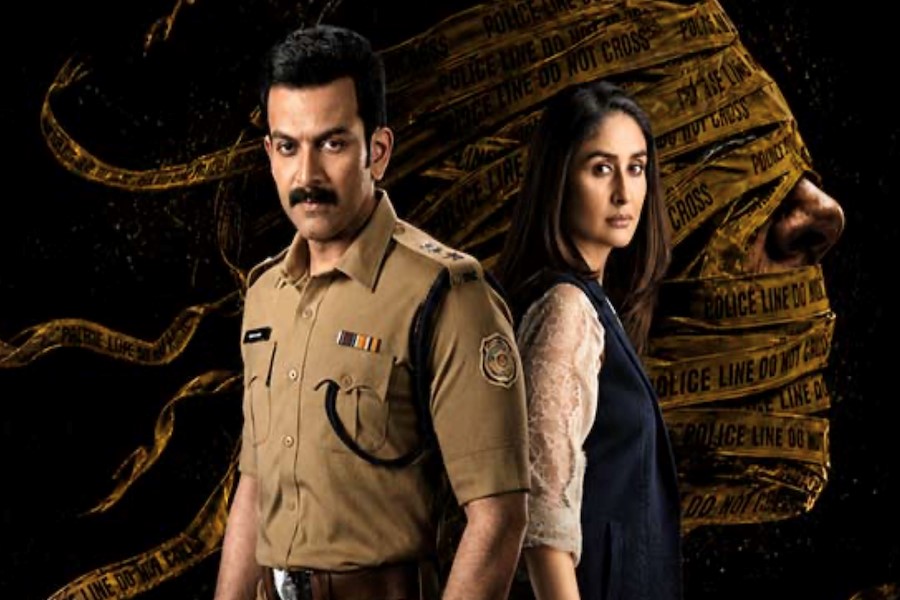
Director: Meghna Gulzar
Star Cast: Kareena Kapoor Khan, Prithviraj Sukumaran, Rishab Shetty, Tovino Thomas and others
Genre: Crime Drama / Social Thriller
Duration: 143 Minutes
Rating: 2
A girl is raped. A heinous crime is committed. The police officer doesn't wait for the court to deliver justice and kills the accused in an encounter. The case is closed, the public applauds, and justice — at least emotionally — seems to have been served. But honestly, we have seen this story before.
The “cop takes the law into his own hands” narrative is hardly new. From mainstream entertainers like Singham 2 to several crime dramas, this territory has already been explored. So when Meghna Gulzar takes up a similar premise in Daayra, my expectation was not simply to see another story about an encounter. I expected her to look beyond the obvious — to explore the grey space between law and justice, revenge and accountability, duty and emotion.
I expected a film that would put two opposing perspectives in front of me and make me understand why each side believes it is right. A film that would leave me debating my own position rather than simply accepting one conclusion. And this is where Daayra failed to impress me.
The film gives us Prithviraj Sukumaran as IPS Raman Kumar, the police officer at the centre of the encounter, and Kareena Kapoor Khan as DCP Ajooni Kohli, who heads the SIT investigating it. Kareena's character looks at the details, questions the people involved and slowly begins connecting the dots. Rather than relying on dramatic revelations, the investigation progresses through evidence, observation and persistence.
There is an intelligence in the way she approaches Ajooni, and watching her gradually establish that the encounter may not be what it appears to be is genuinely interesting.
Kareena Kapoor Khan Is Fantastic
Kareena Kapoor Khan is fantastic in the film. She brings a sense of patience and intelligence to Ajooni, and there is restraint in the way she approaches the investigation. She isn't simply there to deliver dramatic lines or make grand declarations. She observes, questions and keeps digging.
Prithviraj Sukumaran, as Raman Kumar, is equally impressive. He plays a police officer who believes that the system has failed and that he has done what was necessary. Importantly, Prithviraj doesn't turn him into a caricature of a heroic cop. There is conviction in his performance, and you can understand the emotional space from which his character is operating.
And this is where I feel the film had its biggest opportunity. Because the real question isn't whether the crime was horrific. It was. The real question is what happens when the justice system fails, and a police officer decides to become the judge and executioner?
I went into the film expecting Daayra to explore two contrasting perspectives — one represented by Prithviraj's character and the other by Kareena's investigation — and to make us understand the reasoning behind both. But the film never quite brings these two perspectives into the same moral space.
Kareena is investigating whether the encounter was fake, while Prithviraj stands on the other side of that investigation. What I was hoping for was a deeper exploration of the grey area between law and justice, duty and emotion, revenge and accountability. Because when the crime is something as horrific as rape and murder, the audience's emotional response is almost predetermined. If the accused are killed in an encounter, the immediate reaction for many people is going to be, “Good. They deserved it.”
And that is precisely where I wanted Daayra to challenge me.
Can an illegal act become justice because the people on the receiving end are accused of a terrible crime? Can the failure of the system justify a police officer crossing the boundaries of the law? And if an officer genuinely believes that he has delivered justice, should the audience accept that decision simply because the outcome feels satisfying?
These are fascinating questions. Unfortunately, I didn't feel the film explored this moral dilemma as deeply as its premise suggested it would.
And Yes, I Thought of Singham 2
While watching Daayra, I couldn't help but think of Singham 2. In that film, too, the audience gets the satisfaction of seeing an accused brought down by a police officer through a staged situation. Obviously, Daayra approaches its subject with a much more serious and grounded tone, and the two films are not identical. But the basic emotional idea is familiar — the system fails, a police officer takes an extreme step, and the audience gets a sense of instant justice. That's why I expected Daayra to go beyond that familiar territory.
I wanted the film to question why we, as an audience, are so ready to celebrate instant justice. I wanted it to make that emotional satisfaction uncomfortable — or maybe make us comfortable with it with more power and more reasons behind it. Instead, I felt the film stopped short of fully engaging with that uncomfortable conversation.
The supporting cast does a good job and adds weight to the narrative. The performances around the two leads are convincing and help maintain the serious tone of the film.
But ultimately, the film belongs to Kareena and Prithviraj, and thankfully, neither disappoints. Kareena brings patience and intelligence to Ajooni, while Prithviraj gives Raman the conviction and intensity required for his character.
So, What Does Daayra Actually Mean?
This is the question that stayed with me after the film ended. The title Daayra suggests a boundary, a limit, a line that separates one thing from another. And I kept expecting the film to show me that line. The line between law and morality. The line between what feels right and what is legally right. The line between justice and revenge. The line between accountability and taking the law into your own hands. But that connection never became clear enough for me.
The film certainly places Kareena and Prithviraj on opposite sides of the encounter. But I wanted their contrasting positions to create a deeper moral and ideological conflict — something that would make me question where I personally stood. Instead, the investigation has a clearer direction, and the larger philosophical debate feels secondary.
And that's a little disappointing because this is exactly the kind of subject where a film can make the audience uncomfortable in the best possible way. I wanted Daayra to ask me whether justice can ever be separated from the law. I wanted it to make me understand why someone might believe that crossing the legal line is justified when the system appears to have failed. At the same time, I wanted the film to remind me why that line exists in the first place. Because once a police officer decides that he can determine who deserves to live and who deserves to die, where does accountability begin? And if the accused are genuinely guilty, does that automatically make an illegal encounter an act of justice? These questions are sitting right there within the premise of Daayra. That's why I kept waiting for the film to dig deeper.
Daayra is not without its strengths. It has a powerful and sensitive subject, a solid supporting cast and, most importantly, two brilliant actors at the centre of the story. Meghna Gulzar's treatment is serious, and the film does give us enough material to discuss. But my disappointment comes from the gap between what I expected the film to explore and what it ultimately gave me. I wasn't looking for a film to simply tell me whether the encounter was right or wrong. I wanted a film that would make me question why I feel it is right or wrong. I went into Daayra expecting two contrasting perspectives and a genuine moral dilemma. What I found was a good investigation wrapped around a subject that had the potential to become a much deeper conversation about justice, law and accountability.
The performances worked for me. The premise worked for me. Kareena's investigation worked for me. Prithviraj's conviction worked for me. But the larger purpose behind bringing all of this together under the title Daayra remained unclear. Perhaps the film wanted to explore the boundary between law and justice. Perhaps it wanted to examine what happens when personal morality overtakes institutional justice. But for me, that exploration never went deep enough.
And perhaps that's why I walked out with one question still in my mind: “If the film is called Daayra, which boundary exactly did it want me to question?”
News Helpline is a Brand in the world of daily Bollywood Content. We are a team of Innovative, Hard working and Creative people working in media since last 15 years. We were the first to sense the changing phase of News Industry with the progress of IT industry. Hence in the year 2008 we came up with a first of its kind Bollywood News Application, a website where we uploaded Bollywood news on daily basis and our client could download this news from anywhere in the world on the same day of the event. Then with the passage of time we improved and evolved. The result is today our client in any area of the world receives their Bollywood news (HD quality) within 2-3 hrs. post event. The value of News is very Time dependent and we at News Helpline deliver the News before thay become rumors.
This website uses cookies.


