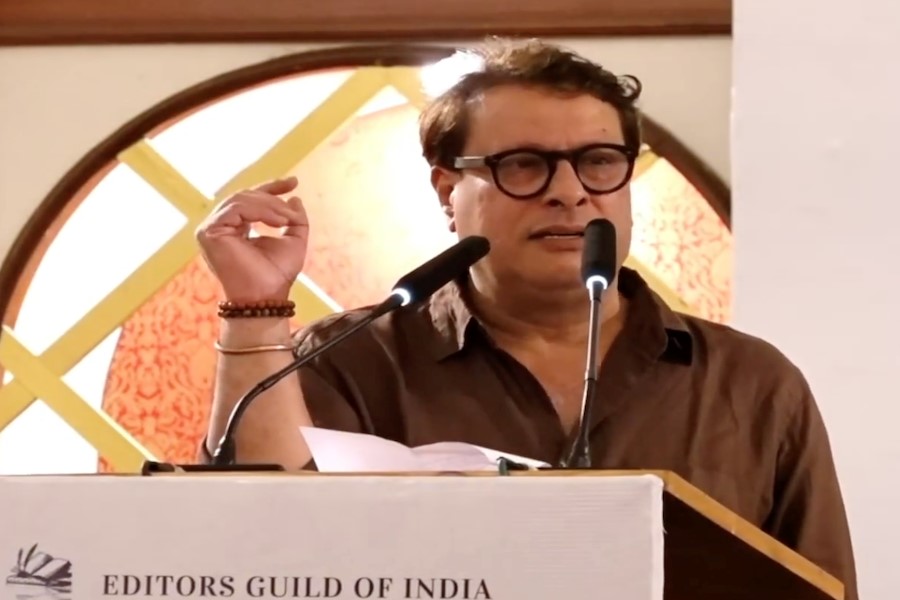
Dhulia began by highlighting the enormous increase in the number of people entering both professions. Actors, writers, music directors and journalists are far more numerous today than they were two decades ago, but according to him, the opportunities have not expanded at the same pace. He recalled seeing aspiring professionals arrive in Mumbai hoping to build careers, often attracted by the glamour, influence or possibilities associated with the industries. Yet he suggested that genuine passion has become increasingly rare. For those who continue working despite financial instability and uncertainty simply because they love what they do, Dhulia expressed particular admiration.
For Dhulia, the biggest underlying problem is corporatisation. He argued that corporate culture entered the media and film industries around the same period and fundamentally altered how both professions function. In journalism, he pointed to the decline of investigative reporting, which requires considerable financial resources. Serious investigations involve travel, accommodation, research and the cultivation of sources and whistleblowers. Independent journalists operating through podcasts or YouTube channels may have the desire to investigate, but often lack the capital required for major investigations. Dhulia therefore questioned how journalism can remain genuinely investigative when the financial structures necessary to support such work are disappearing.
He drew a direct parallel with filmmaking. In the older industry, Dhulia recalled, individual producers often invested their own money and took enormous personal risks. A producer might sell jewellery or even a house to finance a film. Because the investment was personal, the relationship between producer and filmmaker could also be personal. Problems could be discussed and resolved informally. Corporate filmmaking, he argued, replaced that atmosphere with layers of legal, finance and management departments. Decisions increasingly became about numbers, projections and risk rather than instinct, passion or a belief in an unusual story. The endless credits at the end of modern films, he suggested, symbolise how many people can now be involved without necessarily having a personal connection with the work.
According to Dhulia, this corporate approach has contributed to increasingly formulaic cinema. He questioned whether many executives responsible for greenlighting films have a genuine connection with India's cinematic heritage or have even engaged deeply with filmmakers such as Bimal Roy and classics such as Do Bigha Zamin. He argued that commercial considerations have gradually replaced the willingness to experiment. The result, in his view, is a cinema where different films often begin to resemble one another. He also connected this phenomenon to extreme capitalism more broadly, arguing that cities, fashion, lifestyles and even individual appearances are becoming increasingly uniform, with distinctive identities being replaced by the same malls, brands and consumer patterns.
The filmmaker was equally concerned about the pressure placed on filmmakers from outside the corporate system. He described directors as being caught between corporate interests, the Censor Board and political groups that may threaten protests or consequences over controversial content. According to Dhulia, this environment creates fear among producers and executives. Even if an executive believes a script is original and worthwhile, taking a chance can become professionally dangerous when that person is accountable to multiple departments and superiors. A failed film can potentially cost someone their job. Dhulia contrasted this with the older system, where individual producers could absorb the consequences of failure and simply move forward with another project.
Dhulia also lamented what he considers the disappearance of strong storytelling from mainstream Hindi cinema. Reflecting on his career, which began in Mumbai in the 1990s after his earlier work in Delhi, he said he had witnessed a very different film industry. He acknowledged that he enjoyed Dhurandhar, particularly its presentation, music and engaging first part, while still questioning the simplicity of its underlying premise. He also referred to mainstream successes such as Pushpa and KGF, arguing that contemporary commercial cinema frequently relies on familiar templates. His larger concern was that storytellers with genuinely different ideas are either disappearing or being prevented from making the films they want to make because the industry fears unconventional stories will not succeed.
To explain the richness that cinema once possessed, Dhulia turned to history. He recalled how Indian filmmakers drew inspiration from theatre, devotional traditions, regional cultures and the independence movement. Cinema could communicate political ideas through symbolism, allowing filmmakers to say more than was immediately visible on screen. He cited Chal Chal Re Naujawan and Kismet, explaining how nationalist messages could reach Indian audiences even when colonial authorities misunderstood their meaning. The famous song from Kismet, for example, was interpreted by the British as being directed towards the Japanese, while Indian audiences understood its nationalist significance. For Dhulia, such examples demonstrated the extraordinary power of imaginative storytelling.
He also shared anecdotes about censorship in the years following independence, including stories involving Balraj Sahni, Hulchul and Dilip Kumar's Ganga Jumna. Dhulia contrasted those experiences with his own film Raag Desh, which he made in 2017 about the Indian National Army trials. He recalled that the Censor Board passed the film without a single cut and even praised his work, but the project was later stalled and he had to wait years to receive payment. For him, this demonstrated how successfully navigating censorship does not necessarily guarantee that a film will receive proper support or distribution.
Another major theme of Dhulia's address was the cultural contribution of Hindi cinema. He argued that Hindi films helped create a shared language and cultural connection across India, with audiences in regions including Manipur and the South understanding Hindi because of cinema. He expressed sadness that this unifying cultural role appears weaker today. Yet he ended on a hopeful note, reflecting on social change, democracy and art. Referring to the ideals of liberty, equality and fraternity, Dhulia called for a future where caste, religious and regional identities no longer divide people. His address ultimately became more than a criticism of cinema and journalism: it was a plea to preserve individuality, courage, responsible journalism and the freedom to tell stories that matter.
News Helpline is a Brand in the world of daily Bollywood Content. We are a team of Innovative, Hard working and Creative people working in media since last 15 years. We were the first to sense the changing phase of News Industry with the progress of IT industry. Hence in the year 2008 we came up with a first of its kind Bollywood News Application, a website where we uploaded Bollywood news on daily basis and our client could download this news from anywhere in the world on the same day of the event. Then with the passage of time we improved and evolved. The result is today our client in any area of the world receives their Bollywood news (HD quality) within 2-3 hrs. post event. The value of News is very Time dependent and we at News Helpline deliver the News before thay become rumors.
This website uses cookies.


