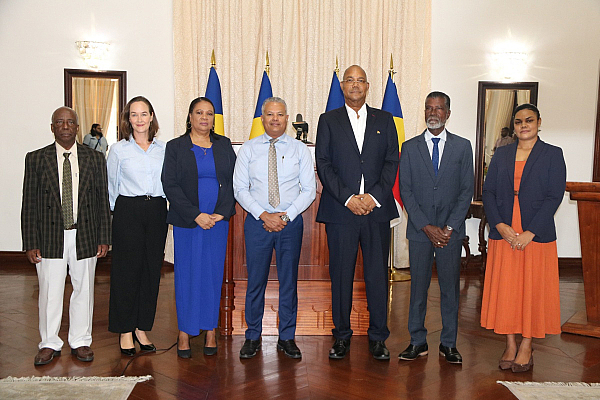
Present at the ceremony were Vice President Mr Sebastien Pillay, former President Mr Danny Faure and members of the National Unity Committee.
The establishment of the Commission marks an important step insupporting the implementation of the recommendations contained in the TRNUC Final Report, and contributing to Seychelles' ongoing process of reconciliation and national unity.
The creation of the Commission reflects President Dr Patrick Herminie's commitment, since taking office, to promoting unity, reconciliation and a renewed sense of togetherness among the people of Seychelles. In previous addresses, the President has consistently emphasised the importance of bringing the country together, promoting healing and restoring hope.
During the ceremony, the Commissioners took their oath as Commissioners, formally assuming responsibility for overseeing, monitoring and supporting the implementation of the recommendations contained in the TRNUC Final Report.
The Commission will serve as an important mechanism to ensure coordination, follow-up and oversight of the implementation of the TRNUC recommendations, supporting the implementation of recommendations relating to victims identified in the TRNUC Final Report.
Speaking to the press following the ceremony, Commissioner Mr George Bibi explained that its primary responsibility is to determine reparations for victims identified in the TRNUC Final Report. He added that the Commission will work closely with relevant institutions, including the Seychelles Human Rights Commission, the Ministry of Education, and the Seychelles Police Force.
Mr Bibi further explained that the Commission will submit an annual report to the President on its activities and provide regular public updates to ensure transparency and prevent misinformation.
"Our role is to determine the quantum of reparations based on the recommendations contained in the TRNUC Final Report. Once a determination has been made, it will be forwarded to the Reparations Trust Fund for payment," Mr Bibi said.
He noted that reparations will be assessed according to the nature of the violations identified in the TRNUC Final Report, including unlawful killing, unlawful imprisonment or other deprivation of physical liberty, forced eviction from legally owned property, forced exile, and other recognised violations.
Mr Bibi clarified that the Commission will not determine compensation solely on the amount requested by victims. Instead, it will establish a clear assessment framework for determining the quantum of compensation, ensuring that all claims are considered fairly, consistently and transparently.
"Today marks our first day in office. Our immediate priority is to establish our Standard Operating Procedures, including the framework that will guide the determination of reparations," he said.
Once the assessment framework has been finalised, victims will be invited for individual interviews, during which the Commission will explain how the amount awarded was calculated. Should a victim disagree with the Commission's determination, they will have the option of seeking redress through the courts. However, there will be no appeal process before the Commission itself, as this could delay the implementation of its mandate.
Acknowledging the long wait experienced by many victims, Mr Bibi said the Commission intends to begin its work without unnecessary delay.
"People have been waiting for this for a long time. We will use these first few days to establish our office and put the necessary administrative arrangements in place. We anticipate that recruitment and the installation of the required facilities will take approximately two months, and we expect to expects to become fully operational, subject to the completion of the necessary administrative arrangements. This is a sensitive responsibility, and while we recognise that we may not be able to satisfy everyone, we are committed to carrying out our mandate fairly, professionally and to the best of our ability."
Mr Bibi also emphasised that the Commission's responsibility is limited to determining the quantum of reparations. Responsibility for mobilising and managing the funds rests with the Reparations Trust Fund Committee, which will process payments based on the Commission's determinations.
He further noted that reparations are not limited to monetary compensation.
"It is important to understand that reparations are not only monetary. They can take different forms, including restitution, compensation and rehabilitation. Our team includes members with legal and psychological expertise, while both Mr Gbilimou and I bring experience from our work with the TRNUC."
The Commissioners will designate a Chairperson and a Vice Chairperson from among themselves. Their mandate will last for a period of five years.
The recommendations contained in the TRNUC Final Report were submitted to former President Wavel Ramkalawan at the end of March 2023.
Distributed by APO Group on behalf of State House Seychelles.
This website uses cookies.



