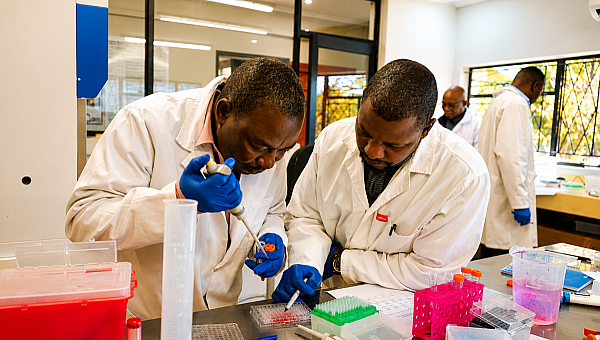
The five-day training, held from 20 to 24 July 2026, was delivered under the European Union-funded Support Towards the Operationalization of the SADC Regional Agricultural Policy Project Phase II (STOSAR II), with complementary support from the Pandemic Fund multi-country project.
Opening the training, STOSAR II Project Coordinator, Dr Elma Zanamwe, welcomed participants, facilitators and partners, and acknowledged the collaboration among FAO, the Directorate of Veterinary Services/Central Veterinary Laboratory, the Victoria Falls Wildlife Trust Laboratory, ZimParks and KAZA partners. She noted that the training responded to a request from the KAZA Secretariat for FAO support to strengthen brucellosis diagnostic capacity and reflected the importance of collaboration between livestock and wildlife health institutions under FAO’s One Health approach.
Brucellosis is a bacterial zoonotic disease affecting livestock, wildlife and people. It can reduce animal productivity, affect food safety and livelihoods, and pose public health risks, particularly in areas where wildlife, livestock and communities interact closely.
The training addressed a practical diagnostic gap by strengthening capacity to move beyond initial screening with the Rose Bengal Plate Test towards reliable Complement Fixation Test capacity as part of complementary and confirmatory testing for brucellosis diagnosis and surveillance. This is particularly important in the KAZA landscape, where the movement of wildlife and interaction with livestock require timely detection, coordinated surveillance and evidence-based response.
By improving animal health surveillance and laboratory diagnosis, the initiative also contributes to reducing human health risks, protecting communities and supporting safer livestock production systems, in line with FAO’s One Health Programme Priority Area.
Building practical laboratory skills
The training brought together veterinarians and veterinary laboratory technologists from the Victoria Falls Wildlife Trust, ZimParks, Zimbabwe’s Central Veterinary Laboratory, the Bulawayo and Masvingo Provincial Veterinary Laboratories, FAO Zambia and FAO Zimbabwe. The programme strengthened both technical capacity and collaboration across wildlife and livestock health institutions.
Participants received theory and intensive practical laboratory training covering brucellosis epidemiology, One Health principles, biosafety, quality assurance and the full CFT workflow. Practical sessions focused on reagent preparation, serum processing, complement and haemolysin titration, test execution, quality control, troubleshooting and interpretation of results.
The training led to measurable improvements in participants’ knowledge and confidence. Average assessment scores increased from 69 percent before the training to 82 percent after the training. Participants also identified the practical laboratory sessions, troubleshooting exercises and interpretation of results as among the most valuable components of the programme.
Advancing One Health collaboration
The initiative reinforced collaboration among the Victoria Falls Wildlife Trust, ZimParks, the Directorate of Veterinary Services, FAO and the KAZA Secretariat. It also strengthened understanding of how laboratory diagnosis, disease surveillance and field epidemiology work together to support evidence-based decision-making at the wildlife–livestock interface.
Zimbabwe’s Central Veterinary Laboratory will continue to play an important role in technical mentorship, quality assurance and referral support as confirmatory brucellosis testing capacity is expanded. Continued collaboration is expected to improve disease reporting, sample referral and coordinated surveillance across the KAZA landscape.
Sustaining the gains from the training will require continued mentorship, quality-control support, reagent standardisation, documentation and coordinated technical backstopping among the Victoria Falls Wildlife Trust, the Central Veterinary Laboratory, ZimParks, FAO, the KAZA Secretariat and other partners.
The training forms part of the STOSAR II Project’s broader efforts to strengthen veterinary services, laboratory networks and One Health collaboration across Southern Africa. The skills gained through the training are expected to contribute to stronger brucellosis surveillance and response in Zimbabwe and the wider KAZA region, while helping safeguard livestock production, wildlife conservation, public health and rural livelihoods.
Distributed by APO Group on behalf of Food and Agriculture Organization of the United Nations (FAO): Regional Office for Africa.
This website uses cookies.



