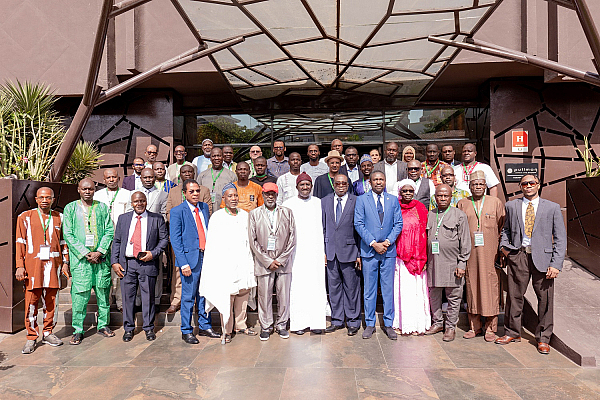
More than seventy representatives of farmer organisations and their regional networks, as well as partner organisations active in food security stockpiling, from the seventeen countries of the ECOWAS-UEMOA-CILSS region, assessed the management of local stockpiles – also known as the ‘first line of defence’ of the regional storage strategy.
This consultation provided an in-depth assessment of the management of local stocks, examining their level of functionality, the governance mechanisms in place, and the procedures for procuring, managing and replenishing stocks.
Participants assessed the results achieved in terms of preventing and responding to food crises, in particular the ability of these mechanisms to ensure that vulnerable populations have access to staple foods during lean periods or in the event of shocks. Discussions also focused on best practices developed at community level, the difficulties encountered in mobilising financial resources, access to institutional markets, the management of storage infrastructure, and the challenges relating to coordination between the various stakeholders. Local storage operators also highlighted the lack of information on stock availability and their limited capacity to supply the Regional Food Security Reserve (RFSR).
As a key instrument of regional solidarity within ECOWAS for the prevention and management of food and nutrition crises in West Africa, the Regional Reserve has achieved significant results since its creation in 2013. However, changes in the regional context and the growing scale of food and nutrition challenges now make it necessary to review its strategic and operational framework as part of the revision of the Regional Agricultural Policy (ECOWAP).
This review of the regional strategy also calls for adjustments to the rules and operating procedures of the Regional Food Security Reserve (RFSR), as the third line of defence in the regional strategy.
The work undertaken is based on building on existing achievements, analysing the lessons learnt from the implementation of the regional storage strategy, and assessing developments in the regional context and projections for the next ten years.
At the end of four days of discussions, organised into plenary sessions and working groups, the participants compiled a collection of experiences, lessons learnt and best practices currently in use on the ground, as well as their expectations for the future.
In light of emerging issues and changes observed at regional and national levels, the participants engaged in an in-depth discussion on adapting and strengthening the regional food security stockpiling framework. These discussions helped to identify the main areas for improvement in the current strategy, in line with ECOWAP’s guidelines, particularly regarding stock governance, coordination between the different levels of storage (local, national and regional), sustainable financing of the systems, and the establishment of platforms to obtain information on stock availability in order to respond to food and nutrition crises.
The work has also identified further needs in terms of research, decision-support tools, monitoring and evaluation mechanisms, digital information and early warning systems, and, finally, capacity-building for stakeholders. These elements should help to guide and frame the envisaged developments, with a view to ensuring a regional strategy that is more effective, inclusive and resilient, and better adapted to the new food and nutrition security challenges within the Community.
The work resulted in a matrix of proposals and recommendations, including reform options that could effectively inform the process of revising the Regional Food Security Storage Strategy as well as the regional agricultural policy.
Distributed by APO Group on behalf of Economic Community of West African States (ECOWAS).
This website uses cookies.



